25+
Years Engineering Expertise
30,000m²
Manufacturing Footprint
30,000t
Monthly Fabrication Capacity
10,000+
Global Projects Installed
Precision Engineered Solutions
Heavy-Duty Racking Systems & Warehouse Infrastructures
Direct factory configurations manufactured with high-tensile Q235B/Q355B cold-rolled structural steel, optimized for back-to-back aisle integration, gravity feed, and high-cube volumetric utilization.
Engineering White Paper
Structural Mechanics, Row Spacer Rigidity & Aisle Topology in Back-to-Back Racking
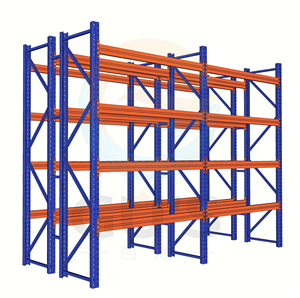
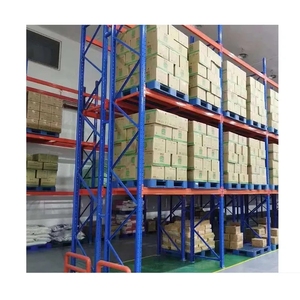
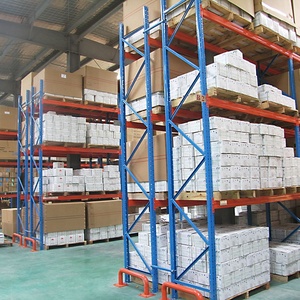
In modern high-density distribution centers, Back to Back Pallet Racking constitutes the structural backbone of palletized unit load storage. Structurally defined, a back-to-back layout pairs two single runs of selective pallet racks joined mechanically along their longitudinal axis via calibrated Row Spacers (Run Spacers). By merging adjacent runs back-to-back, warehouse planners eliminate intermediate access aisles, instantly reclaiming up to 42% of floor footprint compared to isolated single-row configurations, while preserving unimpeded 100% SKU selectivity for standard counterbalance and reach trucks.
1. The Kinematic & Static Role of Mechanical Row Spacers
Under international engineering standards, notably EN 15512:2020 (Steel static storage systems – Adjustable pallet racking systems) and FEM 10.2.02, row spacers do not merely maintain aesthetic aisle alignments; they serve as critical transverse structural ties. When upright frames are linked back-to-back at nodes aligned with frame bracing panel points, the pair acts as a combined truss frame. This configuration increases down-aisle structural inertia and resists transverse torsion induced by asymmetric pallet placements, reach-truck impacts, or seismic accelerations.
At Guangzhou Heda Shelves, our row spacers are manufactured from heavy-gauge structural channel steel (minimum 3.0mm thickness) and bolted using grade 8.8 high-tensile hardware. Standard clearance lengths range from 200mm to 450mm, specifically engineered to accommodate pallet overhang (typically 50mm per side per European and ISO standards) and fire suppression in-rack sprinkler pipework, preventing pallet-to-pallet impingement during fast forklift cycles.
2. Material Metallurgical Specifications & Structural Profiles
Reliability in heavy industrial storage originates in raw material purity. We source hot-rolled structural steel coils exclusively from premier Tier-1 domestic mills, cold-rolling them into Omega-profile upright posts and interlocking box beams. The steel grades utilized—predominantly Q235B (yield strength ≥ 235 MPa) and high-performance Q355B (yield strength ≥ 355 MPa)—undergo automated continuous-roll forming to preserve uniform wall thickness and eliminate residual cold-working microcracks.
| Component Profile | Standard Dimensional Range | Steel Grade Option | Surface Treatment | Engineering Design Standard |
|---|---|---|---|---|
| Cold-Rolled Uprights | 80×60, 90×70, 100×70, 120×95 mm (Thickness 1.8 - 2.5mm) | Q235B / Q355B | Pickling, Phosphating + Electrostatic Epoxy (60-80μm) | EN 15512 / FEM 10.2.02 |
| Box Interlock Beams | 80×50, 100×50, 120×50, 140×50, 160×50 mm (Thickness 1.5 - 2.0mm) | Q235B High Tensile | Electrostatically Applied Powder Coat (Standard RAL 2004) | Deflection Limit: L/200 Under UDL |
| Rigid Row Spacers | Clearance Lengths: 200, 250, 300, 350, 400, 450 mm | Structural Channel Steel | Zinc Galvanized or Powder Coated | Fastened at Frame Bracing Node Points |
| Base Plates & Anchors | Heavy-Duty Punched Footplates; M12×100 / M16×120 Expansion Anchors | Q235B Hot Rolled | Hot Dip Galvanized / Zinc Dichromate | Resisting Overturning Shear & Uplift |
| Safety Locking Pins | Spring-Loaded Auto-Engaging Gravity Snap Pins | Grade 4.8 / 8.8 Steel | Electro-Galvanized Clear Passivated | Resists ≥ 5,000N Upward Fork Dislodgment |
3. Finite Element Analysis (FEA) & Seismic Safety Coefficients
Every back-to-back rack design engineered by Guangzhou Heda Shelves is validated through finite element modeling simulations under ultimate limit state (ULS) and serviceability limit state (SLS) loading matrices. Upright perforations (50mm or 75mm pitch teardrop or hexagonal holes) allow micro-adjustable beam elevations. Beam connectors incorporate 3-claw or 4-claw cold-stamped brackets that produce a tight moment-resisting semi-rigid joint when seated into the upright. An integrated safety clip prevents accidental upward beam disengagement when operators lift pallets rapidly.
Warehouse Topology Comparison
System Architecture: Back-to-Back vs. Alternative Storage Typologies
Compare core operating metrics to evaluate volumetric density, crane/truck aisle allowances, capital expenditure per pallet location, and stock turnover agility.
| Storage Topology | Pallet Selectivity | Volumetric Density | Typical Aisle Width (m) | Material Handling Unit Required | CapEx Index / Position |
|---|---|---|---|---|---|
| Back-to-Back Selective Rack | 100% (Direct Access) | Medium (40-45% of Floor) | 3.0 - 3.5m (Reach / Counterbalance) | Standard Reach Truck / Counterbalanced | $ (Baseline Benchmark) |
| Double Deep Racking | 50% (First Pallet Obstructs) | High (55-60% of Floor) | 3.1 - 3.4m (Specialized Reach) | Pantograph / Deep-Reach Forklift | $$ (+20-30% vs Baseline) |
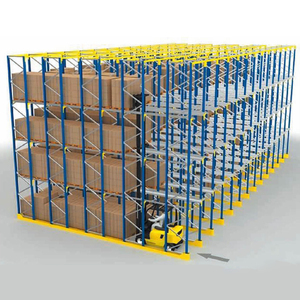
| Drive-In / Drive-Through | Low (Last-In, First-Out) | Very High (65-75% of Floor) | Eliminated Aisles (Internal Lanes) | Counterbalanced / Narrow Cab | $$$ (+40-50% vs Baseline) |
| Very Narrow Aisle (VNA) | 100% (Direct Access) | High (55-65% of Floor) | 1.6 - 1.9m (Rail or Wire Guided) | VNA Turret Truck / Man-Up Order Picker | $$$$ (+80-120% Inc. Floor/Truck) |
| Radio Shuttle Cart System | FIFO or LIFO by Lane | Maximum (75-85% of Floor) | Eliminated Internal Aisles | Standard Forklift + Automated Cart | $$$$$ (+150-200% Automation) |
Strategic Foresight
Global Procurement Trends in Warehouse Storage Systems (2025–2030)
How global supply chain logistics, ESG frameworks, and automated guided vehicles (AGVs) are revolutionizing structural pallet racking specifications.
1. AMR & AGV Floor Interface Ready
Modern procurement contracts require tighter manufacturing tolerances (±0.5mm) across base plates and bottom beam elevations to accommodate autonomous mobile robots and laser-guided forklifts navigating aisle layouts.
2. Decarbonized Steel & ESG Tracing
Tier-1 multinational logistics operators increasingly demand verified carbon footprint accounting and Environmental Product Declarations (EPDs). Heda Shelves utilizes energy-efficient continuous powder coating curing ovens.
3. Container-Optimized Modularity
Escalating maritime container freight rates demand intelligent knock-down parts nesting. Knock-down upright trusses and slotted boltless components maximize 40ft High Cube container volumetric load factor above 95%.
4. Tropical & Coastal Corrosion Proofing
Rapid growth in coastal logistics hubs across West Africa, Southeast Asia, and Latin America prioritizes multi-stage zinc phosphate pre-treatments and hot-dip galvanized components resistant to 1,000+ hours of salt spray testing.
Enterprise Authority & Capabilities
Guangzhou Heda Shelves Co., Ltd.: Global Manufacturing Credibility
Founded in 2001, Guangzhou Heda Shelves Co., Ltd. has grown into an international leader in the engineering, design, and turnkey fabrication of industrial racking systems, high-density drive-in systems, structural steel mezzanines, and automated pallet storage solutions. Operating from our state-of-the-art 30,000 m² automated manufacturing hub in Guangzhou, Guangdong, China, our team of over 300 experienced technical personnel and structural design engineers maintains a monthly output exceeding 30,000 metric tons.
Unlike trading intermediaries, Heda Shelves operates a fully integrated, self-contained production ecosystem: from decoiling flat steel strip and automated precision punching, to CNC multi-station cold roll-forming lines, robotic welding stations, pre-treatment wash tunnels, and twin-track automated electrostatic powder coating lines. This single-roof operational chain ensures total traceability, uncompromised structural metallurgy, and direct factory pricing benefits transferred straight to our international clients.
CE Certification Verified
Certified under CE Certificate No. 2435-CPR-8605159, confirming full legal conformity for structural steel components under European Construction Products Regulation (CPR).
ISO 9001:2015 Accredited
Operating under certified Quality Management Standard ISO 9001:2015 No. 18624Q00169R0M (valid through June 2027), ensuring strict batch testing and dimensional tolerance compliance.
RoHS & Eco Compliant
Our surface finishes adhere rigorously to international chemical restriction protocols, utilizing lead-free, non-toxic polyester powder formulations suitable for pharmaceutical and food storage.
Quality Control Lifecycle
Our 10-Stage Quality-Controlled Manufacturing Pipeline
From raw coil slitting to international export bundling, each production stage adheres strictly to ISO 9001:2015 protocols.
01
Steel Coil Slitting & Inspection
Verification of yield tensile strength, elongation percentage, and thickness uniformity of incoming Q235B/Q355B coils.
02
High-Speed CNC Punching
Continuous hydraulic stamping of 50mm/75mm pitch upright teardrop and hexagonal locking patterns with ±0.1mm tolerance.
03
Continuous Roll Forming
Multi-stand automated cold-roll forming lines shaping open Omega profiles and closed seam-locked box beams.
04
Robotic Connector Welding
Dual-torch robotic arm shielded CO2 welding fusing beam end-connectors with deep weld penetration and zero porosity.
05
8-Phase Chemical Pretreatment
Multi-stage immersion: degreasing, water wash, acid pickling, rust stripping, phosphate conversion coating, and passivation.
06
Electrostatic Powder Coating
Reciprocating spray guns atomizing thermosetting polyester-epoxy resin, ensuring uniform 60-80μm dry film thickness.
07
High-Temp Baking Tunnel
Controlled 200°C curing curing cross-links powder polymers, producing impact-resistant, non-chipping surface hardness.
08
CMM & Deflection QA Testing
Coordinate Measuring Machine (CMM) verification, beam load testing, and cross-hatch paint adhesion testing.
Procurement Knowledge Base
Frequently Asked Questions (FAQ) on Back to Back Pallet Racking
Clear, engineering-backed answers addressing structural calculations, regulatory compliance, layout design, and shipping logistics.
Q Why should a warehouse adopt back-to-back selective racking instead of single runs?
Installing single runs requires an access aisle on each side of the rack, resulting in substantial lost floor space. By connecting two runs back-to-back using rigid row spacers, an aisle is shared between two pallet positions, eliminating nearly 50% of the aisle requirement. This doubles row-level volumetric efficiency while preserving 100% direct picking access to every single SKU without needing deep-reach pantograph trucks.
Q What parameters determine the required length of row spacers?
Row spacer length is governed by three primary factors: standard pallet depth (e.g., 1,200mm Euro pallets or 48"x40" GMA pallets), the allowable pallet rear overhang (typically 50mm per side), and the presence of building columns or in-rack fire sprinkler drops. Standard row spacers range from 200mm to 300mm. When vertical sprinkler pipes run through the flue space, spacers of 350mm to 450mm are specified to ensure NFPA 13 building code compliance.
Q How does Heda Shelves verify structural compliance with CE and EN 15512?
Guangzhou Heda Shelves Co., Ltd. holds CE Certification No. 2435-CPR-8605159. Our engineering design calculations adhere to European standard EN 15512:2020 for static steel racking. We test component yield strengths, beam-to-column joint moment rotations, and upright compression-buckling capacity in calibrated laboratory conditions, providing certified load capacity plaques with every completed project.
Q What data do your structural engineers need to deliver a free 3D CAD design?
To generate a free, customized 3D CAD proposal and structural load analysis, please provide: 1) Architectural building layout showing clear internal height, column grid coordinates, and door locations; 2) Pallet dimensions (width × depth × height including cargo); 3) Maximum gross weight per pallet; 4) Forklift model, mast collapsed height, and maximum fork elevation; 5) Warehouse floor slab thickness and concrete compressive strength.
Q How are components protected against moisture and corrosion during ocean transport?
All steel components undergo eight-stage chemical pickling and phosphating pre-treatments, followed by electrostatically applied epoxy-polyester thermoset powder coating (60–80 μm). For ocean shipping, beams and upright frames are bundled with protective corrugated paper buffers, industrial plastic shrink-wrap, and heavy composite strapping. Components destined for coastal or cold-room settings can be hot-dip galvanized.
Q Can a standard selective back-to-back system be upgraded or reconfigured later?
Yes. The modular boltless construction of our racking makes it fully reconfigurable. Beam heights can be adjusted incrementally along the 50mm or 75mm upright pitch without tools simply by removing the safety pins. Should your throughput expand, back-to-back runs can easily be converted into double-deep racks or integrated with carton flow tracks and drop-in wire mesh decking.
Ready to Engineer an Optimized Back-to-Back Pallet Racking System?
Submit your warehouse floor plans and storage requirements today. Our team of senior structural storage engineers will prepare a complete CAD layout, 3D conceptual rendering, and structural load calculation—delivered within 24 hours with factory-direct pricing.