Drive-In Racking System: The Complete Global Procurement & Engineering Guide
How modern industrial facilities optimize volumetric storage capacity up to 80%, reduce footprint costs in cold chain operations, and evaluate structural safety against operational risks.
Why Global Logisticians Turn to Drive-In Racking Systems
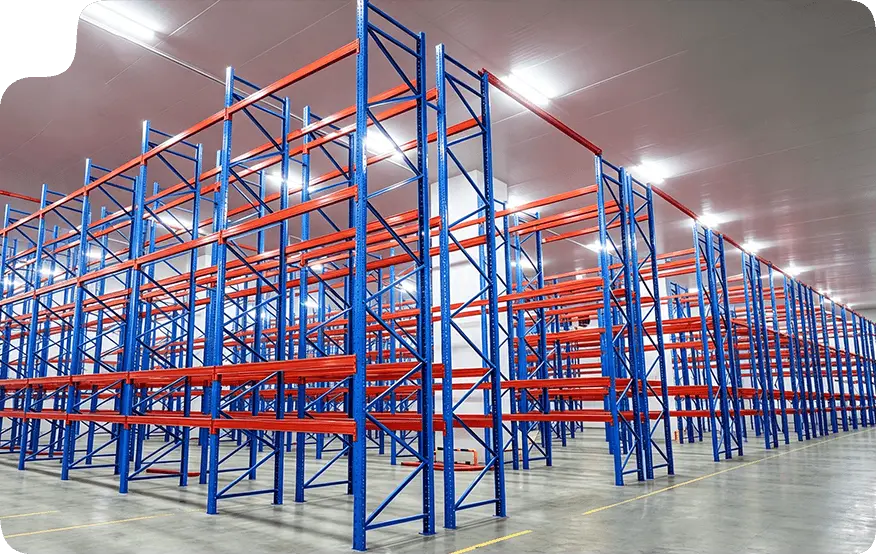
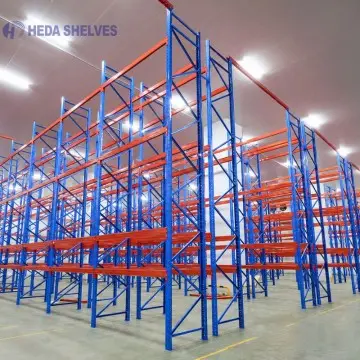
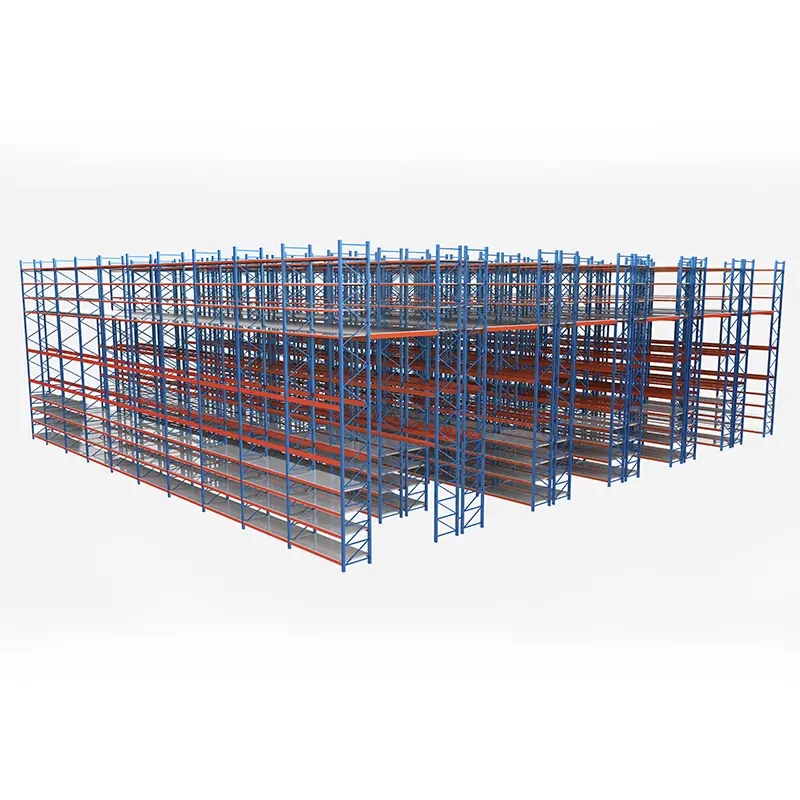
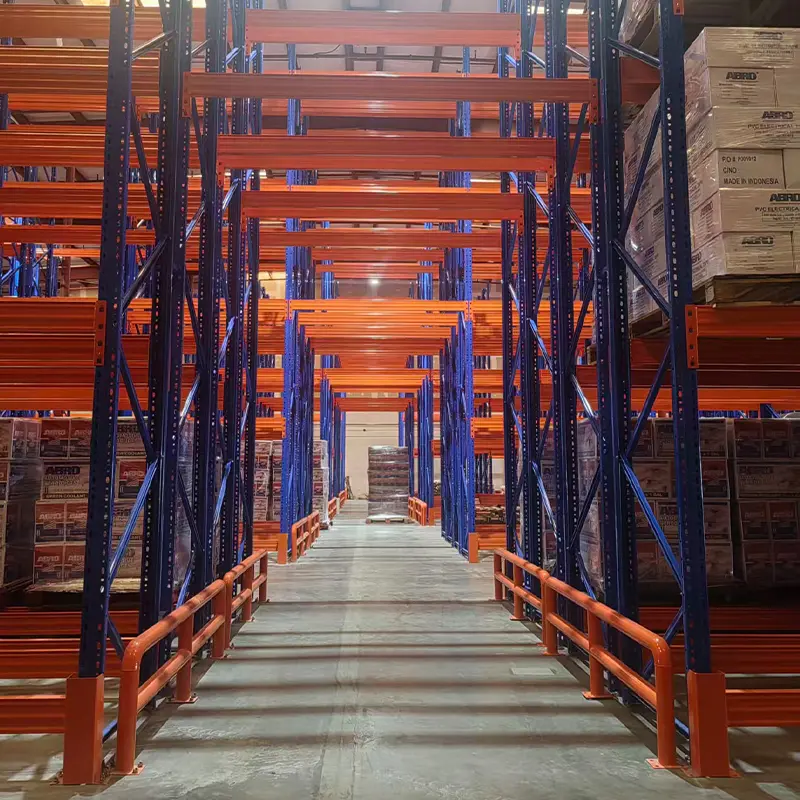
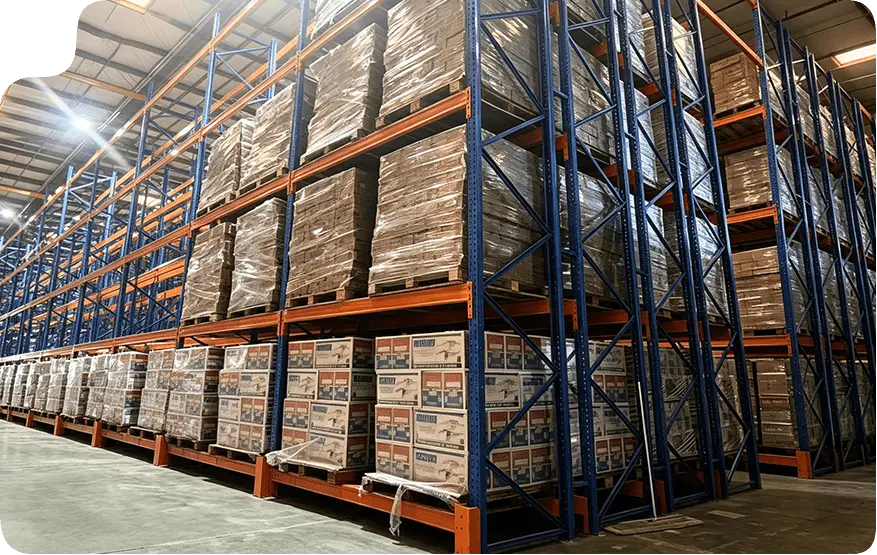
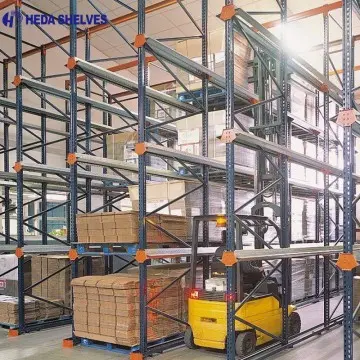
In modern industrial storage, floor space represents an ongoing operational liability. A Drive-In Racking System eliminates conventional operating aisles by allowing counterbalanced or reach forklifts to drive directly into deep storage bays, resting pallets upon continuous horizontal cantilever support rails.
Structural Geometry: Maximizing Cubic Utilization
Unlike standard selective racking which commits between 55% to 65% of floor area solely to forklift transfer corridors, drive-in systems reallocate up to 80% of warehouse volume to pure product storage. By creating continuous depth channels of 2 to 10 pallets deep and 2 to 6 pallet levels high, storage density reaches benchmark levels.
Engineered around the Last-In, First-Out (LIFO) material handling principle, or First-In, First-Out (FIFO) when configured as Drive-Through lanes, this system is the premier engineering response for high-volume operations handling low-to-medium SKU variations with consistent batch sizes.
High-Density Architecture75%–80% Floor Space Efficiency
Product Configurations
Engineered Configurations Tailored to Application Demands
Drive-in systems require bespoke engineering to match structural dynamics with forklift dimensions, mast heights, and cold chain tolerances. Guangzhou Heda Shelves Co., Ltd. configures four core industrial variants:
Optimized for batch manufacturing, raw material staging, and bulk packaging plants. Utilizes robust upright frames tied together with rigid top portal cross-bracings.
Load capacity: 500–2,000 kg/pallet
Upright section: 90×65 to 120×95 mm
LIFO single-access bay configuration
Heavy-Duty LIFO
Thermal Efficiency
Cold Chain Drive-In System
Engineered for sub-zero freezers down to -30°C. Hot-dip galvanized or specialized low-temperature powder-coated steel prevents structural micro-fracturing and condensation rust.
Temperature tolerance: -30°C to +40°C
Hot-dip galvanized / low-temp epoxy
Cuts thermal refrigeration waste by 40%
Cold Room System
FIFO Rotation
Drive-Through (FIFO) System
Featuring independent entry and exit aisles. Pallets are loaded from the rear and picked from the front, providing strict FIFO control for perishable FMCG and pharmaceutical lines.
FIFO inventory flow control
Overhead structural bridge bracing
Continuous pallet rail cantilever arms
Dual-Access FIFO
Impact Protected
Floor-Guided Precision Drive-In
Integrated with high-durability angle iron or tubular floor guide tracks. Keeps reach trucks centered, minimizing operator steering errors and eliminating mast impact damages.
Heavy structural floor guide rails
Flared entrance guide boots
Protective wrap-around upright guards
Floor-Guided Drive-In
Strategic Market Insights
Future Procurement Trends in Drive-In Racking Architecture
As global supply chains navigate volatile demand patterns and real estate premiums, enterprise procurement models for drive-in racking are rapidly transforming across five key vectors.
Higher Yield Micro-Alloys
Global logistics facilities are migrating from standard structural sections to custom cold-rolled high-tensile steels (e.g., Q355B and modified Q235B alloys). This shift reduces total structural deadweight by 12% to 18% while simultaneously elevating seismic moment-resisting ductility in deep storage corridors.
AGV & AMR Readiness
Procurement teams increasingly specify drive-in designs engineered for autonomous narrow-aisle reach trucks. Tighter tolerance rail designs (±1.5mm variance) alongside optical sensor-reflective channel coatings ensure that drive-in channels accommodate both manned forklifts and emerging automated pallet handlers.
Modular Lifecycle Engineering
Modern buyers reject rigid proprietary designs. Procurement tenders now explicitly require modular cantilever bracket connections, standard teardrop or diamond hole pitches, and bolt-free adjustable pallet rails that allow easy conversion to push-back or pallet flow systems as inventory dynamics shift.
Industry Dynamics
Technological Evolution & Future Development of Drive-In Racks
Drive-in racking is transcending its traditional role as a static steel assembly. Breakthroughs in simulation software, surface metallurgy, and hybrid automation are reshaping performance metrics.
FEA Load Modeling
Advanced non-linear Finite Element Analysis (FEA) dynamically calculates secondary torsion effects on slender upright columns when forklifts operate inside multi-level cantilevered lanes.
Thermally Reactive Coatings
Modern electrostatic powder finishes formulated with zinc phosphate primer substrates maintain elasticity down to -30°C, eliminating brittle coating flaking under intense cold room abrasion.
LiDAR Mast Telemetry
Integration of optical guide indicators and RFID-tagged lane markers allows mast-mounted forklift telemetry to monitor entry speed, vertical clearance, and structural alignment in real time.
Zero-Power Passive Resilience
Amid unpredictable electrical utility costs and grid instability, drive-in systems represent an entirely mechanical, zero-power storage solution that sustains full throughput during outages.
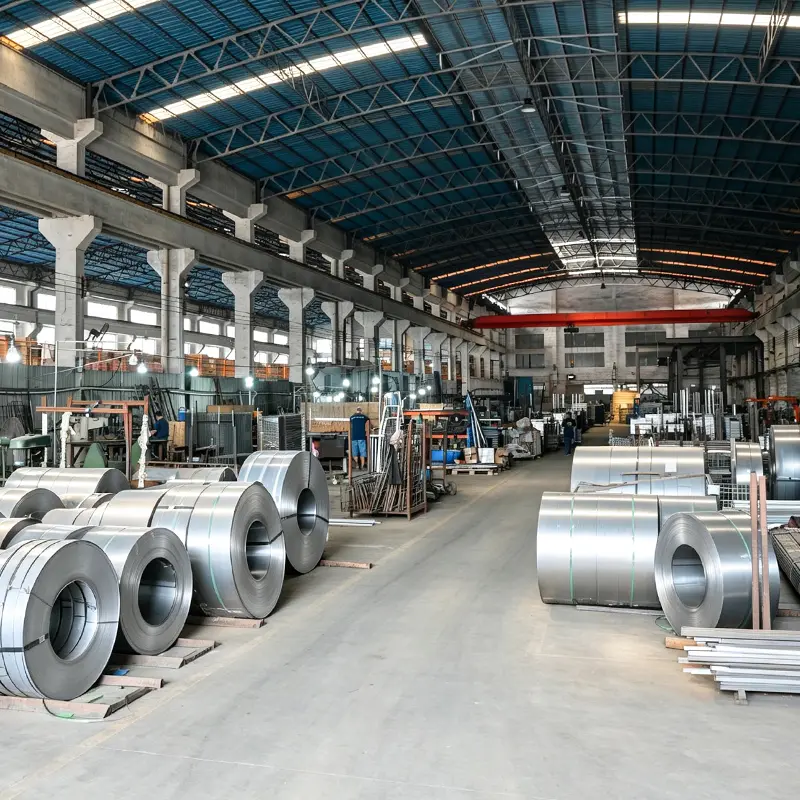
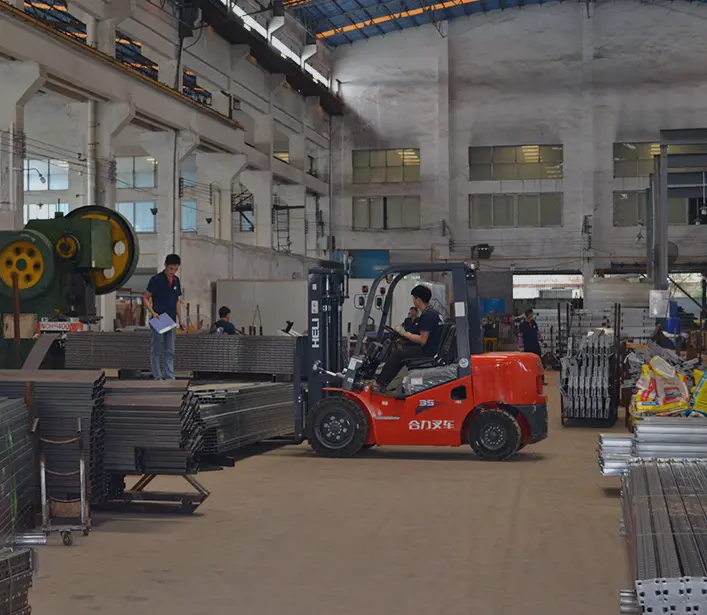
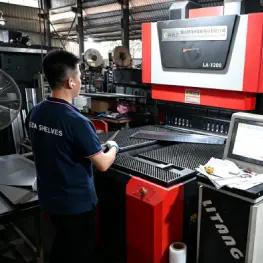
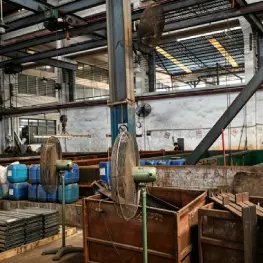
Since 2001, Guangzhou Heda Shelves Co., Ltd. has stood at the forefront of heavy-duty industrial storage design and intelligent manufacturing. Operating from our dedicated 30,000 square meter production facility in Guangzhou, China, our team of over 300 experienced engineers and technicians has successfully engineered, fabricated, and exported advanced racking solutions to clients across more than 120 countries.
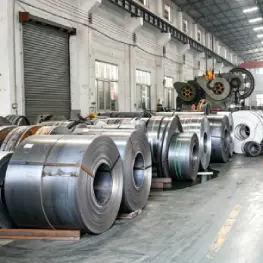
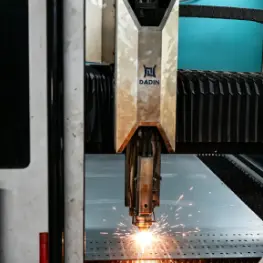
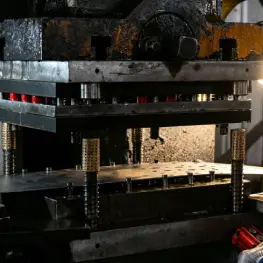
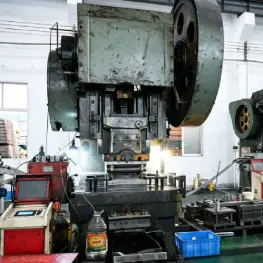
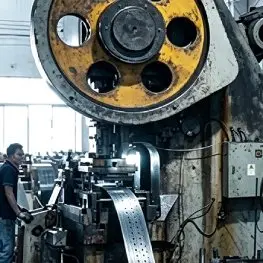
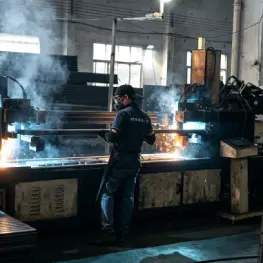
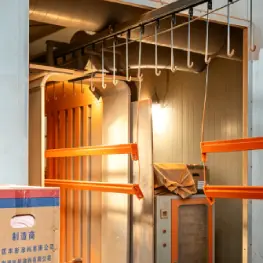
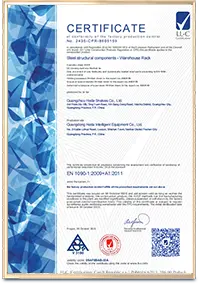
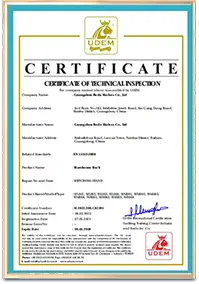
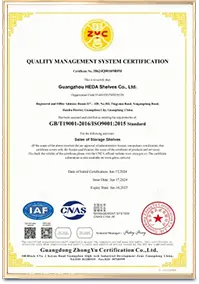
Every drive-in racking system leaving our facility is backed by verified CE European standard compliance (No. 2435-CPR-8605159) and ISO 9001:2015 quality management certification. From high-tensile hot-rolled steel coil selection to continuous roll-forming, automatic robotic column punching, 10-stage pre-treatment, and automated electrostatic powder coating, we ensure every beam, rail, and upright achieves unyielding structural resilience.
Global Production FacilityWatch our manufacturing lines
Manufacturing Precision
10-Stage Quality Control Protocol for Drive-In Uprights & Rails
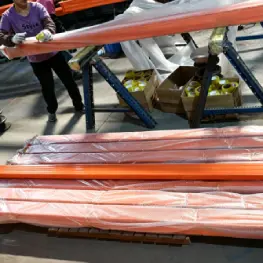
Drive-in racks lack intermediate shelf beams across drive bays, making raw steel ductility and weld integrity paramount. Every component undergoes ten rigorous production steps.
01
Prime Steel Selection
02
High-Precision Slitting
03
Automated Punching
04
Cold Roll-Forming
05
Pallet Rail Profiling
06
Surface Deburring
07
Robotic Arm Welding
08
Pickling & Phosphating
09
Powder Polymerization
10
QC & Container Loading
Quality Accreditations
Internationally Audited Structural Certification
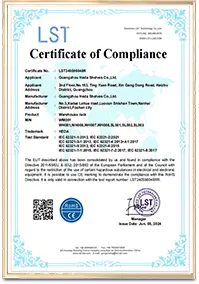
Industrial procurement demands traceable engineering metrics. Guangzhou Heda Shelves Co., Ltd. products comply with EN 15512, RMI guidelines, and hold registered European CE certification.
CE Construction Products RegulationCertificate No. 2435-CPR-8605159
ISO 9001:2015 Quality ManagementCertificate No. 18624Q00169R0M · Valid through June 2027
RoHS Environmental ComplianceFull restriction of toxic chemical treatments
Trusted by multinational supply chains & industrial distributors worldwide
What is the primary operational difference between Drive-In and Drive-Through racking?
The fundamental distinction lies in inventory accessibility and internal bracing geometry. A Drive-In Racking System operates from a single entry and exit face per storage bay, implementing Last-In, First-Out (LIFO) inventory management. This configuration allows rigid X-bracing along the rear upright plane, delivering high structural rigidity against lateral loads. Conversely, a Drive-Through Racking System provides open vehicular access at both opposing ends, enabling First-In, First-Out (FIFO) stock turnover. Because forklifts must traverse the entire length of the lane, Drive-Through systems cannot utilize full rear vertical cross-bracing and must instead rely on heavy-duty overhead portal tie-beams and reinforced ground anchorage to achieve structural stability.
What pallet specifications and clearances are critical for drive-in racking safety?
Drive-in racking is highly sensitive to pallet quality because pallets sit directly on continuous cantilever support rails rather than full structural cross beams. Pallets must possess uniform dimensions (typically 1200×1000mm or 1200×800mm) without broken bottom perimeter boards, missing blocks, or split stringers. Pallet deflection under maximum design load must not exceed 1/200th of the rail span. Standard engineering clearance requires a minimum of 50mm of support wing bearing surface on each side, a minimum of 75mm to 100mm of vertical lift clearance above the pallet load before entering or exiting the bay, and a minimum of 75mm of side clearance between the forklift mast and the inner flange of the guide rail.
Can standard counterbalance forklifts operate inside drive-in racking lanes?
Standard counterbalance forklifts can theoretically operate inside drive-in lanes provided their chassis, mast, and overhead guard widths are smaller than the bay's clear internal width. However, because standard counterbalance trucks possess wider turning radii and broader wheelbases, reach trucks and narrow-chassis electric forklifts are preferred in professional environments. When operating inside drive-in channels, forklifts should be fitted with tapered overhead guard roof protectors to deflect incidental rail contact and should interface with ground-anchored steel guide rails to ensure straight, centered travel down the storage lane.
Why is drive-in racking preferred for refrigerated and cold storage logistics?
Cold storage energy consumption is directly proportional to refrigerated air volume. Because traditional selective pallet racking dedicates over 60% of warehouse floor area to empty forklift aisles, refrigeration compressors must continuously chill massive volumes of dead air space. By condensing pallet positions into deep, compact blocks and eliminating operational aisles, drive-in racking increases volumetric storage density up to 75%–80%. This drastic footprint reduction translates into 30% to 45% savings in continuous refrigeration electricity per metric ton of stored frozen food, dairy, seafood, or pharmaceutical product.
How does Guangzhou Heda Shelves Co., Ltd. protect drive-in systems against forklift impact?
Because forklifts drive directly within the rack skeleton, drive-in uprights face greater exposure to operational impact. Guangzhou Heda Shelves Co., Ltd. resolves this risk through four coordinated structural defenses: first, heavy-duty floor-mounted guide rails (angle steel or heavy-gauge RHS) run the entire depth of the bay; second, entrance columns are protected by wrap-around 8mm-thick solid steel bull-nose column protectors anchored directly into the floor slab; third, cantilever rail arms feature formed lead-in tapers that gently guide pallets into alignment; and fourth, horizontal and diagonal portal top bracing grids distribute incidental lateral impacts across multiple adjoining upright columns.
How does drive-in racking compare to semi-automated radio shuttle racking in ROI?
Drive-in racking represents the lowest capital investment per pallet position among all high-density storage systems, typically costing between $45 and $85 per pallet position compared to $120 to $220+ for radio shuttle systems. Because drive-in racking is 100% mechanical, it requires zero electrical maintenance, no lithium battery replacements, and suffers zero operational downtime during utility power failures. While radio shuttle systems offer faster pallet extraction cycles and eliminate forklift entry into the rack, drive-in racking remains the undisputed return-on-investment leader for facilities handling large batches of identical SKUs with moderate throughput turnover.
Proven Case Studies
Engineered Solutions Delivered Across Continents
Explore real-world industrial installations engineered, manufactured, and shipped by Guangzhou Heda Shelves Co., Ltd.
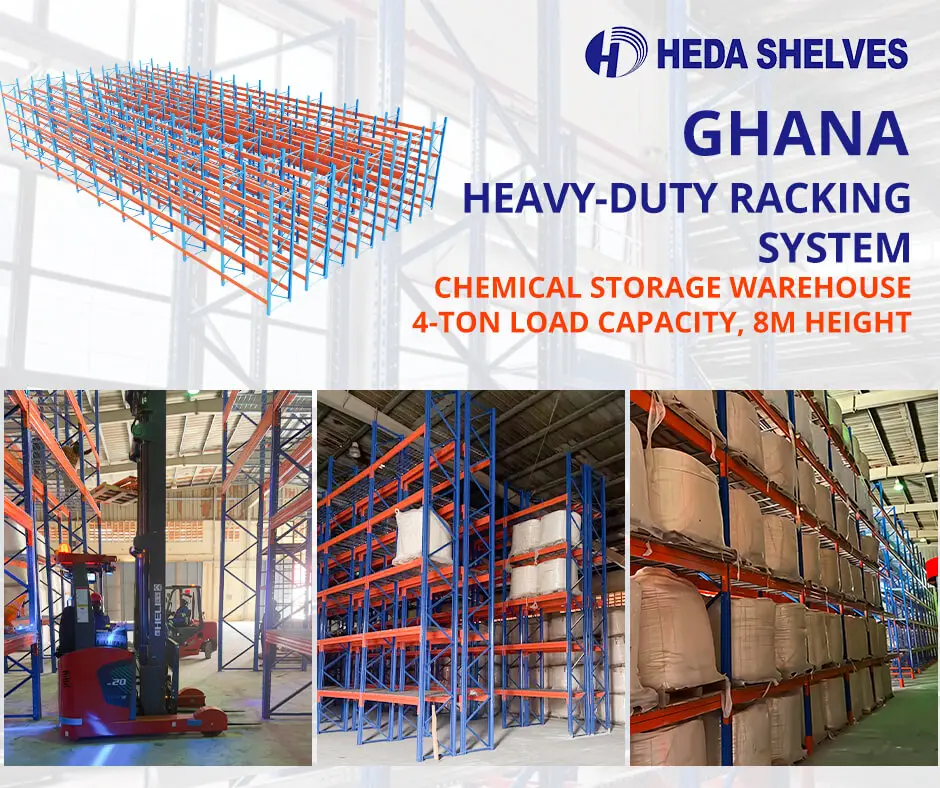
Custom-engineered 6-deep drive-in bays utilizing Q235B steel with corrosive-resistant electrostatic coatings designed to store 1,500 kg chemical drum pallets safely.
Cold Chain-25°C Frozen Seafood
Freezer Facility High-Density Pallet Expansion
Supplying 4,800 pallet positions of galvanized drive-in racking, reducing facility power consumption while maximizing cubic utilization under strict temperature parameters.
Beverage LogisticsStrict FIFO Flow
High-Throughput FMCG Bottling Distribution Hub
Dual-access Drive-Through racking configuration processing fast-moving seasonal beverage pallets with zero aisle congestion and uninterrupted forklift flow.
Factory-Direct Engineering Consultation Speak directly with our senior structural engineers to receive an optimized CAD layout, dynamic load calculation, and freight-optimized quotation within 24 hours.
Direct Manufacturing Inquiry
Calculate Your Warehouse Capacity with Drive-In Racks
Provide your warehouse dimensions, pallet configurations, and forklift specifications. Guangzhou Heda Shelves Co., Ltd. provides comprehensive 3D drawings and structural load certifications completely free of charge.

 Most Versatile