High-Yield Industrial Warehouse Racking Systems
Manufactured from certified Q235B and Q355B structural steel, our high-density racking configurations undergo rigorous finite element analysis (FEA) and cycle-testing to guarantee continuous operational integrity in ambient, automated, and cryogenic logistics facilities.
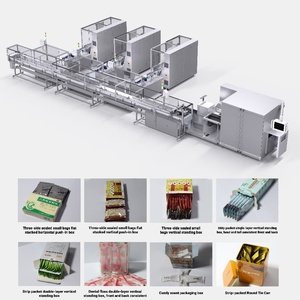
Bulk Product Feeders 3-in-1 Vertical Stacking Machine Multi Lane Pouch Alignment Feeder
- Integration: High-speed automated lines
- Control: PLC & Servo Drive sync
- Standard: CE Machinery Directive
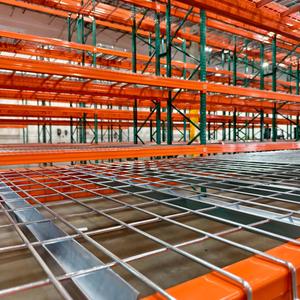
Heavy-Duty Teardrop Pallet Rack Welded Steel Upright Frame Footplate Bolt-Structured Shelves Industrial Warehouse Galvanized 12
- Compatibility: Universal US Pitch
- Finish: Hot-dip galvanized baseplate
- Capacity: Up to 18,000 kg/frame
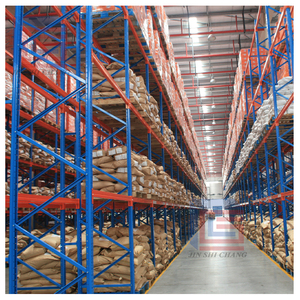
Manufacturer Steel Selective Pallet Rack for Warehouse Storage
- Layout: Direct pallet SKU accessibility
- Beam Pitch: 50mm / 75mm adjustable
- Load: 1,000 - 4,500 kg per beam tier
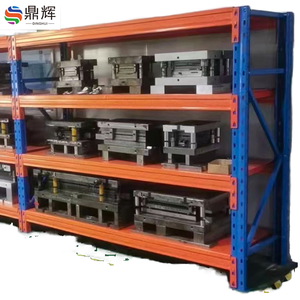
Selective Medium Duty Cold Rolled Steel Pallet Rack Frame System Common Upright Column for Factory Warehouse Expansion Racking
- Forming: Continuous 14-pass rolling
- Structural: Omega profile high-rigidity
- Modular: Ready for bay expansion
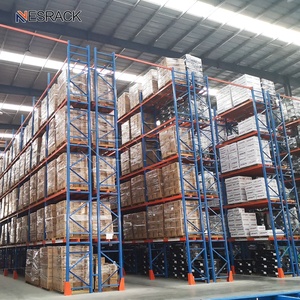
Heavy Duty Selective Pallet Racking System Easy Install Pallet Rack for Cold Storage
- Temp Range: Operates down to -35°C
- Coating: Zinc-rich powder or HDG
- Steel: Q355D high-impact resistance
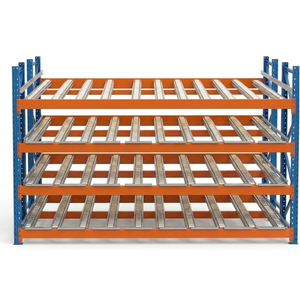
Heavy Duty Flow rack Gravity Flow Q235 Steel Assembled Blue/Orange OEM Main Rack 1000-2000kg/pallet
- Rotation: First-In, First-Out (FIFO)
- Rollers: Dual brake-drum controllers
- Floor Saving: 60% denser than selective
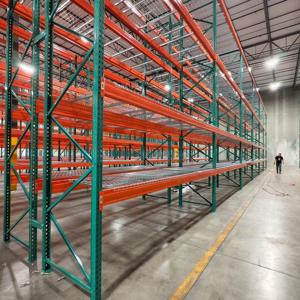
Industrial US Standard Warehouse Shelving Storage Racks Heavy Duty Pallets Racking System for Retail Distribution Center
- Application: Fast FMCG distribution
- Decking: Drop-in galvanized wire mesh
- Safety: Spring safety locks on connectors
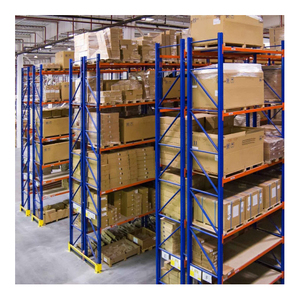
Peterack CE Certified Warehouse Storage Steel Heavy Duty Stacking Racks Shelves Selective Pallet Racking System
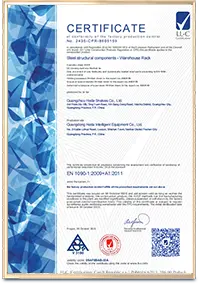
- Certification: CE No. 2435-CPR-8605159
- Structural Steel: High-tensile cold rolled
- Export Packing: Nested container packs
Guangzhou Heda Shelves Co., Ltd.: Structural Precision for Global Intralogistics
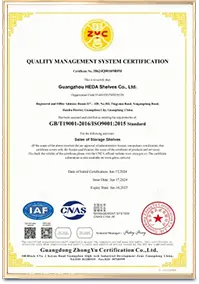
Founded in 2001, Guangzhou Heda Shelves Co., Ltd. has evolved over nearly a quarter-century into one of the world's primary Tier-1 manufacturers and exporters of certified industrial warehouse racking. Headquartered in Guangzhou, China, our 30,000-square-meter integrated manufacturing plant manages every phase of production under strict ISO 9001:2015 quality assurance protocols (Certificate No. 18624Q00169R0M, valid through June 2027).
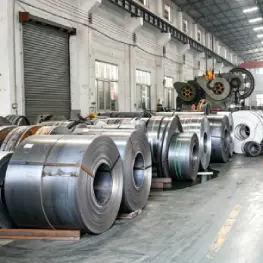
Unlike regional fabricators or trading intermediaries, Heda maintains fully auditable metallurgy tracing for every batch of hot-rolled structural coils sourced directly from top-tier domestic mills (including Baosteel and Shougang). Our structural members undergo continuous CNC roll-forming, computerized punch profiling, dynamic load testing, and multi-stage automated surface conversion to satisfy the stringent requirements of the European Union Construction Products Regulation under CE Certification No. 2435-CPR-8605159.
For international supply chain planners, general contractors, and logistics REITs, procuring structural racking is a multi-million-dollar safety liability. Our technical engineering division provides complete pre-bid 3D finite element structural load simulation, seismic vulnerability calculation according to local building codes, and container stowage maximization plans that substantially lower landed freight costs per cubic meter.
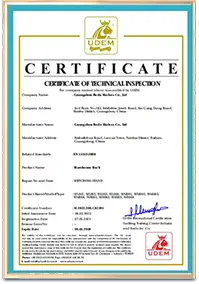
Certified EN 15512 Safety
Fully compliant with European rack design deflection limits and beam-end connector moment capacities.
Anti-Corrosive Pretreatment
Advanced chemical pickling and phosphating preps substrate steel for 80-120μm electrostatic powder curing.
Our 10-Stage Precision Fabrication Workflow
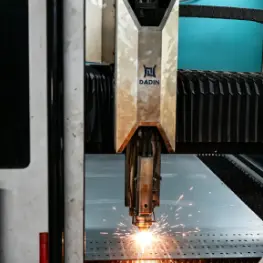
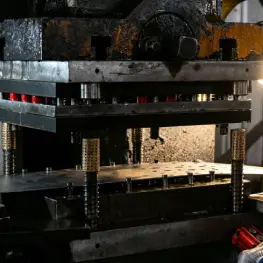
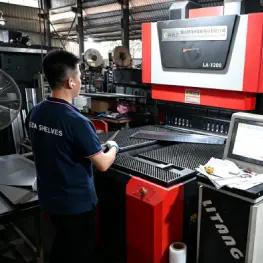
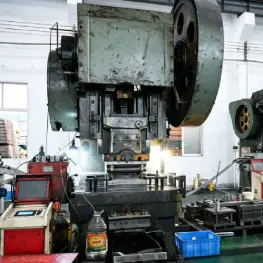
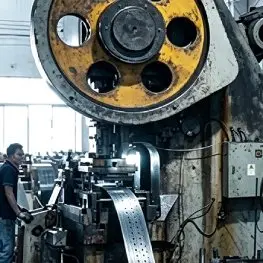
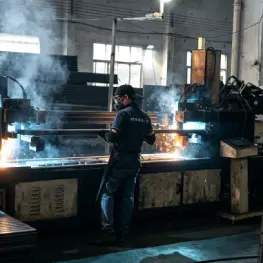
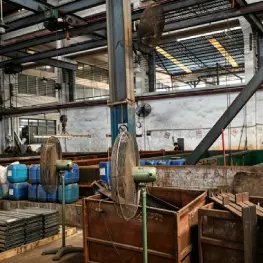
To ensure zero dimensional tolerance drift across thousands of structural components destined for international sea freight, our Guangzhou factory operates under a continuous ten-station production sequence:
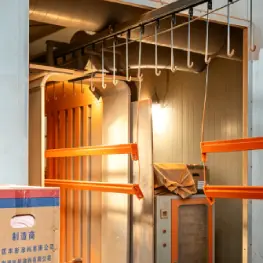
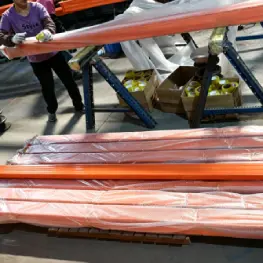
Racking Procurement Matrix: Structural Steel Standards & Deflection Tolerances
A rigorous comparative guide for procurement directors, structural engineers, and facility consultants evaluating Chinese manufacturing quality against European (CEN), North American (RMI), and Australian standards.
| Evaluation Parameter | European Standard (EN 15512 / CE CPR) | American Standard (ANSI / RMI MH16.1) | Heda Manufacturing Standard (Q235B / Q355B) |
|---|---|---|---|
| Primary Design Methodology | Limit State Design (LSD) incorporating partial material & load safety factors. | Load and Resistance Factor Design (LRFD) or Allowable Stress Design (ASD). | Dual-verified LSD calculation calibrated for global seismic & dynamic load envelopes. |
| Maximum Beam Vertical Deflection Limit | Span length / 200 (L/200) under full design working payload. | Span length / 180 (L/180) calculated between column faces. | Stringent L/250 default design factor; L/300 available for automated crane & shuttle interfaces. |
| Upright Frame Perforation Profile | 50mm or 75mm standardized metric European pitch slots. | Standard 2-inch (50.8mm) Teardrop slot pattern with locking pin. | Precision CNC cold-punched 50mm, 75mm European, and universal 2-inch teardrop profiles. |
| Surface Pretreatment & Dry Film Thickness (DFT) | Multi-bath chemical immersion; 60μm to 100μm polyester powder coating. | Degreasing wash and iron phosphate spray; 50μm to 80μm finish. | Full 8-stage pickling, rinsing, and zinc phosphating bath; 80μm-120μm electrostatic cure. |
| Traceability & Material Test Reports (MTR) | Mandatory EN 10204 3.1 chemical & physical certification under CPR 305/2011. | ASTM A1011 / A1008 mill test reports verified by RMI licensed engineer. | Full EN 10204 Type 3.1 mill certs provided per heat batch; raw steel yield stress verified >235-355 MPa. |
Crucial Information Gain for Procurement Teams:
While standard commercial storage suppliers quote generic sheet metal, high-volume automated distribution centres require upright column steel with strict carbon equivalency (CEV ≤ 0.45) to prevent brittle fracture under localized impact. Heda Shelves applies proprietary cold-roll section optimization, increasing torsional rigidity across the frame profile by 18.4% compared to standard open-lip C-channels.
Future Procurement Trends in Warehouse Storage Systems
The convergence of omnichannel supply chains, automated guided vehicles (AGVs), and international carbon taxation (CBAM) is permanently altering how global enterprises procure racking infrastructure.
Automation-Ready Hybrid Topologies
Buyers are rapidly moving away from single-tier static racks in favor of modular structures capable of transitioning into Automated Storage and Retrieval Systems (AS/RS) or Radio Shuttle channels without replacing upright uprights. Tolerances for floor flatness (DIN 18202 Table 3 Group 4) and millimetric beam alignment are now demanded directly at the procurement stage.
Embodied Carbon & CBAM Verification
With the implementation of the European Union's Carbon Border Adjustment Mechanism (CBAM), importers of Chinese steel structures require comprehensive cradle-to-gate Environmental Product Declarations (EPDs). Sourcing now evaluates blast furnace emissions, heavy scrap ratios, and clean electrostatic thermoset powders that omit Volatile Organic Compounds (VOCs).
Total Cost of Ownership (TCO) Racking Models
Rather than evaluating purely on FOB pricing per ton, multinational procurement heads now employ 15-year TCO metrics. These factor in paint adhesion failure under tropical humidity, structural damage replacement parts lead times, interchangeable upright connector designs, and nested shipping packaging that slashes 40HQ container requirements by 28%.
Emerging Technological Trends in Industrial Racking Design
Modern warehouses are no longer passive storage shells; they are high-velocity kinetic environments requiring structural storage systems engineered with smart materials, seismic dampening, and digital twin compatibility.
• High-Strength Thin-Walled Profiles
By substituting standard mild carbon steel with cold-formed high-strength micro-alloyed structural grades (such as Q355B and S355MC), upright columns achieve up to 35% higher yield thresholds with lower mass. This reduces overall seismic dead load on the slab foundation while expanding allowable clear heights beyond 15 meters for modern high-bay facilities.
• BIM LOD 400 Digital Twin Modeling
Engineering design now integrates directly into building infrastructure via Building Information Modeling (BIM) at Level of Development (LOD) 400. Upright columns, fire sprinkler clearance corridors, ESFR head alignments, and cable trays are dynamically modeled in Revit and Tekla before steel rolling starts, preventing on-site spatial clashes.
• Cryogenic Cold-Chain Ductility
The exponential expansion of global refrigerated biopharma and perishable food cold chains requires racking steel capable of withstanding brittle transition temperatures down to -35°C. Heda applies specialized silicon-killed steel formulations accompanied by automated Charpy V-notch impact validation to certify zero structural fracture risk under freezing conditions.
Frequently Asked Questions for Commercial Importers & Contractors
In-depth answers covering compliance protocols, customs clearing, load tests, freight logistics, and anti-corrosion engineering for international racking acquisition.
Q1 How does CE Certification (EN 15512) protect buyers from structural liability?
Under the EU Construction Products Regulation (CPR 305/2011), static steel racking installed as structural building fixtures must carry a verified Declaration of Performance (DoP). Our CE mark (Certificate No. 2435-CPR-8605159) validates that our structural calculations, raw steel mill chemistry, and weld joints have been audited by a notified European laboratory, ensuring building insurance validity and worker safety compliance across the EU, Middle East, and Commonwealth jurisdictions.
Q2 What parameters are required for Heda engineers to generate a free 3D CAD layout?
To deliver an optimal structural floor plan, our engineering team requires: (1) Architectural building CAD files detailing clear ceiling height to the lowest obstruction (sprinklers/lighting), column spacing, and dock door placements; (2) Pallet specifications including overall dimensions (W x D x H), overhang, and maximum pallet gross weight; (3) Existing forklift equipment model, turning radius, and maximum reach height; and (4) Desired stock turnover logic (FIFO vs. LIFO).
Q3 How does Heda optimize international ocean shipping container stowage?
Structural racking is freight-dense and susceptible to volumetric dimensional penalties if improperly packed. Heda engineers calculate custom bundling nesting schedules for 40-foot High Cube (40HQ) containers. Uprights are nested back-to-back with custom timber spacer blocks, and box beams are wrapped in moisture-impervious protective membranes with designated forklift strap loops, routinely packing 22 to 26 metric tons per container while eliminating transport rubbing abrasion.
Q4 What surface finish is recommended for high-humidity coastal and tropical facilities?
For coastal installations located in West Africa, Southeast Asia, or the Caribbean, standard single-pass spray paint will corrode within 18 months due to saline air. Heda utilizes a comprehensive multi-bath chemical immersion process (degreasing, acid pickling to remove mill scale, and zinc phosphating) followed by an 80-120μm electrostatic polyester powder cure. For extreme cold chain condensation or semi-outdoor applications, we supply full Hot-Dip Galvanized (HDG) components certified to ISO 1461.
Q5 Can mechanical racking systems function without electric power during grid outages?
Yes. Mechanical systems such as Selective Pallet Racking, Drive-In, Push-Back, Gravity Flow, and Heavy-Duty Cantilever systems are 100% mechanical and rely entirely on forklift kinematics or gravity roller slopes, ensuring uninterrupted operation during electrical blackouts. For semi-automated Radio Shuttle installations, Heda provisions high-capacity lithium iron phosphate (LiFePO4) battery packs with synchronized charging cycles designed around backup diesel generator windows.
Q6 How do you provide installation support for overseas construction crews?
Every export shipment is tagged with matching alphanumeric steel stampings linked directly to CAD assembly schematics. We furnish comprehensive 3D step-by-step installation manuals, bolt torque tolerance specifications, anchor expansion bolt depth protocols, and remote video inspection sessions conducted by our senior project engineers. For enterprise projects over 5,000 pallet positions, on-site installation supervisors can be deployed globally.
Q7 What is the standard production lead time for full container orders?
Thanks to our dedicated 30,000 m² factory footprint and 30,000-ton monthly processing capacity, standard production lead times for standard selective pallet racking typically average 15 to 20 working days following final CAD layout sign-off. Highly customized mezzanine platforms or complex automated shuttle rail runs require 25 to 30 days including pre-shipment dry fit assembly inspections.
Q8 How does Heda verify structural safety against seismic activity?
We perform site-specific seismic base shear calculations according to Eurocode 8 (EN 1998) or American ASCE 7 seismic hazard zones. Frame configurations are reinforced with heavy-duty structural diagonal bracing, enlarged structural footplates with multi-point chemical anchoring, and high-ductility steel alloys formulated to absorb seismic energy without sudden catastrophic weld shearing.
Accelerate Your Logistics Infrastructure With Certified Engineering
Request our comprehensive technical whitepaper, full 2025 structural engineering catalog, and a complimentary 3D CAD warehouse layout simulation customized to your facility dimensions.