Core Automation & Heavy-Duty Racking Implementations
Direct factory-manufactured racking solutions meeting international FEM 10.2.02, EN 15512, and RMI standards. Designed for seamless manual, semi-automated, and robotic integration.
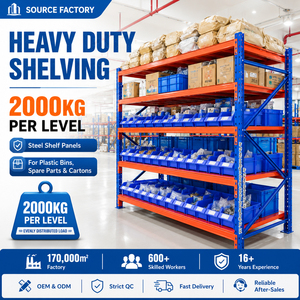 Heavy Duty
- Capacity: 2000kg UDL per beam tier
- Material: Cold-rolled Q235B structural steel
- Application: Bins, spare parts, carton storage
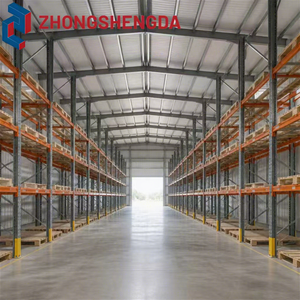 3PL Fulfillment
- Config: Prefab multi-tier central aisle
- Finish: Continuous hot-dip galvanized finish
- Clear Height: 8m to 24m vertical scalability
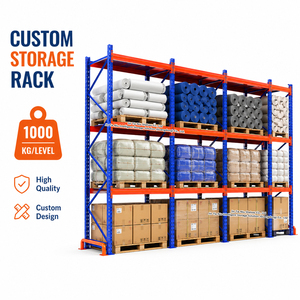 Adjustable
- Uprights: 80x60mm to 120x95mm profiles
- Pitch: 50mm / 75mm beam adjustment
- Access: 100% selective individual pallet entry
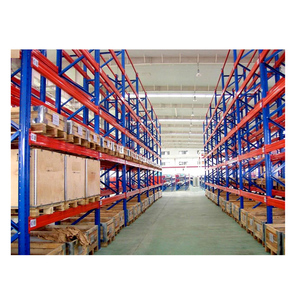 ISO Certified
- Engineering: Fully welded baseplate connectors
- Coating: Electrostatic cured epoxy finish
- Standard: CE No. 2435-CPR-8605159 compliance
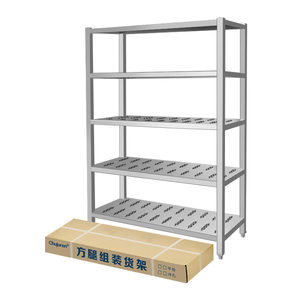 Anti-Corrosion
- Grade: AISI 304 / 316 austenitic stainless steel
- Hygiene: Cleanroom, food processing, laboratory
- Durability: Chemical, humidity & acid resistant
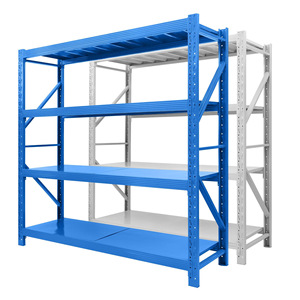 Manual Picking
- Capacity: 200kg to 500kg per shelf layer
- Assembly: Knock-down modular clip-in design
- Use: Fulfillment picking and fast retail dispatch
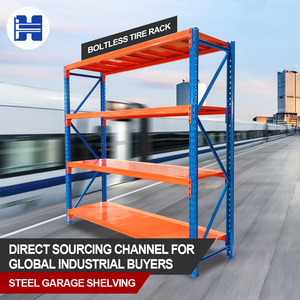 Boltless Rivet
- Erection: Tool-free keyhole/rivet mechanical slot
- Decking: Solid steel deck plates or wire mesh
- Flexibility: Rapid readjustment of shelf heights
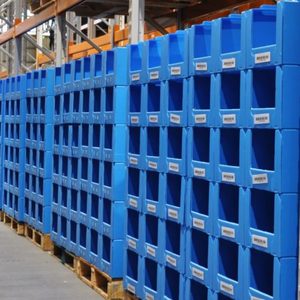 Accessories
- Structure: Virgin polypropylene fluted sheets
- Features: Moisture-proof, oil-proof, stackable
- Optimization: High-density SKU division
Architectural Anatomy: Automation Racking vs. Conventional Static Racking
In modern supply chain engineering, transitioning from traditional static selective pallet systems to automated environments requires a complete paradigm shift in mechanical tolerances, metallurgy, and dynamic structural analysis. Conventional storage configurations rely on forklift operators who compensate visually for beam deflection, rack out-of-plumbness, and minor floor settlement. Conversely, an Automated Storage and Retrieval System (AS/RS), four-way radio shuttle matrix, or automated miniload infrastructure demands millimeter-level precision. High-speed automated cranes and autonomous shuttles travelling at speeds up to 4 meters per second with acceleration rates exceeding 1.5 m/s² induce massive dynamic, cyclical horizontal braking and acceleration forces directly into the racking uprights.
Chinese manufacturing leaders like Guangzhou Heda Shelves Co., Ltd. (founded in 2001) utilize high-tensile hot-rolled steel coils slitted and cold-roll formed into omega-shaped upright columns with multi-flange profiles. High yield strength steel such as Q235B and high-grade Q355B (yielding minimum yield stresses of 235 MPa and 355 MPa respectively) are engineered to resist torsion, sway, and localized buckling. In automated high-bay warehouses extending up to 30 or 40 meters, the rack structure is often clad-rack engineered—where the steel racking framework itself supports the building roof and insulated wall sandwich panels, eliminating external structural building pillars entirely.
| Structural Parameter | Conventional Selective Racking | Radio Shuttle Racking (Semi-Automated) | High-Bay AS/RS & 4-Way Shuttle (Fully Automated) |
|---|---|---|---|
| Beam Deflection Limit | 1/200 of beam span ($L/200$) | 1/250 to 1/300 of span | 1/400 to 1/500 ($L/400$), FEM 9.831 / EN 15512 |
| Plumbness Tolerance | $\pm 1/350$ of total height | $\pm 1/500$ of total height | $\pm 1/1000$ to $\pm 1.5\text{ mm}$ absolute deviation |
| Aisle Width Requirement | 3,000mm – 3,600mm (Counterbalance) | 1,800mm – 2,200mm (Clearance entry) | 1,400mm – 1,650mm (Crane/SRM rail guided) |
| Storage Density Index | 40% – 50% warehouse volumetric use | 70% – 80% footprint utilization | 85% – 95% volumetric cube optimization |
| Throughput Capacity | 20 – 35 pallet moves/hour/forklift | 45 – 65 pallet moves/hour/lane | 120 – 300+ continuous pallet moves/hour |
Product Procurement Trends: How Enterprise Buyers Sourcing from China are Shifting (2025–2030)
Procurement directors and Chief Supply Chain Officers (CSCOs) globally are transitioning away from buying disconnected static steel uprights in favor of fully integrated logistics ecosystems. Evaluating tier-one Chinese automated racking factories now encompasses structural-to-automation integration capabilities, lifecycle carbon impacts, and modular future-proofing:
1. Modular Decoupled Architecture
Global supply chains demand boltless, reconfigurable channel rails allowing static pallet lanes to be converted into automated radio shuttle or automated guided vehicle (AGV) paths without tearing down primary upright columns.
2. Green Steel & EPD Certification
Driven by EU CBAM and North American ESG reporting, corporate buyers prioritize Chinese manufacturers using electric arc furnace (EAF) low-carbon steel, zinc-aluminum-magnesium (ZAM) alloys, and volatile organic compound (VOC)-free powder coatings.
3. Container Density Engineering
With volatile maritime container shipping freights, top-tier factories utilize custom nesting punch dies and algorithmic container bundling schemes to pack up to 26–28 tons of structural components into a standard 40HQ container without in-transit damage.
4. Hardware-Agnostic WCS Interfacing
Enterprises reject proprietary closed lock-in systems. Buyers specify racking and shuttle carriers with open API-driven Warehouse Control Systems (WCS) capable of native bi-directional handshake with SAP, Manhattan, Oracle, or proprietary warehouse management software.
Industry Development Trends: The Technological Leap from High Bay to 3D Matrix Robotics
The automated storage sector in China has matured from replicating European structural frameworks into an innovation epicenter for flexible, scalable autonomous intralogistics. High land acquisition costs, coupled with expanding SKU proliferation across cold chains, pharmaceutical manufacturing, and omnichannel cross-border e-commerce, have driven racking development through distinct technological eras:
Generation I: Rigid High-Bay AS/RS
Characterized by single or twin-mast stacker cranes operating strictly along single straight floor rails within dedicated aisles. While achieving immense vertical heights (up to 40 meters) and high payloads (over 3000 kg per pallet), this system presents single-point-of-failure vulnerability—if a stacker crane goes offline for maintenance, access to the entire storage aisle is completely blocked.
Generation II: 2D Pallet Shuttle Systems
Eliminating deep-lane entry risks associated with traditional drive-in racking, semi-automated radio shuttles travel inside rack channels on customized extruded rails under remote or optical guidance. Forklifts transport the shuttle between lanes, significantly elevating throughput and safety while operating inside harsh environments from ambient storage down to -30°C cold chain facilities.
Generation III: 3D Multi-Way Fleet Robotics
The contemporary pinnacle of warehouse automation: Four-Way Radio Shuttles and Autonomous Mobile Robots (AMR) moving in multi-directional 3D matrices. Shuttles transition across aisles using integrated vertical lifts, dynamically reallocating robotic units to high-demand pick zones during peak throughput surges without human intervention.
This mechanical evolution places profound demands on the factory’s metal forming capabilities. Upright columns must maintain tight dimensional consistency ($\pm 0.5\text{ mm}$ on profile cross-sections) across thousands of linear meters. Cross-beams and shuttle rail guides require high precision to prevent track binding, shuttle wheel slippage, or sensor target misalignment.
Enterprise Engineering Advantages: Guangzhou Heda Shelves Co., Ltd.
Since its founding in 2001, Guangzhou Heda Shelves Co., Ltd. has stood at the forefront of China’s storage equipment manufacturing sector. Supplying comprehensive warehouse racking infrastructure to more than 120 countries across North America, Europe, Africa, Southeast Asia, and the Middle East, the enterprise unites turnkey engineering design, precise automated cold roll-forming, and strict quality control under one unified roof.
With a staff of over 300 experienced engineers, structural modelers, and certified fabricators, Heda Shelves operates state-of-the-art continuous production lines. Structural integrity is certified and auditable globally under CE Certification No. 2435-CPR-8605159, ISO 9001:2015 Certification No. 18624Q00169R0M (valid through June 2027), and international RoHS environmental compliance directives.
Controlled 10-Stage Precision Manufacturing Workflow:
Every component—from baseplates and upright trusses to load beams and shuttle runner rails—is produced in-house under strict quality checkpoints, eliminating structural variation:
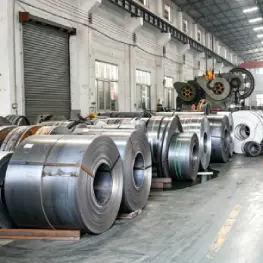
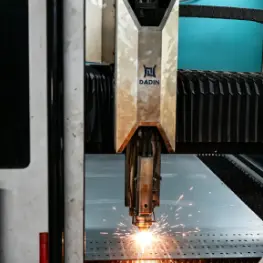
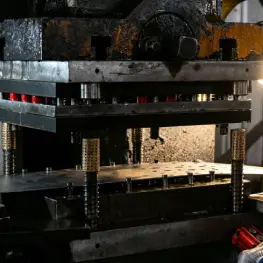
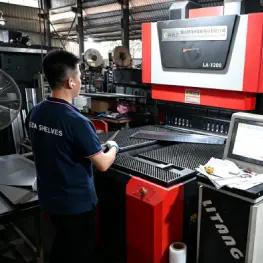
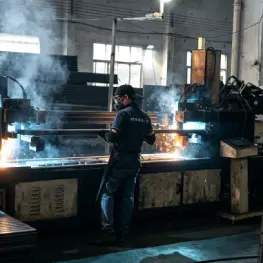
Following roll-forming and robotic welding, structural components undergo a continuous multi-stage pickling and phosphating pre-treatment (acid wash, degreasing, zinc phosphating, and deionized water rinsing). This industrial process cleans the steel at a chemical level, guaranteeing superior adhesion for the subsequent automated electrostatic powder-coating. The resulting 60–80 micron cured thermoset polyester finish prevents oxidation even in high-humidity tropical ports or sub-zero refrigeration conditions.
Enterprise Procurement FAQ: Technical & Operational Sourcing Guide
Straightforward, engineering-verified guidance answering common structural, logistical, and commercial inquiries when procuring high-bay and automated racking directly from China: