Featured Warehouse Storage & Pallet Racking Portfolios
Precision-manufactured in our automated production facility from high-yield SS400/Q235B & Q355B structural steel coil. Fully certified to ISO 9001:2015, CE EN 15512, and AS4084 standards for high-density international warehousing.
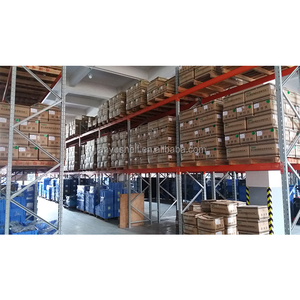
Commercial Industrial Storage Rack System Heavy Duty Pallet Warehouse Solution
- Beam Pitch: 50mm / 75mm Adjustable
- Payload: 1,000kg - 4,500kg / Tier
- Finish: High-Adhesion Epoxy Coating
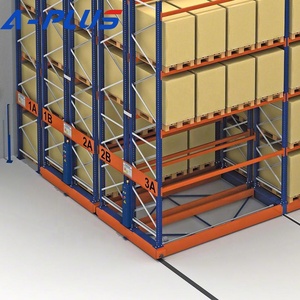
Motor Control Electrical Movable Heavy Duty Pallet Rack / Electricity Mobile System
- Density: +85% Floor Space Utilization
- Control: PLC + Infrared Safety Grids
- Operation: Single Floating Aisle Mode
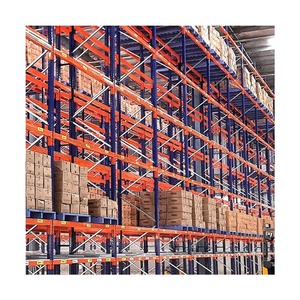
Metal Pallet Racking Warehouse Storage Pallet Racking System Heavy Duty Unit
- Material: Premium Q235B Carbon Steel
- Upright Profile: Omega Section Roll-Formed
- Standard: Conforms to FEM 10.2.02
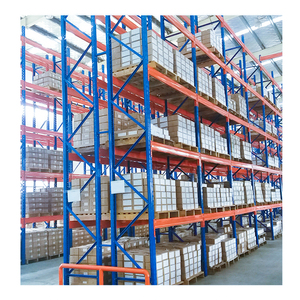
Factory Industrial Selective Steel Pallet Racking System Storage Equipment
- Selectivity: 100% SKU Direct Accessibility
- Forklift Compatibility: Standard Counterbalance
- Bay Height: Up to 14,000mm Engineered
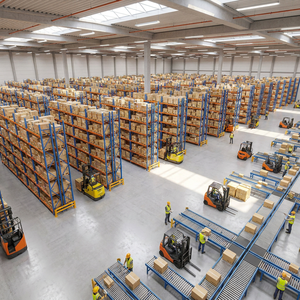
Narrow Aisle Pallet Racking System Heavy Duty Warehouse Storage Equipment
- Aisle Width: Ultra-Narrow 1.6m - 1.8m
- Guidance: Floor Mechanical Rail or Wire
- Volumetric Gain: +40% over Standard Selective
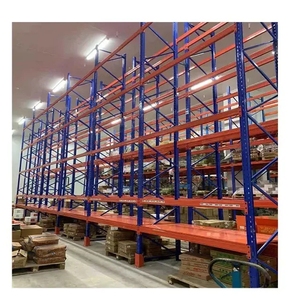
Heavy Duty Steel Shelving Units Adjustable Warehouse Racking Industrial System
- Connector: 3/4/5 Claw Stamped Safety Hooks
- Decking: Wire Mesh or Galvanized Steel Plates
- Safety Lock: Heavy-Duty Spring Locking Pins
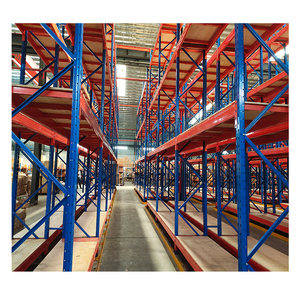
Warehouse Racking Solution Steel Storage System Commercial & Logistics Hubs
- Bracing: Bolted K-Bracing & D-Bracing Grid
- Seismic Safety: UBC & EN 16681 Engineering
- Application: FMCG, 3PL Distribution, Paper
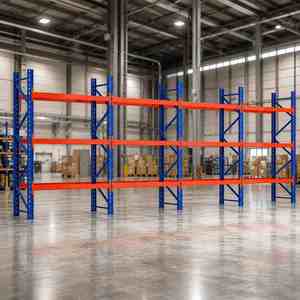
Steel Pallet Racking System Warehouse Rack Storage Shelves Heavy Duty Build
- Storage Mode: FILO / FIFO High-Density Lane
- Pallet Rails: Formed Continuous Heavy Rails
- Floor Capacity: Up to 80% Volumetric Index
Drive In Pallet Racking System: The Technical White Paper for Global Logistics Buyers
In modern industrial supply chains, balancing floor real estate costs against vertical storage capacity is a critical operational mandate. A Drive In Pallet Racking System (frequently engineered as Drive-Through racking when two-sided accessibility is required) represents the benchmark solution for high-density, batch-oriented inventory storage. By eliminating conventional forklift operational aisles, Drive In systems eliminate up to 75% of dead floor space compared to classic single-deep selective configurations, enabling global warehouse operators in cold storage, food and beverage processing, petrochemicals, and bulk commodities to achieve floor space utilization rates exceeding 80%.
Unlike standard static racking systems where pallet loads rest horizontally upon two transversal box beams spanning adjacent upright frames, Drive In racking is characterized by cantilevered structural support brackets and continuous roll-formed pallet guide rails running longitudinally along the depth of the storage bay. Lift trucks directly enter the rack structure’s internal lanes to position or retrieve unitized loads, which are held on the cantilevered rail flanges. This mechanical geometry introduces complex horizontal shear forces, lateral displacement challenges, and localized torsional stresses that demand rigorous engineering calculation, precision manufacturing tolerances, and top-tier metallurgical consistency.
Structural Mechanics & Torsional Rigidity Standards
Because Drive In lanes lack horizontal front-to-back beam ties within the vehicle transit zone, top cross-portal bracing trusses and rear horizontal-diagonal tie systems are essential. HEDA Shelves engineers utilize 3D Finite Element Analysis (FEA) compliant with FEM 10.2.02 (European Design Code), RMI ANSI MH16.1 (North American Standard), and AS4084-2023 (Australian Standard) to ensure overall portal stability, side sway suppression, and adequate resistance to unintended forklift impact loads.
Drive-In vs. Selective vs. Radio Shuttle Racking: Technical Benchmark
To assist industrial procurement directors, distribution center general managers, and logistics design engineers in specifying the right storage technology, the engineering matrix below outlines core design parameters across primary heavy-duty pallet racking methodologies:
| Technical Parameter | Drive-In Racking System | Standard Selective Racking | Semi-Automated Radio Shuttle |
|---|---|---|---|
| Volumetric Efficiency | 75% – 85% Maximum Cube | 35% – 45% High Aisle Ratio | 80% – 90% Ultra-High Cube |
| Stock Rotation Principle | LIFO (Last-In, First-Out) | FIFO (First-In, First-Out) | Both FIFO & LIFO Supported |
| SKU Diversity Suitability | Low SKU / High Pallet Count | Infinite SKU / Fast Picking | Medium-Low SKU / High Throughput |
| Forklift Mast Entrance | Yes (Direct Lane Entry) | No (Aisle Operation Only) | No (Shuttle Enters Lanes) |
| Initial Capital Outlay (CapEx) | Cost-Effective / Highly Economic | Lowest per Pallet Position | Medium-High (Carrier Batteries & PLC) |
| Cold Chain Operating Suitability | Exceptional (Lowers kW / m³) | Fair (High Chilling Footprint) | Exceptional (High Cycle Efficiency) |
Future Procurement Trends in High-Density Pallet Racking (2025–2030)
Strategic procurement directors evaluating Chinese racking manufacturers are expanding their evaluation criteria beyond unit FOB pricing. Over the coming five-year cycle, global warehouse infrastructure investments are governed by five macro procurement evolutions:
High-Yield Micro-Alloyed Steel Transition
Global buyers increasingly favor high-strength cold-rolled steels (such as Q355B and specialized micro-alloyed structural grades) that deliver higher yield strengths (≥355 MPa) with lower net tare weights. This lightens container ocean freight, decreases total carbon footprints, and boosts seismic resistance.
Total Landed Cost (TLC) Modeling
Smart procurement teams now calculate the complete landed cost, including ocean freight volume, container stuffing nesting density, assembly labor speed, and long-term surface durability. Boltless quick-lock upright framing and nested beam designs substantially reduce total installed project costs.
Hybrid Automation Reconfigurability
Modern logistics hubs demand Drive-In profiles that can be retrofitted into radio shuttle lanes or automated AGV interfaces without dismantling main uprights, protecting long-term capital investments as warehouses expand toward automation.
Technological Development & Engineering Trends in Drive In Racking
Driven by rising cold-chain operational demands and stricter international warehouse safety mandates, Drive In pallet racking design is undergoing substantial engineering advancements:
1. Finite Element Dynamic Modeling & Seismic Deflection Analysis: Modern tall rack installations (surpassing 10 to 14 meters in clear height) require full simulation of dynamic forklift braking, asymmetrical lane unloading sequences, and local seismic acceleration responses. By evaluating second-order $P-\Delta$ and $P-\delta$ geometric effects under load, modern engineering ensures that structural deflections do not cause beam unseating or lane pinching.
2. Advanced Protective Impact Engineering: Because lift truck operators maneuver inside the structural lanes, accidental upright column collisions are an acknowledged operational hazard. Today's high-performance installations integrate continuous wrap-around anchor-mounted floor guide rails, heavy ductile iron column wrap guards, and high-molecular polyethelyne impact dampers, isolating the structural vertical columns from direct kinetic impacts.
3. Cold-Chain Anti-Corrosion Metallurgy: In deep-freeze cold environments operating between -20°C and -30°C, cyclic condensation and thermal contractions can embrittle standard steels and accelerate oxidation. Progressive manufacturers have developed specialized low-temperature impact-resistant steel grades, paired with 9-stage pre-treated electrostatic polyester powder coatings or continuous hot-dip galvanization (HDG compliant with ISO 1461), preventing micro-cracking and rust creep.
Why HEDA Shelves Ranks Among China's Premier Drive In Racking Exporters
Since our establishment in 2001, Guangzhou Heda Shelves Co., Ltd. has grown to become a premier designer, manufacturer, and international exporter of high-density industrial storage solutions. Our integrated 30,000 m² factory in Guangzhou, China, operates advanced automated roll-forming and robotic welding lines, giving international buyers direct access to factory pricing, certified metallurgical quality, and rigorous structural engineering oversight.
Our facility holds recognized international certifications, including CE Certification (No. 2435-CPR-8605159), ISO 9001:2015 Quality Management (No. 18624Q00169R0M), and verified RoHS environmental compliance. Every production run undergoes complete in-house mechanical and metallurgical verification, from tensile coupon testing of steel coils to cross-hatch powder-coat adhesion checks, guaranteeing that every export container fulfills rigorous global standards.
Our 10-Stage Precision Production Quality Control Process
Consistent structural integrity across thousands of tons of roll-formed cold steel requires strict stage-by-stage quality controls. Our production line incorporates ten synchronized manufacturing stations:
Certified Coil Inspection
Chemical spectrometer & yield verification of prime steel coils.
Precision Slitting
High-speed CNC slitting ensuring zero-burr edge tolerances.
Multi-Axis Punching
Automated synchronized pitch perforation for uprights.
Continuous Roll-Forming
18-24 pass cold bending for high-moment Omega profiles.
Robotic Welding
Shielded CO₂ automated welding for connector claws & arms.
Mechanical Shot-Blasting
Surface descaling and contaminant removal to Sa 2.5 standard.
9-Stage Pretreatment
Pickling, phosphating, and deionized ultrasonic cleansing.
Electrostatic Powder Coating
Gema automated spray guns providing 60-90µm cured coating.
High-Temp Curing
200°C polymerization tunnel ensuring impact resilience.
Container Stuffing Optimization
Knock-down bundling maximizing 40HQ payload and freight economy.
Drive In Racking System Sourcing & Procurement FAQ
Engineered answers to the most frequent technical, freight, and structural design inquiries submitted by international supply chain buyers and project engineers:
What is the structural difference between Drive-In and Drive-Through racking systems?
How are clearance tolerances calculated for forklift passage in Drive-In lanes?
How does HEDA Shelves ensure safety against progressive collapse during accidental forklift impacts?
What surface finish should be specified for sub-zero cold room environments?
How do you optimize export container packing to minimize maritime shipping costs?
What floor slab specifications (FF/FL numbers and concrete strength) are necessary?
Plan Your Warehouse Storage Layout with HEDA Senior Engineers
Send us your warehouse CAD floor plan, ceiling clear height, pallet dimensions, and forklift specifications. Our engineering team will deliver a customized CAD layout drawing, 3D visualization render, and static load calculation free of charge within 24 hours.