Featured Industrial Storage & Warehouse Infrastructure
Direct factory supply of heavy-duty pallet systems, structural building components, and high-density industrial storage configurations engineered to international EN 15512 and RMI standards.
Engineering Principles of Very Narrow Aisle (VNA) Pallet Racking
A comprehensive examination of space compaction, static structural load paths, deflection tolerances, and aisle guidance mechanics for modern high-throughput logistics hubs.
Volumetric Space Recovery
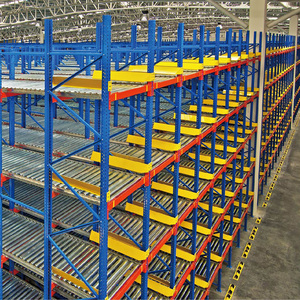
Very Narrow Aisle (VNA) pallet racking reduces working operating aisles from the conventional 3.5–3.8 meters down to a mere 1.5–1.8 meters. By compressing dead aisle space and expanding vertical frame heights up to 18 meters, distribution operators unlock 40% to 50% more pallet locations across identical warehouse footprints without civil infrastructure expansions.
Structural Steel Rigidity
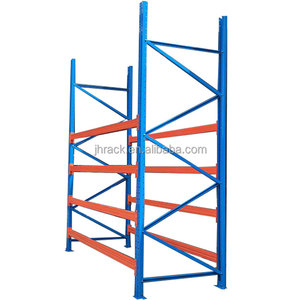
Operating turret trucks (man-up or man-down) at elevations exceeding 14 meters generates extreme dynamic sway forces. HEDA manufactures cold-rolled uprights utilizing high-yield Q235B and Q355B structural steel. With cross-sectional omega-profiles engineered for torsional resistance and cold-riveted brace configurations, we enforce deflection limits well within EN 15512 (maximum L/200).
Guidance System Integration
Turret trucks operating within sub-millimeter aisle clearances cannot rely on manual steering. Our VNA frameworks are precision-machined to integrate with continuous mechanical guide rails (anchored structural angle L100×75 or heavy C-channels) or underground low-frequency inductive wire guidance (6.25 kHz / 10 kHz), enabling maximum travel speeds with zero rack impact risk.
| Storage System Architecture | Typical Aisle Width (m) | Floor Space Utilization (%) | Direct Selectivity | Vertical Clear Heights | Forklift Compatibility | Relative CAPEX / Pallet |
|---|---|---|---|---|---|---|
| HEDA Very Narrow Aisle (VNA) | 1.5 m – 1.8 m | 85% – 90% | 100% Immediate Direct Access | Up to 18.0 Meters | Articulated / VNA Man-Up Turret | Moderate (High ROI) |
| Standard Selective Pallet Racking | 3.2 m – 3.8 m | 40% – 50% | 100% Immediate Direct Access | Up to 11.0 Meters | Standard Counterbalance / Reach | Baseline Economy |
| Double Deep Pallet Racking | 2.8 m – 3.2 m | 55% – 65% | 50% (Requires Shifting) | Up to 10.0 Meters | Pantograph Reach Truck | Low to Moderate |
| Drive-In High Density Storage | 2.2 m – 2.6 m (Lane) | 70% – 75% | Low (LIFO / Block Stack) | Up to 10.0 Meters | Counterbalance Driving In | Moderate |
| Semi-Automated Radio Shuttle | Non-Aisle Block Grid | 80% – 85% | SKU Lane Dependent (FIFO/LIFO) | Up to 15.0 Meters | Standard Forklift + Battery Shuttle | Moderate to High |
Future Sourcing & Procurement Trends for VNA Infrastructure
How supply chain executives, industrial developers, and logistics engineering teams are rethinking narrow-aisle asset lifecycle management for the 2025–2035 horizon.
1. Total Cost of Occupancy (TCO) Prioritization
Global warehouse rental rates across primary logistics nodes have surged between 28% and 42% over recent fiscal cycles. Modern industrial procurement has pivoted from assessing purely "Price Per Metric Ton of Steel" to "Amortized Cost Per Pallet Stored Over a 10-Year Asset Life." VNA systems provide an aggressive CAPEX payback window (typically under 14 months) by doubling existing building envelope storage without the permitting delays, municipal taxes, and construction liabilities of physical ground-breaking expansions.
2. Cold-Chain Energy Optimization Synergies
Refrigerated and cold-storage operations carry thermal cooling costs calculated directly on facility volume (cubic meters). Running wide forklift aisles inside a -25°C freezing chamber represents a massive recurring power penalty. Procurement directors in food, meat, dairy, and cold-chain pharmaceutical logistics are deploying specialized VNA configurations treated with hot-dip galvanization and low-temperature ductile alloys to concentrate thermal cubic density, shrinking energy loss per cold-storage SKU by up to 35%.
3. Containerization & Landed Freight Engineering
Volatile international maritime freight pricing requires supply chain engineers to design racking with knock-down geometry optimized for tight maritime container packing. HEDA’s proprietary nesting frame profiles and modular beam end-connectors achieve over 95% volumetric packing factor within standard 40HQ ocean shipping containers, significantly slashing ocean shipping and inland haulage surcharges per unit.
4. Circular Economy & High Re-configurability
Long-term leasing dynamics demand racking hardware that does not become obsolete upon lease termination or layout restructuring. Modern VNA specifications mandate modular beam connection pitches (50mm / 75mm adjustability) and bolted modular upright frames that allow warehouses to disassemble, ship, reconfigure, or add top-tie mezzanines without welding or cutting on-site.
Engineering Tolerances, Floor Physics & Autonomous Logistics
Delivering sub-millimeter manufacturing precision required for robotic turret automated guided vehicles (AGVs) and high-elevation stability.
Floor Flatness Classifications (VDMA 15251 / DIN 18202)
When operating a VNA turret mast at 16 meters altitude, a 2-millimeter floor deflection at the base translates to a dangerous 80-millimeter mast shift at full reach. HEDA's engineering team provides comprehensive floor flatness assessment criteria complying with DIN 18202 Class 3, VDMA 15251 Floor Quality Guidelines, and ASTM F-min 75 to F-min 100, ensuring zero structural collisions.
Autonomous VNA-AGV Fleet Coordination
The industry is transitioning rapidly toward fully automated driverless turret AGVs. HEDA's VNA installations are engineered with laser reflector target plates, optical end-of-aisle safety barriers, and floor induction antenna conduits, ensuring uninterrupted compatibility with 3D vision LiDAR systems, automated pallet positioning, and high-speed robotic picking cycles.
Integrated High-Hazard Fire Suppression
Due to the density and vertical height of narrow-aisle racking, ceiling ESFR (Early Suppression, Fast Response) sprinklers require precisely calculated horizontal flues. We fabricate beam systems that enforce continuous longitudinal and transverse flue openings, incorporating pre-punched intermediate conduit brackets for in-rack sprinkler pipe integration compliant with NFPA 13 regulations.
Guangzhou Heda Shelves Co., Ltd. — Your Global Manufacturing Partner
Two and a half decades of relentless engineering rigor, heavy structural production mastery, and complete end-to-end supply chain accountability.
Internationally Audited Standards
Our facility operates under rigorous international quality management protocols, verified by CE Certification No. 2435-CPR-8605159 and ISO 9001:2015 Certification No. 18624Q00169R0M. Every batch of coil steel undergoes spectrophotometric composition analysis and mechanical tensile testing before rolling.
Integrated 10-Stage Manufacturing
Unlike assembly assemblers, HEDA performs all manufacturing in-house: automated CNC coil slit-shearing, robotic upright continuous cold-bending, high-speed automated column punch presses, automated beam connector GMAW robot welding, and our proprietary 10-stage pickling, phosphating, and electrostatic powder-coating line ensuring 500-hour salt spray corrosion resistance.
Full 3D Structural Simulation & BIM
Before steel is punched, our design department conducts complete Finite Element Analysis (FEA) and provides detailed Autodesk Revit/Navisworks BIM models with structural load calculations, ensuring zero geometric conflicts with existing HVAC, lighting, structural building portals, or sprinkler conduits.
Technical & Engineering Questions: VNA Racking Specification
In-depth, candid answers from our chief structural engineers regarding floor flatness, deflection, safety, logistics, and turnkey installation.
What concrete slab tolerances are mandatory prior to erecting a 12m+ VNA system? +
Should we specify mechanical steel floor guide rails or an inductive wire-guided system? +
How does HEDA guarantee seismic compliance in high-risk zones (e.g., FEM 10.2.02 / RMI MH16.1)? +
What is the standard beam deflection limit enforced across your manufacturing cycles? +
Can our local installation crew erect HEDA VNA racking, or is factory supervision required? +
What are your manufacturing lead times, ocean packing, and CIF delivery schedules? +
Ready to Engineer Your High-Density Warehouse Infrastructure?
Send your warehouse architectural AutoCAD drawing (.dwg), internal clearance height, pallet specs, and forklift model. Our senior structural logistics engineering team will deliver a comprehensive 3D layout, static load calculations, and a turnkey CIF factory quotation within 24 hours.