Featured Industrial Racking & Warehouse Equipment
Browse our high-tensile structural steel racking assemblies, modular profiles, and industrial components precision-engineered for global logistics hubs, distribution centers, and manufacturing supply chains.
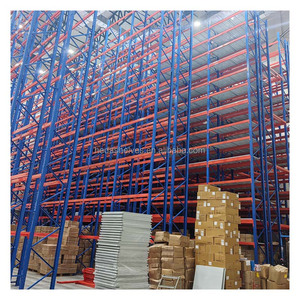
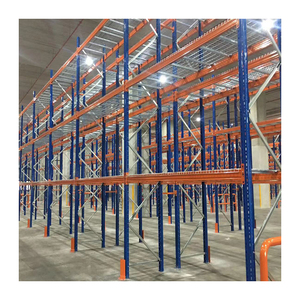
Double Deep Pallet Racking: Mechanics, Optimization, and Floor-Density Metrics
Double deep warehouse racking represents the quintessential balance between pure volumetric density and accessibility in contemporary supply chain engineering. By placing two rows of standard selective pallet racks back-to-back, double deep configurations eliminate 50% of the working aisles required by conventional single-deep selective layouts. This structural philosophy increases warehouse floor utilization to approximately 55%–65%, transforming standard industrial footprint into high-density storage without incurring the extreme capital expenditure of fully automated AS/RS cranes.
Key Design Principle: A standard double deep system operates on a Last-In, First-Out (LIFO) protocol per dual-slot pair, requiring specialized reach forklifts equipped with pantograph mechanisms or telescopic double-reach forks. When identical pallet lots are stored together (2 to 4 pallets per SKU batch), selectivity loss is mathematically negligible while storage capacity increases by 30% to 40% over standard selective layouts.
As premier Chinese exporters of double deep racking, Guangzhou HEDA Shelves Co., Ltd. calculates all load vectors under rigorous international standards, including European FEM 10.2.02, British SEMA codes, American RMI MH16.1, and Australian AS 4084-2012. Upright frame depths typically measure between 2,100 mm and 2,400 mm for paired depth, bound by structural row spacers (ranging from 200 mm to 450 mm) engineered from hollow structural steel sections. Our profile roll-forming machines utilize high-yield Q235B and Q355B cold-rolled coiled steel, punched at continuous 50 mm or 75 mm pitches to give facility engineers absolute vertical modularity.
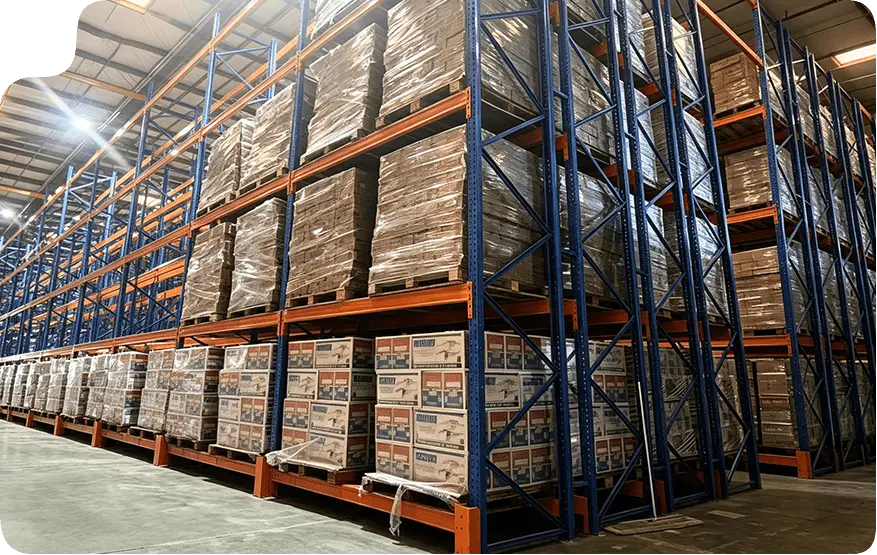
Storage System Architectural Comparison: Density, Capital Cost & Throughput
Procurement teams evaluating China double deep warehouse racking exporters should understand how double deep racking compares mechanically and operationally against alternative configurations:
| Storage System Type | Space Utilization (%) | Pallet Selectivity | Forklift Equipment Requirement | Capital Cost / Pallet | Optimal SKU Inventory Profile |
|---|---|---|---|---|---|
| Double Deep Racking | 55% – 65% (High) | 50% Immediate Access | Pantograph Reach Truck / Telescopic Mast | Moderate ($35 - $60) | 2–4 Pallets per SKU / High Turnover FMCG |
| Selective Pallet Racking | 35% – 45% (Standard) | 100% Immediate Access | Standard Counterbalance / Reach Truck | Lowest ($25 - $45) | High SKU Variety / 1 Pallet per SKU |
| Drive-In / Drive-Through | 65% – 75% (Ultra High) | 15% – 20% (LIFO Lane) | Standard Counterbalance (Driven in-bay) | Moderate-High ($60 - $90) | Homogeneous Stock / Seasonal Warehousing |
| Radio Shuttle System | 75% – 85% (Maximum) | Semi-Automated (Lane FIFO/LIFO) | Standard Forklift + Automated Cart | High ($110 - $180) | High-Volume Cold Stores & Beverage Hubs |
| Very Narrow Aisle (VNA) | 50% – 60% (High Vertical) | 100% Immediate Access | Man-Up / Turret Truck + Wire Guidance | High System Cost | High SKU Count + Tall Roof Clearance (>10m) |
Omega Profile Section Rigidity
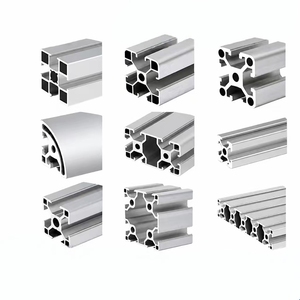
HEDA double deep uprights utilize an engineered multi-bend "Omega" profile (typically 90x68 mm, 100x70 mm, or 120x95 mm) with up to 13 rolling deformation stages. This geometry maximizes the moment of inertia ($I_x, I_y$) and cross-sectional torsional stiffness, resisting buckling under heavy dual-depth dynamic loading.
Telescopic Deflection Calculations
Because second-tier pallets are loaded via extended pantograph forks, beam deflection limits are designed to strict $L/250$ or $L/300$ criteria rather than standard $L/200$. Our engineering packages include finite element static analysis and secondary beam safety stops to prevent pallet overshooting.
Seismic & Baseplate Engineering
For installations in seismically active regions across the Pacific Rim, Mediterranean, or Rift Valley, our baseplates are customized with heavy structural gussets and chemical anchor embedments, engineered under Eurocode 8 and RMI seismic displacement protocols.
Why Leading Global Brands Choose HEDA Shelves as Their Primary Chinese Racking Exporter
Founded in 2001 in Guangzhou, China, HEDA Shelves has spent over two decades mastering the intersection of metallurgy, precision roll-forming, and overseas shipping logistics. We provide full lifecycle engineering services from initial CAD design to site commissioning.
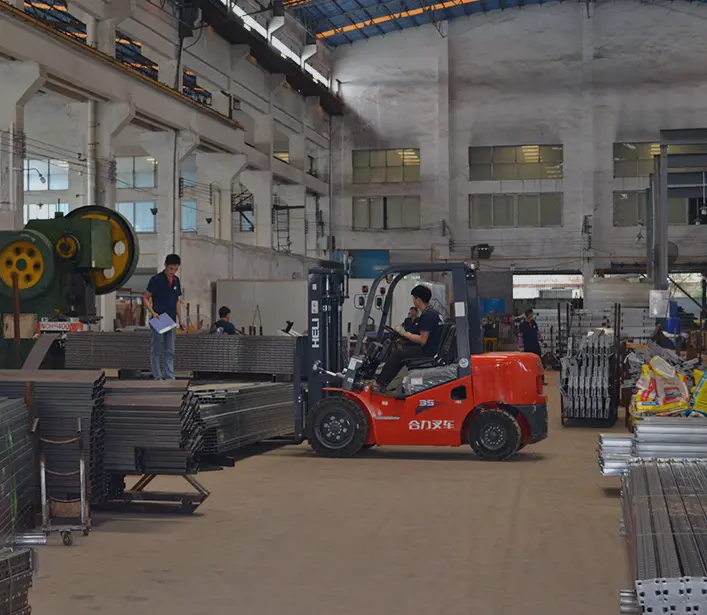
30,000 m² Integrated Production Hub with 30,000-Ton Monthly Output
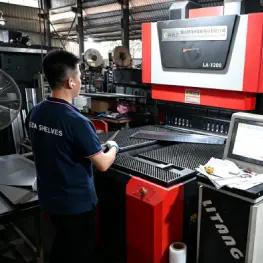
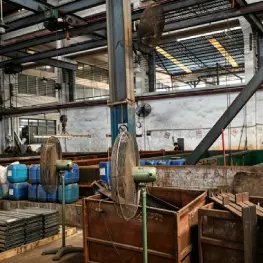
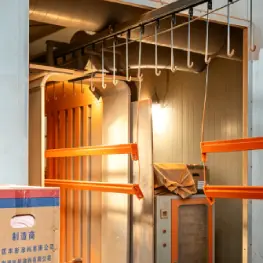
Unlike sourcing intermediaries, Guangzhou Heda Shelves Co., Ltd. operates a proprietary 30,000 square meter intelligent production complex. Every stage of manufacturing—precision slit coil feeding, cold roll-forming, computerized punch pressing, robotic plasma cutting, automatic submerged welding, and continuous conveyor electrostatic powder coating—occurs under a singular ISO 9001:2015 quality management framework.
Our monthly raw steel conversion capacity surpasses 30,000 metric tons. This high-volume infrastructure shields overseas distributors and turnkey EPC general contractors from prolonged delivery times, ensuring large 50-container double deep projects are produced, inspected, and packed in less than 25 working days.
End-to-End Precision Manufacturing Pipeline
Our proprietary 10-stage processing system ensures exceptional metallurgical yield strength and surface finishing capable of withstanding aggressive industrial environments:
Container Optimization Engineering
Exporting structural steel demands advanced maritime packaging. HEDA engineers bundle uprights and box beams using customized wooden battens, protective corners, and steel strapping designed for 20GP and 40HQ volumetric boundaries. This stuffing optimization achieves over 95% space utilization, reducing landed shipping costs per pallet position by up to 25% across ocean routes to African, Middle Eastern, Southeast Asian, European, and American ports.
Verified International Accreditations
We provide full transparency with certified compliance documentation: Factory CE Certification (No. 2435-CPR-8605159) for structural conformity under EN 1090-1 execution standards; ISO 9001:2015 Quality Management Accreditation (Certificate No. 18624Q00169R0M, valid through June 2027); and RoHS chemical safety compliance for all cured polyester powder coatings.
Free 3D Layout & Static Calculations
Every commercial quote is accompanied by comprehensive engineering assets at zero cost. Within 24 to 48 hours of receiving warehouse blueprints, our CAD engineering team generates optimized beam elevation profiles, 3D DWG/BIM layout renders, egress aisle simulations, and formal load compliance sheets certifying structural capacity per bay.
Future Procurement & Technological Trends in Double Deep Racking Systems
As commercial land values appreciate and global supply networks face volatility, the procurement criteria for double deep racking are evolving rapidly. Procurement directors must anticipate these emerging technological shifts over the 2025–2035 horizon.
1. AGV & AMR Deep-Reach Fleet Integration
The traditional reliance on human-operated pantograph forklifts is shifting toward autonomous reach trucks (AMRs) guided by SLAM LiDAR and 3D visual cameras. Modern double deep racking procurement contracts increasingly require optical retro-reflective beam markers, tighter fabrication tolerances (±1.0 mm beam elevation variances), and non-deflective entry guide rails to accommodate autonomous navigation without manual intervention.
2. Cold-Chain Volumetric Rationalization
Refrigerated and frozen food logistics are expanding globally, where electrical refrigeration costs represent up to 35% of total warehouse overhead. Because double deep layouts reduce the uncooled cubic space taken by access aisles while maintaining high SKU rotation, procurement for cold storage centers is transitioning away from single-deep racking toward hot-dip galvanized or high-zinc epoxy double deep systems.
3. High-Strength Micro-Alloy Steel & Scope 3 Decarbonization
Leading international buyers are scrutinizing the carbon footprint of steel components. Chinese manufacturers are adopting high-yield micro-alloyed steel coils (such as Q355B and automotive-grade high-strength strip), which allow for reduced material thickness while maintaining load capacities up to 4,500 kg per beam level. This reduces raw material weight, decreases shipping carbon emissions, and satisfies ESG sustainability criteria.
4. Digital Twin Modeling & Sensorized Uprights
Procurement specifications in tier-1 distribution centers now stipulate integration with Warehouse Management Systems (WMS) and Digital Twin models. Double deep racks are increasingly pre-fitted with integrated IoT strain gauges and impact accelerometers on lower column guards, delivering real-time telemetry on frame deflection, accidental forklift impacts, and localized bay overloading.
5. Hybridization with Pallet Flow & Mezzanines
Modern distribution hubs rarely rely on a single racking format. Engineering procurement now prioritizes hybrid modularity: lower levels configured with double deep racking for dynamic bulk storage, while upper elevations integrate rack-supported mezzanines or gravity carton flow beds for fast-moving piece-picking operations.
6. Near-Zero Downtime Knock-Down Assembly
With warehouse space lease rates rising, logistics operators cannot tolerate weeks of construction downtime. The demand for boltless, pre-engineered drop-in beam connectors with safety pin autolocking mechanisms is accelerating. HEDA's 4-prong heavy-duty hook connectors ensure quick assembly with minimal tooling, slashing on-site installation timelines by 30%.
Frequently Asked Questions: Sourcing Double Deep Racking from China
Technical, logistical, and structural answers written directly by our senior structural engineers to help procurement managers eliminate project risk.
Operating double deep racking requires specialized material handling equipment. Standard counterbalance forklifts cannot reach the rear pallet position. Facilities must deploy either: (1) a pantograph reach truck featuring a scissor-action extended mast; (2) a reach truck fitted with telescopic hydraulic forks (tele-forks); or (3) an articulated narrow-aisle forklift capable of deep-lane extension. When calculating beam clearances and frame load ratings, engineers must account for the fork tilt deration, as extended tele-forks exhibit reduced residual capacity at heights above 6.0 meters.
Safety in double deep environments is achieved through a multi-layered design. First, uprights feature dual-depth row spacers tying back-to-back frames into a unified, high-stability seismic diaphragm. Second, upper beam levels are commonly equipped with pallet guide rails, heavy-duty wire mesh decking, or center pallet support bars to ensure off-center pallets cannot slip through the beam aperture. Third, modern reach trucks deployed in double deep aisles are outfitted with fork-tip wireless micro-cameras and mast-height laser alignment markers to provide operators with clear visibility into the secondary depth slots.
As an established Chinese exporter, HEDA Shelves engineers each shipment to maximize either the payload weight limit (typically 26 to 28 metric tons for a 40HQ container, subject to local road weight regulations) or the volumetric capacity (68 to 76 m³). Uprights are assembled or knocked down (disassembled) into dense stacks cushioned with corrugated boards and high-tensile strapping. Beams are nested with interlocked claws, protecting the powder coating and ensuring full container volume utilization. We provide a complete loading plan with center-of-gravity calculations prior to container sealing.
We use certified high-strength carbon steel grades Q235B (yield point $\ge 235 \text{ MPa}$) and Q355B (yield point $\ge 355 \text{ MPa}$, equivalent to European S355JR and ASTM A572 Grade 50) directly sourced from tier-1 Chinese steel mills (Baosteel, Shougang). For surface protection, parts undergo a continuous 9-stage pretreatment sequence: hot alkaline degreasing, water rinsing, acid pickling to eliminate mill scale, secondary water rinsing, and zinc phosphating to provide chemical bonding. Following pretreatment, an automated electrostatic polyester powder coating is cured at 180°C–200°C to achieve a durable 60–80 μm film thickness that withstands 500+ hours of continuous neutral salt-spray exposure.
Every overseas export includes a complete engineering package: stamped structural static calculation reports, 3D CAD anchor placement drawings, step-by-step bilingual installation manuals, and individually tagged parts matching the packing lists. Furthermore, HEDA provides dedicated remote video supervision with multilingual structural engineers. For large EPC developments, our senior commissioning managers can be dispatched on-site to oversee local assembly crews, verify torque-tightening values, check frame verticality tolerances (within 1/1000 plumb line standards), and execute final load acceptance testing.
Yes. HEDA double deep systems are inherently modular. Because a double deep array is constructed from two standardized selective upright frames joined by bolted structural row spacers, the system can be reconfigured back into two independent single-deep selective racking aisles with minimal scrap components. This flexibility protects your long-term capital investment against unexpected shifts in business models, SKU diversity, or warehouse leasing contracts.
Accelerate Your High-Density Warehouse Project Today
Send us your building dimensions, clear roof heights, pallet load parameters, and forklift models. Guangzhou Heda Shelves Co., Ltd. will supply a professional 2D/3D CAD layout, finite-element load analysis, and factory-direct CIF quotation within 24 hours.