[email protected] Serving West, East, Southern & North Africa
Engineering Standard EN 15512 & RMI Spec

China Top Gravity Flow Racking System Manufacturers & Exporters

High-Density FIFO Pallet Flow Dynamics, Cold-Chain Engineering & Global Export Solutions from Guangzhou Heda Shelves Co., Ltd.

2001
Founded Year
30,000m²
Smart Factory Base
30,000
Tons / Month Capacity
300+
Engineers & Technicians
10,000+
Global Projects Built
120+
Export Destinations
Engineered Storage Portfolio

Featured Warehouse Racking & Material Handling Equipment

Review our heavy-load pallet flow systems, structural cold-chain racks, and versatile industrial storage matrices fabricated under ISO 9001:2015 and CE certification standards.

Technical Whitepaper

Physics, Dynamics & Structural Mechanics of Gravity Flow Racks

Gravity flow racking (pallet flow) uses inclined wheel beds or rollers driven purely by gravitational potential energy, providing strict First-In, First-Out (FIFO) material movement without electrical grid consumption.

As leading Chinese racking manufacturers, Guangzhou Heda Shelves Co., Ltd. applies strict structural dynamics to eliminate run-away loads, pallet bridging, and impact deformation at discharge faces. By harnessing a regulated incline angle—typically configured between 2.5% and 3.5% (approx. 1.5° to 2.0°)—unit loads weighing up to 1,500 kg per pallet travel smoothly down lanes extending from 2 to 20 pallets deep.

A persistent operational risk in deep gravity flow installations is uncontrolled acceleration resulting in pallet collision or rail derailment. To control kinetic velocity, HEDA incorporates indirect centrifugal speed controller rollers spaced at calculated pallet-pitch intervals (usually every 1 to 2 pallet lengths). These internal centrifugal brake drums automatically modulate rolling speeds to an ergonomic 0.2 m/s to 0.3 m/s, irrespective of whether the pallet weighs 250 kg or 1,500 kg.

Storage System Rotation Principle Aisle Requirement Energy Reliance Optimal Use Cases
Gravity Pallet Flow Strict FIFO (100% Guaranteed) 2 Aisles (Loading & Picking) Zero (Pure Mechanical Gravity) Food, Beverage, Pharma, Cold Chains with short shelf life
Radio Shuttle System FIFO or LIFO Selectable 1 or 2 Aisles Rechargeable Lithium Batteries Ultra-deep mass batch storage (20-40 pallets deep)
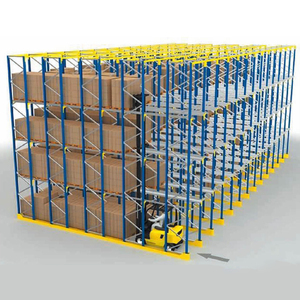
Drive-In Racking Strict LIFO 1 Loading/Retrieval Face Zero (Forklift Enters Rack) Low-cost bulk seasonal goods; single-SKU manufacturing
Push Back Racking Strict LIFO (Nested Carts) 1 Single Operating Aisle Zero (Forklift Pushes Against Incline) Medium turnover; 2 to 6 pallets deep per lane

Furthermore, terminal impact at the pick face is mitigated via mechanical pallet separators (brake load separators). When the first pallet comes to rest on the rigid end stop, the separator mechanism disengages behind it, withholding backline pallet hydrostatic line pressure. When a forklift retrieves the lead pallet, the secondary lever trips smoothly, allowing the next consecutive load to glide forward under safety braking. This protects forklift operators, eliminates pallet squeeze, and protects structural upright frames from sudden horizontal punch loads.
Enterprise Manufacturing Authority

Why Top Global Importers Choose HEDA Shelves

Founded in 2001, Guangzhou Heda Shelves Co., Ltd. controls the complete supply chain lifecycle from raw hot-rolled steel strip processing to export container stowage.

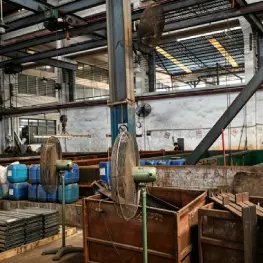
30,000 m² Integrated Plant

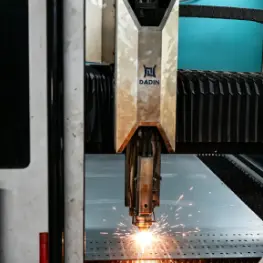
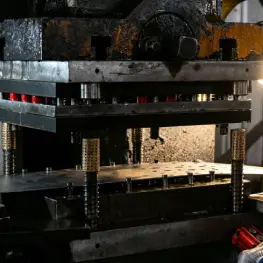
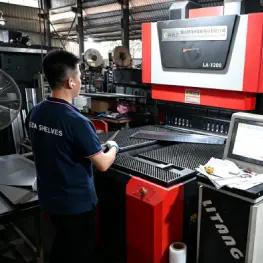
Equipped with high-precision CNC automatic roll-forming lines, automated laser cutting tables, robotic welding cells, and continuous electrostatic powder spray lines.

Verified Certifications

CE Certificate No. 2435-CPR-8605159 and ISO 9001:2015 registration No. 18624Q00169R0M ensure structural safety, weld penetration, and strict raw material traceability.

Container Stowage Mastery

Custom modular knock-down engineering maximizes 20GP & 40HQ volume stowage, cutting landed sea freight costs to Lagos, Mombasa, Durban, Santos, and Rotterdam.

Free 3D Layout & Static Sizing

Our design department provides free AutoCAD blueprints, 3D renderings, floor slab pressure calculations, and beam load charts within 24 hours of inquiry receipt.

Precision 10-Stage In-House Quality Process

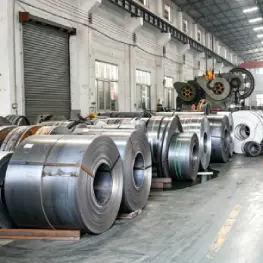
Raw steel inspection
STEP 01
Certified Steel Coil
Precision CNC cutting
STEP 02
Precision CNC Cutting
Automated column punching
STEP 03
Automated Punching
Cold bending forming line
STEP 04
Cold Roll Bending
Acid pickling and phosphating
STEP 05
Pickling & Phosphating
What is the optimum slope gradient for pallet gravity flow racks?
The standard engineering gradient is between 2.5% and 3.5% (approx. 1.5° to 2.0° incline). The exact pitch depends directly on pallet construction (solid timber, wooden skids, or molded plastic), overall pallet deflection, bottom board orientation, and unit weight ranging between 300 kg and 1,500 kg. HEDA runs physical roller inclination tests in our factory using your actual pallet specimens prior to mass roll-forming.
How does gravity flow racking prevent pallet runaway and terminal impacts?
We integrate two mechanical safeguards: First, internal centrifugal speed controllers (brake rollers) mounted beneath the track at regular 1.2m–1.5m intervals maintain roll velocity between 0.2 and 0.3 m/s. Second, heavy-duty mechanical pallet separators near the pick-end hold back line pressure, ensuring the leading pallet is relieved of rear hydrostatic weight before extraction by forklift.
Can standard wooden and plastic pallets run on the same gravity lane?
Yes, provided full-width steel roller tracks or multi-lane skate-wheel tracks are specified instead of narrow dual-wheel rails. Plastic pallets with irregular bottom runners or central depressions require full-surface galvanized steel cylindrical rollers with sealed ball bearings to prevent point deflection or wheel bridging.
How does Guangzhou Heda protect racking from coastal humidity and cold store frost?
Our steel components undergo an automated 8-stage chemical immersion process: degreasing, clean water rinsing, acid rust removal (pickling), zinc phosphating, and passivation. Finished parts receive an electrostatic thermosetting epoxy-polyester powder coating (60–90 microns) cured at 180°C–200°C. For sub-zero cold rooms or high-salinity ports, hot-dip galvanized finishes complying with ISO 1461 can be applied.
What export terms and shipping documentation do you provide for African and global ports?
We ship under EXW, FOB, CFR, and CIF terms to all major global ports including Lagos (Apapa/Tin Can), Mombasa, Tema, Durban, Alexandria, and Valparaiso. All uprights and beams are bundled with steel strapping, corrugated corner protection, and high-tensile stretch film to prevent maritime transit friction. We issue verified Certificates of Origin (Form E, Form A, CO), CE declarations, mill test certificates (MTC), and packing lists mapped by container bundles.
How is installation handled on overseas warehouse job sites?
Every system is delivered with color-coded assembly CAD blueprints, exploded 3D component diagrams, and bolt-torque tables. Components are modular and boltless-lockable where applicable. For large projects, HEDA provides video conference engineering supervision, or dispatches veteran installation team managers to overseas project sites to oversee local mechanical labor.

Ready to Optimize Your Warehouse with High-Density Gravity Flow Racking?

Send us your building layout (DWG or PDF), pallet specs, and turnover throughput. Our senior rack engineers will deliver custom 3D AutoCAD drawings, load-deflection calculations, and landed price estimates within 24 hours.