Industrial Logistics Engineering Analysis
Heavy-Duty Pallet Racking Architecture & Industrial Storage Capabilities
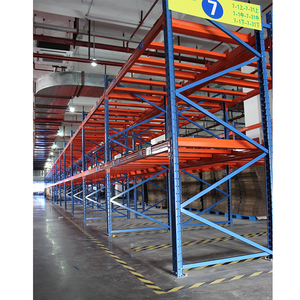
Modern global logistics networks demand heavy-duty pallet racking infrastructure capable of supporting extreme localized mass while maintaining seismic resilience, mechanical precision, and compatibility with emerging semi-automated and autonomous mobile robot (AMR) material-handling equipment.
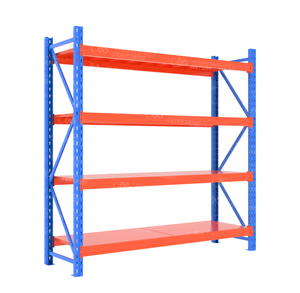
2001
Established Since
30,000㎡
Dedicated Factory Facility
30,000T
Monthly Cold-Formed Steel Capacity
10,000+
Turnkey Projects Deployed
The Next Decade in Heavy Duty Pallet Racking: Engineering Procurement Trends
As enterprise supply chain managers balance rising real estate costs against expanding fulfillment throughput, procurement specifications for heavy-duty pallet racking are shifting from static, generic steel configurations toward customized structural platforms designed for extreme vertical density. Global manufacturing and distribution hubs are prioritizing cold-rolled high-tensile steels, such as certified Q235B and Q355B alloys, engineered to yield greater strength-to-weight ratios and dynamic load thresholds exceeding 4,000 kg per beam level.
A critical shift is the transition from conventional selective layouts to integrated Automated Storage and Retrieval Systems (AS/RS) and radio shuttle configurations. Modern fulfillment infrastructure demands millimeter-precise upright perpendicularity tolerances and customized run-spacers that can integrate seamlessly with high-bay cranes, laser-guided automated guided vehicles (AGVs), and autonomous mobile robots without structural drift.
Furthermore, climate resilience and corrosion resistance have become paramount in cross-border industrial procurement. Projects situated across high-salinity coastal logistics hubs, tropical free zones, and harsh sub-zero cold chains require comprehensive dual-surface treatments—pairing structural phosphating conversion coatings with high-micron electrostatic polyester powder systems or full hot-dip galvanization (HDG compliant with ISO 1461) to eliminate rust-induced structural fatigue.
Direct Manufacturer Infrastructure
Why Global Logistics Leaders Partner with Our Chinese Manufacturing Base
Guangzhou Heda Shelves Co., Ltd. controls the complete structural engineering cycle under one industrial roof, ensuring strict adherence to EN 15512, RMI, and ISO 9001:2015 quality standards.
Structural CAD & Free 3D Finite Element Design
Before steel cutting begins, our certified structural engineering team calculates deflection indices, seismic shear reactions, and baseplate point loads to deliver compliant architectural floor plans and 3D visual models at zero cost.
Traceable High-Tensile Steel & CE Certification
Holding verified CE Marking (Cert. No. 2435-CPR-8605159) and ISO 9001:2015 management credentials, we source structural prime coils with documented chemical composition and tensile mill test certificates for uncompromising safety.
Container-Optimized Sea Freight Packaging
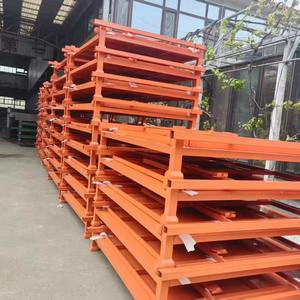
Uprights, box beams, and bracing assemblies are modularly nested and packed in steel skids to fully optimize volumetric capacity inside 20GP and 40HQ maritime containers, drastically lowering the landed transport cost per pallet location.
Controlled Production Pipeline
End-to-End Quality Management Across 10 Industrial Production Stages
Precision roll-forming and multi-stage surface treatments ensure industrial steel racks endure heavy impacts, continuous forklift interactions, and harsh warehouse ambient conditions.
STAGE 01
Coil Slitting & Punching
Continuous CNC-controlled automated punch presses create teardrop or diamond 50mm/75mm upright pitch profiles.
STAGE 02
Precision Cold Roll-Forming
Multi-roller forming lines profile high-load Omega-shaped upright columns and nested interlocking box beams.
STAGE 03
MIG Robot Welding
Robotic welding fixtures assemble 3-prong, 4-prong, or 5-prong beam connectors to prevent human error and weak welds.
STAGE 04
Chemical Pretreatment
Complete multi-tank acid pickling and phosphating washes strip scale, oils, and pre-treat the steel substrate.
STAGE 05
Powder Coating & Curing
Automated electrostatic powder application cured at 200°C creates high-durability, impact-resistant finishes.
B2B Sourcing Guide
Frequently Asked Questions for Warehouse Pallet Racking Procurement
Technical guidance addressing key commercial parameters, seismic design codes, and container freight calculations directly from our engineering office.
Q1: How do you determine the safe working load (SWL) for beam levels?
Safe Working Load is determined under FEM 10.2.02 and ANSI MH16.1 specifications. We calculate maximum bending moments based on clear span dimensions and distribute the weight of standard 1,000×1,200mm or 800×1,200mm pallets. The standard deflection limit is strictly constrained to L/200 or L/250 to ensure structural integrity under sustained point stresses.
Q2: What technical parameters are required for custom CAD warehouse layouts?
To prepare an optimized 3D and CAD layout, our engineering team requires: warehouse clear height (to the lowest truss or sprinkler line), building column grid spacing, floor slab thickness and concrete psi/mpa rating, palletized cargo outer dimensions (W×D×H including overhang), maximum gross pallet weight, and forklift mast clear-lift height and turning radius.
Q3: Can Chinese heavy-duty racking comply with regional seismic building codes?
Yes. We engineer racking systems according to local seismic hazard acceleration maps (such as Eurocode 8 or AS 4084). By altering the upright column thickness (up to 2.5mm or 3.0mm), enlarging floor baseplate footprints, adding heavy top-tie bracing, and utilizing M12/M16 chemical expansion ground anchors, our installations meet seismic resistance standards worldwide.
Q4: How does HEDA Shelves protect structural racking against moisture in tropical climates?
Steel assemblies endure immersion pickling and iron phosphating to dissolve mill oils and micro-rust before powder application. We utilize premium exterior-grade polyester resin powder coatings with minimum 70–90 micron thickness. For high-humidity coastal ports, external yards, or cold storage facilities, full hot-dip galvanized uprights and zinc-chromated wire decking are deployed.
Engineering Your High-Density Storage Transformation
Partner directly with a proven Chinese racking manufacturer. Our design engineering division is ready to review your warehouse floor plans and calculate your optimal layout within 24 hours.
Inquire Now