1 What is the operational distinction between nested cart and roller bed push back systems?
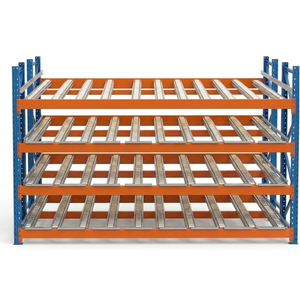
Nested cart systems carry pallets on dedicated structural steel carts that glide on perimeter flanged wheels along inclined rails. Roller-bed systems rely on full-width steel conveyor rollers with internal speed governors. Nested carts are generally preferred for standard GMA, Euro, or industrial pallets (weighing 500–1,500 kg) due to lower capital cost, reduced wheel maintenance, and zero vulnerability to bottom-slat splintering. Roller-bed push back is typically reserved for specialized deep-lane tote storage or applications involving non-standard pallet bottom patterns.
2 What pallet lane depths are safely possible in push back configurations?
Push back racking is engineered in 2-deep, 3-deep, 4-deep, 5-deep, and 6-deep configurations. In standard practice, 2-deep to 4-deep are the most prevalent, offering an optimal balance of forklift pushing thrust and vertical beam clearance. Systems engineered for 5-deep and 6-deep configurations require higher-capacity forklifts with sufficient tractive power to push 5 cumulative pallet loads up a 2% slope simultaneously, alongside heavier front-stop structural reinforcements.
3 What floor flatness and foundation slab specifications are mandatory?
Unlike Very Narrow Aisle (VNA) systems requiring strict Superflat or DIN 18202 Table 3 Line 4 flooring, push back racking typically operates effectively on industrial concrete floors adhering to standard Class FF 25 / FL 20 to FF 35 / FL 25 tolerances. Because forklifts operate in standard-width perimeter aisles (typically 3.0 m to 3.4 m for counterbalance or reach trucks), the primary slab requirement is adequate concrete compressive strength (minimum 25–30 MPa) and reinforcement depth to withstand dynamic column baseplate loads.
4 How does push back racking prevent pallets from hanging up or failing to advance?
Pallet hang-ups occur when low-quality systems use plain bushings or incorrect rail slopes. HEDA Shelves addresses this by fitting each cart with heavy-duty precision-ground shielded ball bearings coated with low-temperature synthetic lubricants, maintaining consistent rolling performance down to -30°C. Additionally, our cart chassis is designed to support the perimeter stringers or blocks of the pallet directly, preventing bottom-board wood deflection from contacting the steel rails.
5 What certifications and steel standards govern Chinese racking manufacturing?
High-tier Chinese racking manufacturers adhere to European standard EN 15512 (Steel static storage systems - Adjustable pallet racking systems - Principles for structural design) and American RMI MH16.1 specifications. Guangzhou Heda Shelves Co., Ltd. holds verified CE Certification No. 2435-CPR-8605159, ISO 9001:2015 Certification No. 18624Q00169R0M, and RoHS testing verification, utilizing prime mill-certified Q235B and Q355B structural steel.
6 How do you optimize container packing density for ocean export?
Exporting structural steel racking involves balancing volume and gross weight limits. Upright frames are typically shipped disassembled in knock-down form, bundled with protective wooden dunnage and high-tensile steel strapping. Step beams and push back rails are nested tightly, while carts are palletized and boxed. A standard 40HQ container can accommodate approximately 22 to 26 metric tons of structural racking components, minimizing freight costs per pallet location.
7 Can push back racking operate outdoors or in high-humidity coastal zones?
Yes. For standard indoor warehouses, our 10-stage automated electrostatic powder coating (epoxy-polyester hybrid, 60–80 microns) provides excellent wear and chemical resistance. For coastal warehouses, high-humidity regions, or open-air yard structures, components can be specified with hot-dip galvanization according to ISO 1461, yielding an all-weather zinc metallurgical barrier that resists rust and corrosion for over 25 years.
8 How is push back racking assembled and commissioned on site?
Every shipment from HEDA Shelves includes comprehensive structural installation blueprints, component identification tagging, and step-by-step 3D exploded diagrams. The upright frames are assembled with high-tensile Grade 8.8 bolts, beams lock into uprights with safety pins, and push back rail assemblies bolt directly onto the step beams. Local installation crews can easily complete the work under our remote video supervision, or we can deploy an on-site installation supervisor for large turnkey facilities.