China Top Stacking Racks For Warehouse Factory & Exporter
Precision-Engineered Q235B/Q355B Modular Stacking Systems, Certified Heavy-Duty Post Pallets, and Turnkey Storage Solutions for Global Supply Chains
Engineering Excellence & Turnkey Supply
Industrial-Grade Stacking Racks Engineered for Maximum Space Volumetric Efficiency
In contemporary warehousing, cold storage distribution, and high-throughput intermodal logistics, traditional static bolted pallet racking frequently imposes operational rigidity and unrecoverable capital expenditures. As a premier China manufacturer and direct global exporter, Guangzhou Heda Shelves Co., Ltd. provides high-density, flexible, demountable, and foldable post racking systems engineered to optimize cubic storage density while eliminating the structural anchor footprint of permanent installations.
Structural Mechanics & Load Dynamics of Stacking Post Pallet Racks
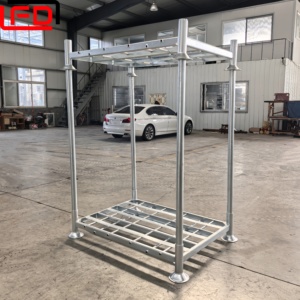
Stacking racks (interchangeably classified across international logistics as post pallets, manuracks, or nestable steel cradles) represent a dynamic alternative to stationary floor-anchored steel racking. By consolidating load support directly into the modular steel columns, stacking racks eliminate column footplates and concrete expansion anchor stresses.
At Guangzhou Heda Shelves Co., Ltd., structural design adheres strictly to the finite element calculation standards set forth by EN 15512 (Steel Static Storage Systems), ANSI MH16.1, and FEM 10.2.02. When specifying stacking racks for high-throughput fulfillment centers or refrigerated terminal facilities, structural engineers must evaluate four non-negotiable stress criteria:
1. Structural Steel Metallurgy (Q235B vs. Q355B Hot-Rolled Coils): Our base frames and load columns utilize certified carbon structural steel (Q235B with a yield strength of 235 MPa, or high-tensile Q355B with 355 MPa for seismic-active regions). The low carbon content ensures maximum elongation during severe forklift impacts, averting catastrophic brittle fracture under cold storage conditions down to -30°C.
2. The Mechanics of the Inverted Nesting Cup Interlock: Stacking safety relies fundamentally on the conical target-cup and foot-shoe junction. HEDA utilizes a heavy-duty, deep-drawn 6.0mm hot-stamped steel cup on top of each upright post, paired with a precision-tapered forged base leg. This configuration creates an engineered interlocking center that prevents rotational slip or lateral column dislocation even when dynamic forklift placement creates up to a 3-degree angular misalignment.
Every HEDA stacking rack base frame is engineered with a safety design factor of 1.5 to 1.8 over the stated nominal safe working load (SWL). Maximum vertical beam deflection under full static payload (e.g., 2,000 kg per tier) is restricted within L/200, maintaining square verticality throughout the entire vertical stack array (up to 4–5 units high).
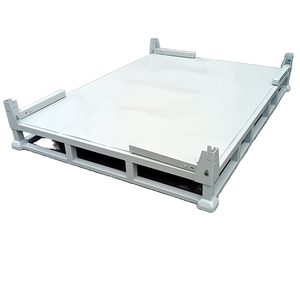
3. Demountable vs. Foldable Base Mechanics: Stacking racks generally fall into two mechanical topologies: post-demountable manuracks and hinged foldable units. Demountable post racks allow posts to be rapidly extracted and bundled, achieving a 1:5 to 1:7 reverse logistics return ratio. Foldable base units feature permanently tethered, heavy-pivot hinge pins that collapse inward within 10 seconds, eliminating loose component management while protecting warehouse staff from hand-crush hazards during re-pitching cycles.
Rack Model Category
Primary Steel Material
Nominal Load / Level
Stacking Factor
Corrosion Protection
Target Industry Application
Heavy-Duty Foldable Manurack
Q235B Rectangular Tube (50x50x2.5mm)
1,500 – 2,500 kg
1 + 3 (4 Tiers Total)
Electrostatic Powder (70-90μm)
Automotive Parts, Chemical Drums, Agro-Seed
Demountable Post Pallet Rack
Seamless Circular Tube (Ø60x3.0mm)
1,000 – 2,000 kg
1 + 4 (5 Tiers Total)
Hot-Dip Galvanized (ISO 1461, 85μm)
Cold Storage Logistics, Seafood, Outdoor Yards
Nesting Tire Stacking Rack
Structural Square Hollow Section
1,000 – 1,200 kg
1 + 4 (5 Tiers Total)
Outdoor High-Gloss Polyester
Tire Distribution Hubs, Rubber Storage
Collapsible Wire Mesh Post Rack
Cold Drawn Steel Wire & Angle Frame
800 – 1,500 kg
1 + 3 (4 Tiers Total)
Zinc Electroplate / Powder Coat
E-commerce Parcel Sorting, Textile Rolls
Strategic Supply Chain Foresight
Future Procurement Trends in Industrial Stacking Rack Systems
As global logistics operators navigate escalating industrial land rents, erratic seasonal surges, and strict ESG compliance mandates, stacking rack procurement is shifting from commoditized hardware purchases toward agile structural strategies.
Corporate 3PLs and seasonal importers are actively divesting from permanent teardown-intensive selective racking. Stacking racks provide instant cubic expansion during seasonal inventory surges (agricultural harvests, holiday retail peaks) and can be fully knocked down when inventories clear, liberating warehouse floors for cross-docking without leaving floor anchor holes.
2. Cold Chain High-Density Galvanization Demands
With refrigerated air volume costing up to 4.5× more than ambient warehouse volume, cold-chain operators are converting open floor space to 4-high and 5-high post pallet clusters. Procurement mandates now demand hot-dip zinc coatings compliant with EN ISO 1461 (>85μm thickness) to prevent flake corrosion, rust-drop product contamination, and moisture degradation inside sub-zero blast freezers.
3. Precision Interfacing with Autonomous AMRs & AGVs
Next-generation procurement demands millimetric fabrication tolerances (±1.5mm) across post centers. Standard manually-welded racks with rotational warp trigger optical sensor fault codes in autonomous mobile robots (AMRs) and automated high-bay forklifts. Laser-cut components and robotic jig welding are becoming standard baseline requirements for global enterprise procurement tenders.
R&D Evolution
Technological Evolution: From Static Crates to Smart Modular Post Pallets
The industrial storage sector has moved far beyond rudimentary wood pallets and rigid wire hampers. The trajectory of Chinese manufacturing in logistics hardware has followed a clear evolutionary progression:
Phase 1 (2000–2010): Heavy Channel-Iron Welding. Early post pallets utilized hot-rolled structural channel iron. While rigid, they possessed an excessive tare weight (often exceeding 120 kg per unit), severely penalizing container payload capacities and presenting severe ergonomic manual handling barriers during assembly.
Phase 2 (2011–2020): Thin-Walled Cold-Formed Tube Engineering. Introduction of automated continuous roll-forming lines enabled manufacturers to use cold-formed closed rectangular hollow sections (RHS). This innovation reduced tare weight by 38% while actually increasing critical buckling thresholds via engineered profile corrugation and structural internal embossing.
Phase 3 (Present & Beyond): Smart Automated Logistics Integration. Modern HEDA stacking systems are built ready for digital traceability. Base frames feature integrated RFID micro-tag pockets, 2D barcode direct laser etching, and guide-shoe lead-in chamfers specifically profiled for low-clearance AGV drive-under lift tables.
Direct Factory Advantage
Guangzhou Heda Shelves Co., Ltd.: Manufacturing Rigor & Global Reliability
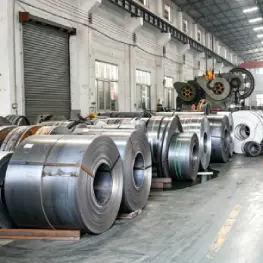
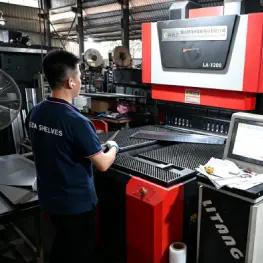
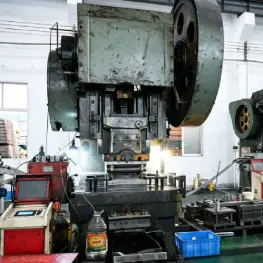
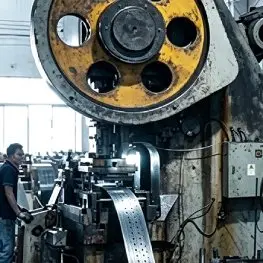
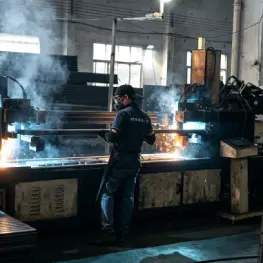
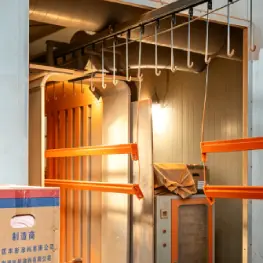
Headquartered in Guangzhou with a certified manufacturing heritage spanning over two decades, Guangzhou Heda Shelves Co., Ltd. is not a trading intermediary. We are an end-to-end original equipment manufacturer (OEM/ODM) executing raw coil slitting, stamping, robotic welding, surface finishing, and container consolidation under one continuous quality control roof.
25 Years Heritage
Continuous production since 2001, mastering custom structural warehouse rack engineering and load mechanics.
Every single piece of racking leaving our factory follows a standardized 10-step quality tracking protocol, guaranteeing uniform tolerances, certified welds, and flawless surface adhesion across multi-ton orders.
STAGE 01Raw Material QC
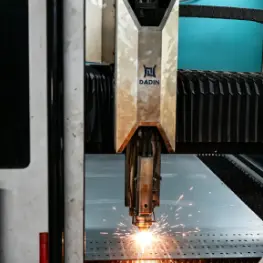
STAGE 02CNC Steel Cutting
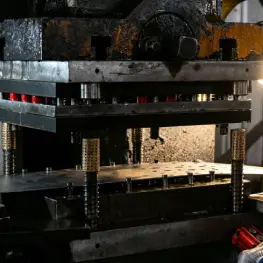
STAGE 03Post Punching
STAGE 04Cold Bending
STAGE 05Profile Forming
STAGE 06Surface Polishing
STAGE 07Robotic Welding
STAGE 08Pickling & Phosphating
STAGE 09Powder Coating
STAGE 10Load Test & Packing
CE Certified (EN 1090-1)Registration No. 2435-CPR-8605159
ISO 9001:2015 ManagementCertificate No. 18624Q00169R0M
Detailed technical, logistical, and structural answers addressing commercial terms, load safety calculations, surface durability, and international container shipments.
What calculation standards and safety coefficients are applied to 4-high stacked metal post pallets?+
At Guangzhou Heda Shelves Co., Ltd., stacking racks are engineered in compliance with EN 15512 and ANSI MH16.1. When calculating vertical column stability for a 4-high stack (1 base unit carrying 3 fully loaded tiers above), we apply a minimum safety design factor of 1.5 to 1.8 against the nominal yield point of Q235B structural steel. For example, in a 2,000 kg capacity unit stacked 4-high, the ground-tier corner posts are calculated to withstand a minimum static axial load of 6,000 kg (plus dynamic impact allowances during forklift placement). Full finite element stress calculations and deflection diagrams are provided with our engineering approval packages.
How does hot-dip galvanized finish compare to electrostatic powder coating in coastal or sub-zero environments?+
For indoor ambient warehousing with relative humidity below 70%, our 9-stage pre-treated thermosetting polyester powder coating (70–90 microns) delivers superior impact resistance, abrasion resistance against forklift tines, and customized corporate color coding. However, for cold storage freezers (-20°C to -30°C), exterior port yards, or coastal distribution centers subject to marine saline air (such as Mombasa, Lagos, or Durban), hot-dip galvanization to EN ISO 1461 is essential. Hot-dip galvanizing immerses the welded steel assembly in molten zinc at 450°C, producing a metallurgical iron-zinc alloy layer exceeding 85 microns that offers complete cathodic self-healing corrosion protection inside hollow tubes where powder spray cannot penetrate.
What is the shipping volume and container packing efficiency (TEU/FEU) for demountable vs. foldable stacking racks?+
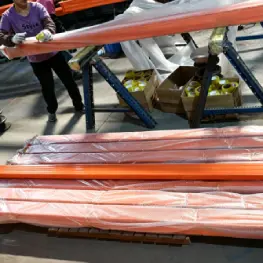
Container loading density directly determines your landed unit cost. Fully assembled static racks consume excessive volume, yielding only 20–30 units per 40HQ container. In contrast, HEDA demountable post racks allow base frames to nest closely while upright posts are bundled separately; a standard 40HQ container can accommodate between 140 and 220 complete sets (depending on footprint dimensions such as 1500x1200mm or 1200x1000mm). Foldable base models collapse into a flat profile of approximately 180–220mm thickness, allowing stacks of 10–12 units per bundle. Our engineering office provides a computer-modeled 3D container stuffing diagram with every formal quotation to ensure zero wasted cubic space.
Can stacking racks be moved safely by standard forklifts when fully loaded?+
Yes. Base frames are fabricated with integrated 4-way or 2-way full-perimeter forklift fork pockets, or engineered base clearance spans (typically 100mm to 120mm under-clearance) compatible with counterbalance forklifts and reach trucks. However, for operational safety, stacked configurations (2, 3, or 4 units high) must NEVER be transported as an entire stacked column while loaded. The industry standard protocol requires picking and moving units tier-by-tier, then restacking at the destination bay. For empty rack repositioning, up to 4 collapsed or post-demounted bases can be transported concurrently by certified operators.
What floor slab specifications are required to support multi-tier stacking racks?+
Unlike static selective racking that concentrates enormous loads onto small 100x100mm baseplates anchored into concrete with expansion bolts, stacking racks distribute their load through four broad target-shoes or perimeter bottom skid rails. For a standard 4-high stack carrying 1,500 kg per tier, the total point load on the bottom four feet is approximately 6,000 kg (1,500 kg per corner). A reinforced industrial concrete floor slab with a minimum thickness of 180mm to 200mm and a compressive strength rating of C25/30 is recommended to prevent localized punch cracking or slab settlement.
How does Guangzhou Heda Shelves control dimensional tolerances across large export orders?+
Consistency is vital: if post sockets vary by even 2mm, stacked racks will lean dangerously at the 4th tier. HEDA maintains strict dimensional tolerances (±1.0mm overall frame diagonally; ±0.5mm socket pitch) through continuous investment in automated tooling. Upright tubes and base beams are cut via automated CNC fiber laser machines, column holes are punched in progressive dies, and frame assemblies are clamped in heavy pneumatic locking jigs before being welded by 6-axis robotic welding cells. Every production batch undergoes a pre-shipment 100% stacking trial test of 10 randomly selected units assembled 4-high under calibrated test weights.
What information does your engineering team require to provide a custom 3D layout and quotation?+
To prepare an exact technical specification and CAD drawing within 24 hours, our team requires: (1) Dimensions of your stored goods or pallet (Length × Width × Height including product overhang); (2) Maximum gross weight per unit; (3) Intended stacking height (e.g., 3-high, 4-high, or 5-high); (4) Operating environment (ambient indoor, cold storage, outdoor yard, or chemical contact); and (5) Warehouse building dimensions including clear ceiling height below sprinklers and main forklift aisle widths.
What export documentation, quality certs, and trade terms are supported?+
We operate internationally under FOB, CFR, CIF, and DDU/DDP terms. Every shipment is accompanied by a Commercial Invoice, Packing List, Clean On-Board Bill of Lading, Mill Test Certificates (MTR) confirming steel chemical composition and tensile strength, CE Certificate of Conformity (2435-CPR-8605159), ISO 9001:2015 audit certificate, and Certificate of Origin (including FORM E, FORM A, or CO for preferential customs tariffs). Third-party inspections via SGS, BV, or TÜV are welcomed and regularly coordinated at our Guangzhou loading docks.
Accelerate Your Warehouse Capacity with Certified Stacking Rack Engineering
Consult directly with senior structural storage engineers at Guangzhou Heda Shelves Co., Ltd. We provide free 24-hour CAD layout planning, dynamic 3D structural simulations, load capacity certifications, and transparent factory-direct pricing for international container consignments.