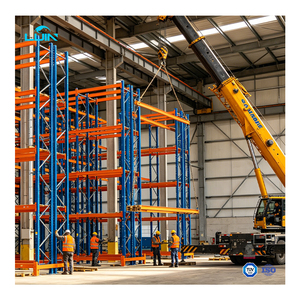
Direct Factory Catalogue
Engineered Industrial Warehouse Storage Solutions
From heavy structural cold-rolled steel architectures to fully automated shuttle warehousing, our certified equipment guarantees optimal space utilization and strict load-bearing compliance.
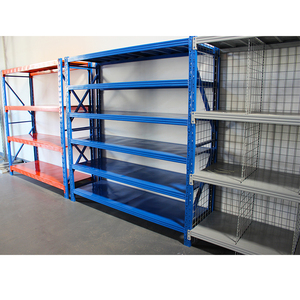
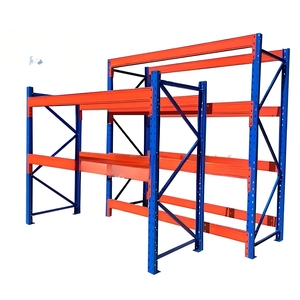
Engineering Whitepaper
Technological Trajectories in Global Warehouse Storage Systems
Modern distribution hubs demand verifiable structural calculations, dynamic seismic tolerance, and intelligent integration with next-generation automated guided vehicle (AGV) platforms.
High-Strength Metallurgy & Seismic Finite Element Analysis
The structural stability of high-bay racking systems relies upon the accurate selection of certified cold-formed structural carbon steels (predominantly Q235B and Q355B). Engineering teams use finite element analysis (FEA) to simulate dynamic cyclic loading, seismic sway, and buckling coefficients under varying ambient conditions. Through computerized upright profiling and multi-stage cold bending, upright columns attain superior moment resistance while minimizing structural deadweight, ensuring total structural integrity across coastal and seismic operational zones.
Automation Convergence: Radio Shuttles & WCS Orchestration
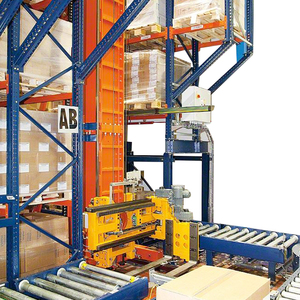
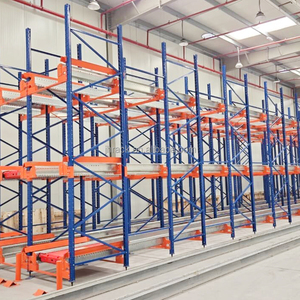
Warehouse operational expenditure is increasingly dominated by manual material handling costs. The future of intralogistics procurement centers on high-density semi-automated Radio Shuttle systems and fully automated 4-way shuttle platforms. By decoupling pallet transit from manual forklift travel corridors, high-density shuttle racking systems increase cubic storage efficiency by up to 80% while integrating directly with enterprise Warehouse Execution Systems (WES) to facilitate real-time inventory reconciliation and continuous batch buffering.
Anti-Corrosion Nanotechnology & Cold-Chain Resilience
Harsh environmental conditions, particularly in coastal tropical logistics hubs and sub-zero refrigerated chambers down to -30°C, demand rigorous surface preparation. High-performance racking manufacturers utilize multi-stage closed-loop automated pre-treatment incorporating hot degreasing, ultrasonic pickling, and fine zinc phosphating prior to electrostatic polyester powder coating. For extreme humidity or chemical storage units, continuous hot-dip galvanization provides zinc sacrificial cathodic protection that eliminates structural steel delamination over multi-decade operational cycles.
Strategic Procurement Framework
Future Procurement Directives for Supply Chain Operators
Navigate supply chain friction, ocean freight volatility, and layout reconfigurability by implementing factory-direct structural procurement standards.
Optimizing Freight Volumetric Density for Containerized Cargo
International ocean freight remains a significant component of total landed procurement cost. Smart global buyers increasingly specify knockdown boltless engineering where upright frames, box beams, and horizontal bracing members can be densely nested. By precision-calculating profile nestability for standard 40-foot High Cube (40HQ) maritime containers, factories minimize non-revenue air transit, drastically lowering logistics expenditures per unit pallet position across cross-border freight routes.
Total Cost of Ownership (TCO) vs. Initial Capital Outlay
Procurement criteria are transitioning from pure initial quotation metrics toward lifecycle asset durability. Low-cost racking featuring substandard structural gauge tolerances and sub-micron powder coatings frequently incurs costly structural beam deflection, floor anchor cracking, and rust degradation under forklift impact stresses. Sourcing certified Q235B steel structures with verified FEM 10.2.02 European design standard compliance significantly lowers inspection overhead, workplace liability, and warehouse repair expenses.
Modularity & Future-Proof Vertical Volume Adaptability
Dynamic supply chains require scalable physical layouts capable of rapidly transitioning from manual wide-span carton picking to multi-tier structural mezzanine flooring or Very Narrow Aisle (VNA) automated turret truck configurations. Forward-thinking enterprise supply managers mandate standardized column pitch punchings (50mm/75mm intervals), enabling seamless vertical beam elevation reconfigurations as SKU packaging dimensions evolve without discarding existing upright infrastructure.
Enterprise Authority
Guangzhou HEDA Shelves: 25 Years of Engineering Excellence
Operating from our proprietary 30,000 m² modern manufacturing complex in Guangzhou, China, we produce world-class industrial racking systems backed by verifiable global quality control credentials.
Verifiable Global Certifications
All HEDA structural steel systems are fully documented under international quality assurance regimes, including formal CE Certification (No. 2435-CPR-8605159), ISO 9001:2015 Quality Management (No. 18624Q00169R0M), and strict European standard EN 15512/RoHS metallurgical environmental compliance.
Complimentary 3D CAD & Load Calculations
Our dedicated structural engineering team develops customized 2D CAD floor plans, high-resolution 3D operational simulations, and verified structural load calculations within 24 hours. Every design incorporates building column offsets, fire sprinkler clearance, slab bearing capacity, and forklift turning radius data.
Full In-House End-to-End Production
We manage quality control across every production phase: raw coil slitting, multi-station continuous roll forming, automated CNC hydraulic hole punching, high-precision robotic CO2 welding, phosphating, electrostatic powder curing, and containerized export packing under one accountable roof.
Procurement Knowledge Base
Frequently Asked Questions on Industrial Racking Systems
Critical engineering criteria, installation workflows, and compliance specifications evaluated by global logistics facility planners.
What raw material grades are utilized in structural upright column manufacturing?
We strictly utilize certified high-tensile structural cold-rolled coil steels, primarily Q235B and high-yield Q355B (equivalent to European S235JR and S355JR under EN 10025). Each coil undergoes mechanical yield stress verification and chemical spectrometer inspections to ensure uncompromised tensile performance under severe static and live floor loadings.
How do engineers design racking systems to resist extreme tropical humidity and saline air?
For coastal distribution warehouses (e.g., West Africa, Southeast Asia, South America), components pass through an automated 9-stage closed-loop pre-treatment process: hot alkaline degreasing, twin water flushes, pickling, and fine crystal zinc phosphating, followed by a durable 70-90 micron electrostatic polyester powder coating. For cold stores and outdoor yards, hot-dip galvanization is specified.
What building parameters must be provided to generate an actionable 3D CAD proposal?
To produce an engineering-compliant layout within 24 hours, our design office requires: interior clear warehouse height (underside of roof truss), floor slab thickness and concrete psi strength, building column spacing, door/dock leveler positions, exact pallet dimensions (W x D x H including overhang), maximum unit gross load, and the operating turning radius of your forklift fleet.
Can high-density shuttle racking systems operate reliably during power grid outages?
Yes. In emerging markets where electrical grid reliability can be variable, mechanical systems (Selective, Double Deep, Drive-in, Push-Back, Gravity Flow) operate completely independent of external power. For semi-automated Radio Shuttle systems, carriers run on swappable lithium-ion battery packs that can be charged during standard generator or solar operational windows.
How is international installation and structural assembly supported on site?
Every shipment is packed with labeled bundles and comprehensive 2D component maps, 3D exploded view isometric assembly diagrams, and precise torque-setting bolt guidelines. Our structural engineering department provides real-time video guidance, and we can deploy on-site installation supervisors for large-scale multi-tier mezzanine and high-bay distribution projects.
What structural safety certifications accompany export shipments from your factory?
Each production run complies with international structural codes (ANSI MH16.1, FEM 10.2.02, AS 4084-2012). Guangzhou Heda Shelves Co., Ltd. provides authentic documentation for CE Marking (Certification No. 2435-CPR-8605159) and ISO 9001:2015 Quality Management System (Certificate No. 18624Q00169R0M) valid through June 2027.
Optimize Your Warehouse Capacity & Structural Integrity
Contact our structural engineering department today to receive a free, customized 3D CAD warehouse layout design, comprehensive load calculation report, and factory-direct containerized quotation.
Get a Quote