Year Established
Guangzhou Facility
Monthly Output
Global Projects
Countries Exported
Free CAD / 3D Layout
High-Density Push Rack & Dynamic Pusher Systems
Explore heavy structural pallet push-back systems and high-precision retail spring pusher platforms fabricated directly from our Guangzhou cold roll-forming and robotic welding facilities.
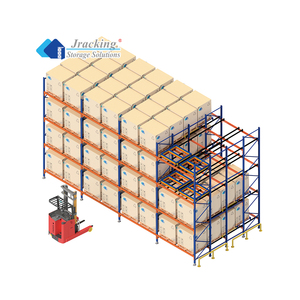
Jracking Push Back Racking Pallet Warehouse System
- Pallet Payload: 500 – 1,500 kg/Pallet
- Track Incline: 2.5% – 3.0% Slope
- Storage Mode: LIFO Dynamic Nested
- Material: Q235B / Q355B Steel
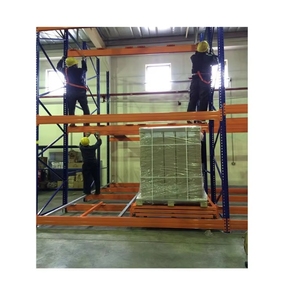
Heavy Duty Push Back Rack Metal Pallet Rack
- Beam Capacity: Up to 4,500 kg/Level
- Cart Material: Heavy Laser-Cut Plate
- Bearings: Double Shielded Sealed
- Finish: Epoxy Powder 70μm
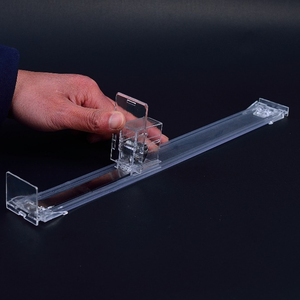
Display Drink Shelf Pusher for Supermarket
- Spring Tension: 2N – 12N Variable
- Divider Width: Adjustable 50-120mm
- Material: Virgin PS / Acrylic
- Service Life: ≥ 100,000 Cycles
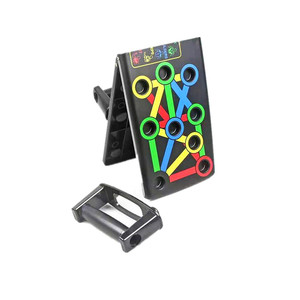
BEONE Foldable Power Push Rack System Board
- Body Material: High-Impact ABS Spec
- Max Static Load: 300 kg Structural
- Grip Ergonomics: Non-Slip Silicone Base
- Packaging: Retail Ready Carton
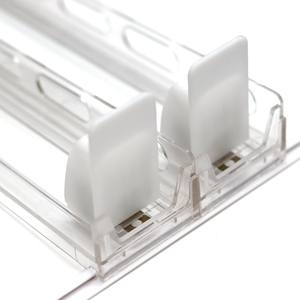
Modular Shelf Pusher Track System for Retail
- Track Length: 250 – 500mm Modular
- Spring Coil: SUS301 Stainless Steel
- Front Stop: Clear Polycarbonate
- Mounting: T-Rail Magnetic / Clip
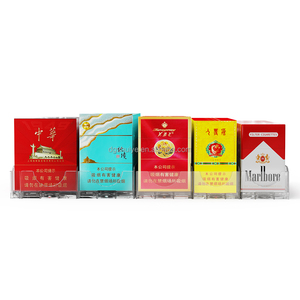
Spring Loaded Precision Pusher Display Track
- Force Rating: 3N – 6N Calibrated
- Lane Width: Standard 65mm Fixed
- Substrate: UV-Stabilized Polymer
- Application: Carton / Pack Facing
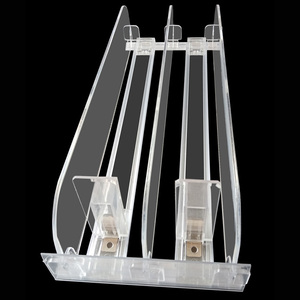
Adjustable Double-Sided Spring Pusher Rack
- Compliance: CE & RoHS Certified
- Divider Rail: Extruded Aluminum Base
- Adjustment: Toolless Sliding Track
- Durability: Impact Modified POM
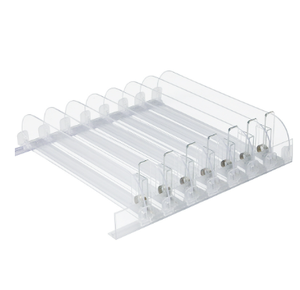
Automatic Beverage Can Spring Pusher Tray
- Target SKU: 250ml – 500ml Can / Bottle
- Roller Assist: Gravity Track Low Drag
- Eco Footprint: 100% Recyclable Poly
- Loading Mode: Front Replenishment
Engineering Principles of Industrial Push Rack Systems
A push-back rack storage system operates on an inclined dynamic rail track supporting nested rolling steel carts. By eliminating unnecessary forklift access aisles, warehouse managers achieve up to 75% higher volumetric storage efficiency compared to standard selective pallet racks.
Gravitational Incline & Cart Kinematics
Push-back pallet lanes are manufactured with an engineered gradient typically calibrated between 2.5% and 3.0% (approx. 1.5° to 1.8° slope). This specific angle guarantees that gravity smoothly propels nested carts forward toward the pick face without generating excessive velocity that could lead to pallet dislodgement or shock-load stress on front structural stops.
Nested Cart Telescopic Architecture
Unlike drive-in racking where forklifts must physically drive into deep bays—risking frame collisions—push-back systems employ multi-tiered nested carriages fabricated from high-tensile Q235B cold-formed structural channels. The first pallet is positioned directly onto the top cart; the second pallet pushes that cart backward to expose the underlying cart, supporting up to 6 pallets deep.
LIFO Inventory Dynamics & Forklift Protection
Push-back systems operate on a Last-In, First-Out (LIFO) material handling principle. Because material handling equipment operates strictly within the perimeter aisle, structural uprights and internal diagonal bracing are shielded from forklift mast impacts. Warehouse throughput velocity increases by 35% compared to drive-in configurations, reducing truck operational hours and operator fatigue.
| Storage System Type | Space Utilization | Selectivity | Forklift Rack Intrusion | Standard Depth | Landed System Cost Index |
|---|---|---|---|---|---|
| Nested Cart Push-Back Rack | High (70-75%) | Medium (1 SKU per Lane) | None (Operates in Aisle Only) | 2 – 6 Pallets Deep | Moderate – High ROI |
| Selective Pallet Racking | Low (40-45%) | 100% Direct Access | None (Direct Beam Access) | 1 Pallet Deep (Single) | Baseline Economy |
| Drive-In Racking System | Very High (75-80%) | Low (1 SKU per Tunnel) | High (Forklift Enters Rack) | 5 – 12 Pallets Deep | Low – High Maintenance |
| Gravity Pallet Flow (FIFO) | Maximum (80-85%) | Medium (Strict FIFO) | None (Dedicated Pick Face) | 4 – 20 Pallets Deep | Premium (Full Roller Bed) |
| Spring-Loaded Shelf Pusher | Optimal (Retail Facings) | 100% Facings Visible | Manual Merchandising | 250 – 600 mm Shelf | Ultra-Low CapEx per SKU |
Future Procurement Trends in Push Rack Systems (2025–2030)
Enterprise procurement directors and supply chain engineers face shifting global dynamics. Here is how modern storage engineering is evolving to meet cold chain expansion, automation interfaces, and decarbonized material standards.
1. Cryogenic Resilience in Cold Chain Expansion
With global cold chain logistics expanding at 14.8% CAGR, push-back racking is rapidly replacing selective racking in refrigerated (-18°C to -25°C) facilities. Because refrigerated air volume is exceptionally expensive to maintain, condensing pallets into 4-deep push lanes slashes thermal loss. Modern specifications demand low-temperature synthetic lubricants inside cart wheel bearings and ductile structural steel with proven Charpy V-notch impact toughness at -30°C.
2. Autonomous Mobile Robot (AMR) & AGV Integration
Traditional push-back racking relied entirely on manual counterbalanced or reach forklifts pushing against nested carts. By 2027, over 38% of Tier-1 distribution centers will interface push racks with Automated Guided Vehicles (AGVs). This shift necessitates tighter engineering tolerances on track front-stop alignment, integrated optical target reflectors, and specialized laser-aligned entrance funnels to prevent robot mast torque fault trips.
3. High-Strength Steel & Down-Gauging Sustainability
Corporate ESG procurement mandates are forcing warehouse racking manufacturers to minimize embodied carbon. By transitioning from conventional Q235B steel to micro-alloyed ultra-high-yield Q355B and Q460 cold-rolled coils, Chinese suppliers reduce overall structural steel tonnage by 18% to 22% while maintaining identical structural moment capacity and seismic shear resistance according to EN 15512 and FEM 10.2.02 codes.
Push Rack Fabrication: State-of-the-Art Production Technology
The operational longevity of a heavy dynamic rack system hinges on microscopic precision at every stage of fabrication. A 2mm deviation across an inclined beam run will cause cart skewing, roller jamming, and hazardous hang-ups. Here is how advanced Chinese manufacturers solve this challenge.
Continuous CNC Roll-Forming & Laser Notch Punching
Modern upright frames are produced on automated continuous 24-station cold roll-forming lines. High-speed hydraulic or laser punch presses stamp beam connection teardrop or diamond slot patterns with a pitch accuracy of ±0.1mm along the entire 12-meter profile length. This extreme structural regularity guarantees that cross-beams lock in at absolute 90-degree right angles, eliminating any parasitic track twist when supporting multi-ton inclined carts.
Similarly, retail spring pusher profiles utilize co-extruded polymers combining high-rigidity PVC bases with ultra-smooth low-friction POM guide channels to ensure continuous product forward-facing without binding.
Automated Pre-Treatment: Pickling, Phosphating & Nanotech Coating
Corrosion resistance is dictated by surface preparation. Before electrostatic powder application, raw steel components undergo a computerized 9-stage chemical immersion sequence including hot alkaline degreasing, acid pickling, multi-rinse deionization, and micro-crystalline zinc phosphating. This forms an insoluble metallic barrier that bonds the steel substrate to thermosetting polyester epoxy powder.
Cured at 190°C to 210°C, the resulting 70–90 micron coating achieves a 2H pencil hardness rating, 500-hour ASTM B117 salt spray endurance, and zero cross-hatch adhesion flaking under ASTM D3359 testing protocols.
Push Rack System Procurement & Technical Specifications FAQ
Direct engineering answers addressing critical questions on pallet sizes, load capacity calculations, seismic considerations, and international import logistics.
1. What are the maximum safe pallet weight limits and lane depths for nested push-back systems?
Standard industrial push-back pallet racks are designed to accommodate between 2 and 6 pallets deep per lane, with individual pallet payloads ranging from 500 kg (1,100 lbs) up to 1,500 kg (3,300 lbs). While 2-deep and 3-deep configurations represent the industry baseline, 5-deep and 6-deep configurations require reinforced heavy-gauge structural channel steel frames (Q355B) and high-load dual-flange wheel bearings.
For payloads exceeding 1,500 kg or lane depths beyond 6 pallets, our engineering team typically recommends transitioning to an automated Radio Shuttle Racking System or Pallet Flow Gravity Racking (FIFO), as the push-back resistance force exerted on standard forklift masts becomes excessive for ordinary warehouse operations.
2. How does the cart slope gradient prevent runaway pallet acceleration or lane hang-ups?
The standard incline angle for nested push-back carts is strictly calibrated between 2.5% and 3.0% (approximately 1.4° to 1.7°). This gradient is mathematically derived from the rolling resistance coefficient of our sealed steel ball bearings (μ ≈ 0.012 - 0.018) balanced against the gravitational forward component ($F = mg \sin\theta$).
If the incline is shallower than 2.0%, pallets risk "hanging up" due to dust accumulation, cold warehouse friction, or uneven wooden runners. Conversely, if the slope exceeds 3.5%, the return velocity of rear pallets during unloading can create an impact force that hazards the forklift carriage and front stops. HEDA integrates positive mechanical stops, safety back-bumpers, and optional centrifugal braking rollers to prevent runaway velocity.
3. Can push-back rack systems safely handle damaged, weak, or varying pallet sizes (Euro vs US GMA)?
Yes. One of the greatest engineering advantages of a nested cart push-back rack over drive-in or roller-flow racking is its tolerance for diverse pallet conditions. Because each pallet sits completely flat on its own independent welded steel nested cart, the bottom pallet deck boards and stringers are not subjected to rolling point-stresses or line-contact friction.
Weak pallets, warped runners, or standard disposable pallets that would jam a roller-track system operate flawlessly on steel nested carts. Furthermore, carts can be custom-engineered with internal welded support cross-members to handle both European standard pallets (800 × 1200 mm) and American GMA pallets (40 × 48 inches / 1000 × 1200 mm) interchangeably within the same bay.
4. What structural standards and quality certifications do Chinese manufacturers comply with for international projects?
Tier-1 Chinese manufacturers supply systems designed, finite-element modeled (FEA), and tested in rigorous accordance with international structural codes. Guangzhou Heda Shelves Co., Ltd. produces racking conforming to:
• EN 15512:2020: European Standard for Steel static storage systems - Adjustable pallet racking systems - Principles for structural design.
• RMI (Rack Manufacturers Institute) MH16.1: Specification for the Design, Testing and Utilization of Industrial Steel Storage Racks (North American Standard).
• AS 4084-2012: Australian Steel Storage Racking Standard.
• CE Certification: Structural factory production control certified under EN 1090-1 / CPR (No. 2435-CPR-8605159).
• ISO 9001:2015: Quality Management Certification (No. 18624Q00169R0M) ensuring end-to-end traceability from raw steel mill certificates to final powder cure inspection.
5. How are push rack components packaged to maximize container volume and protect finishes during sea transit?
Push-back racking components are pre-engineered with a knock-down, boltless architecture specifically designed for 20GP and 40HQ maritime container loading. Upright frames are packaged horizontally with protective high-density EVA foam spacers and corrugated edge protectors between layers, bundled securely with heavy-duty polyester strapping.
Nested carts, dynamic track rails, and beam members are stacked using custom steel pallets or dedicated skids that allow rapid forklift offloading at destination ports (such as Lagos, Mombasa, Durban, Rotterdam, or Los Angeles). By optimizing nesting density, our shipping logistics team achieves up to 26 metric tons per 40HQ container, lowering the freight cost per pallet position to an industry-leading baseline.
6. How does a retail spring-loaded pusher system increase sales conversion and decrease labor overhead?
In retail convenience and supermarket environments, shelf pushers solve the "out-of-sight, out-of-mind" shopper dilemma. By utilizing SUS301 constant-force coiled springs, the pusher automatically drives remaining merchandise forward to the front acrylic stop whenever a front item is removed. This guarantees that product facings are always 100% visible, neat, and accessible.
Commercial retail case studies demonstrate a 12% to 18% lift in impulse category sales (beverages, tobacco, cosmetics, packaged FMCG) combined with a 40% reduction in manual labor hours required for manual shelf facing and fronting by store clerks.
Why Global Buyers Partner with Guangzhou Heda Shelves Co., Ltd.
Manufacturing excellence honed over two decades. Operating our own modern 30,000 square meter production complex in Guangzhou, China, we deliver turnkey warehouse and retail display solutions to over 120 nations worldwide.
25 Years of Engineering Heritage
Founded in 2001, HEDA Shelves has completed over 10,000 warehouse racking installations worldwide. Our senior structural engineers bring deep domain expertise to complex layouts, seismic calculations, and specialized storage environments.
30,000 Tons Monthly Output
Equipped with 24 automated continuous roll-forming lines, OTC robotic welding stations, and specialized electrostatic powder coating lines, our 30,000 m² factory guarantees reliable lead times even for massive 50+ container turnkey industrial contracts.
Full International Certification
Fully compliant with European CE standards (CE Cert No. 2435-CPR-8605159), ISO 9001:2015 Quality Management (No. 18624Q00169R0M), and RoHS compliance. Every batch undergoes strict raw steel metallurgical and ultrasonic weld inspection.
Free 24-Hour 3D CAD Design
Provide our engineers with your warehouse dimensions, clear ceiling height, pallet specifications, and forklift models. We deliver a complete CAD structural layout, load capacity calculation, and photorealistic 3D visualization within 24 hours at zero cost.
Request Your Custom Push Rack System Layout & Factory Quotation
Connect directly with our senior racking applications engineers. Whether planning a 5,000-pallet push-back distribution center or sourcing 50,000 spring-loaded supermarket display tracks, HEDA provides factory-direct wholesale pricing, structural load validation, and container-optimized sea freight coordination.