Industrial-Scale Wholesale Racking Systems Built for High-Density Storage
As global supply chains navigate volatile inventory surges, nearshoring mandates, and escalating cubic-meter land costs, selecting the optimal industrial rack architecture defines operational profitability. Sourced directly from our Tier-1 production facilities in Guangzhou, our heavy-duty storage configurations deliver certified safety margins under ISO 9001:2015, CE (EN 15512), and ANSI MH16.1 specifications.
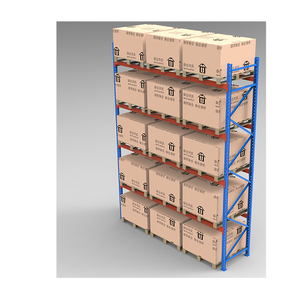
Heavy Duty Adjustable Metal Shelves Warehouse Pallet Racking
- Profile: SS400 / Q235B Cold Rolled
- Pitch Step: 50mm / 75mm Adjustable
- Selectivity: 100% Direct SKU Access
- Surface: Epoxy Polyester Powder Coat
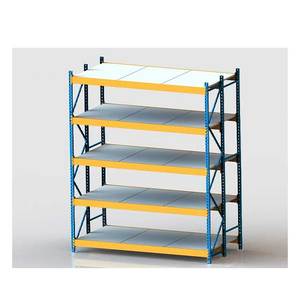
Industrial Longspan Boltless Medium Duty Steel Shelving System
- Decking: Steel / Plywood / Wire Mesh
- Assembly: Interlocking Boltless Lugs
- Application: E-Commerce, Spare Parts
- Config: Starter & Add-on Modules
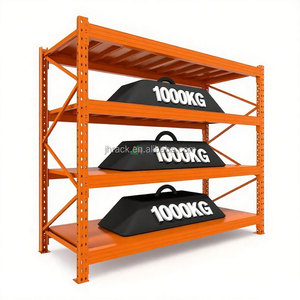
4-Tier 1000kg/Tier Industrial Pallet Rack Stacking Frame Units
- Upright Section: 80x60 / 90x70 / 100x70mm
- Beam Type: Box Beam & P-Step Beam
- Safety Factor: 1.5 Safety Design Limit
- Coating: Anti-Corrosive Phosphating
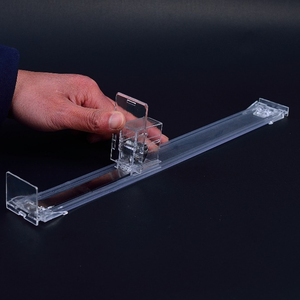
Supermarket Drink Display Shelf System With Auto-Pusher Track
- Pusher Tension: 3N / 6N / 9N Spring Force
- Track Material: Polycarbonate & Acrylic
- Feature: Automated FIFO Stock Facing
- Compatibility: Universal Gondola Mount
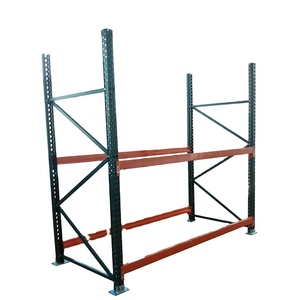
US Teardrop Standard Heavy Duty Industrial Pallet Racking
- Punching Hole: Standard 2-Inch Increments
- Lock Pin: Auto-Engage Spring Locking
- Compliance: RMI ANSI MH16.1 Standard
- Finishing: High-Durability Powder Baked
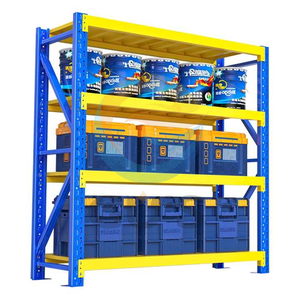
Industrial Storage Racks Medium Duty 500kg Tier Warehouse System
- Frame Thickness: 1.5mm - 2.0mm Q235B
- Decking Type: Rib-Reinforced Cold Sheet
- Adjustment: 50mm Modular Pitch
- Protection: Galvanized Baseplates
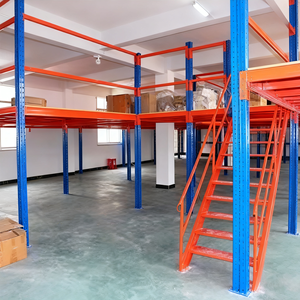
Multi-Layer Mezzanine Floor Platform Racking & Stairway Kits
- Floor Rating: 300 - 1,000 kg / m² Floor Area
- Deck Plate: Anti-Slip Galvanized / Grating
- Safety Guard: 1,100mm Handrails + Kickplate
- Expansion: Bolt-Together Modular Build
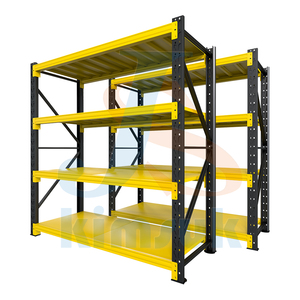
Boltless Adjustable 500kg/Layer Heavy Steel Industrial Shelving
- Upright Post: C-Channel Butterfly Punching
- Assembly Time: 10 Mins / Bay Toolless
- Surface Finish: Electrophoretic + Powder
- Flexibility: Tier Heights Changeable
| Rack Architecture | Space Utilization | SKU Selectivity | Typical Payload (Kg/Level) | Stock Rotation (FIFO/LIFO) | Floor Slab Deflection Requirement |
|---|---|---|---|---|---|
| Selective Pallet Racking | 40% – 50% Volumetric | 100% Direct Access | 1,000 – 4,500 kg | True FIFO Compatible | L/350 Class Industrial Concrete Slab |
| Double-Deep Pallet System | 55% – 65% High Density | 50% Immediate Access | 1,000 – 3,000 kg | LIFO (Batch Rotational) | Reinforced Flat Floor (Pantograph Reach) |
| Drive-In / Drive-Through | 70% – 80% Maximum Density | Low (Single Lane SKU) | 1,000 – 2,000 kg/Pallet | LIFO (Drive-In) / FIFO (Drive-Thru) | Strict Guide-Rail Alignment Anchor Spec |
| Radio Shuttle Automation | 80% – 85% Deep Lane | Channel Segmented | 500 – 1,500 kg/Pallet | Configurable FIFO or LIFO | Superflat DIN 18202 Class 3 Specification |
| Rack-Supported Mezzanine | 180% – 250% (Multiplies Floor) | 100% Manual Hand-Pick | 300 – 1,000 kg/m² Floor | Variable Batch Flow | Heavy Point Load Footing Calculations |
Strategic Warehouse Procurement Trends Shaping Factory Direct Sourcing
Procurement teams are transitioning from static price-per-ton evaluations to holistic Total Cost of Ownership (TCO) frameworks. Analyzing global logistics patterns reveals four dominant market trends driving B2B wholesale racking procurement through 2030.
Modular Reconfigurability for SKU Shifts
Modern distribution hubs face rapid SKU volatility due to omnichannel consumer preferences. Procurement departments are demanding standardized 50mm and 75mm beam adjustment profiles capable of transitioning seamlessly from conventional pallet storage to carton-flow picking without structural re-welding.
This dynamic reconfigurability protects capital expenditure by extending system life cycles beyond the typical 7-year warehouse leasing cycle.
Pre-Engineered Container Loading Optimization
Ocean freight rates remain a volatile determinant of landed cost. Chinese manufacturing partners capable of mathematical containerization—nesting cold-rolled upright frames, staging box beams inside pallet voids, and bunding step decks—save buyers between 18% and 34% per delivered cubic meter.
Knock-down structural packaging ensures maximum tonnage limits (26.5 MT in 40HQ containers) are met without transit bending or surface scuffing.
Structural Resilience & Seismic Certification
Insurance underwriting for mega-fulfillment centers now strictly enforces structural seismic performance compliance (FEM 10.2.02, RMI MH16.1, and AS 4084). Procurement directors require FEA (Finite Element Analysis) simulation reports, stamped anchor shear calculations, and mill cert traceability down to the raw steel heat number before tender release.
Technological Innovations in Industrial Storage Manufacturing
The convergence of material science and automated material handling systems (AMHS) has transformed traditional steel racking from static shelving into precision-engineered kinematic infrastructure.
AMR & Shuttle-Ready Kinematic Tolerances
Automated Guided Vehicles (AGVs) and Autonomous Mobile Robots (AMRs) impose deflection boundaries under 1/800th of beam length—substantially tighter than standard forklift tolerances. Our production line uses 24-station continuous roll-forming mills that maintain beam camber and sweep deviations below ±0.5mm across a 3.9-meter span, preventing shuttle track binding.
Advanced Chemical Pretreatment & Anti-Corrosion
For coastal warehouses, tropical facilities, and harsh cold-chain freezers down to -30°C, traditional paint fails rapidly. We utilize an automated 9-stage degreasing, pickling, and zirconium phosphating immersion bath prior to TGIC-free electrostatic powder deposition, resulting in over 1,000 hours of continuous salt-spray resistance (ASTM B117 standard).
High-Tensile Cold-Rolled Steels (Q355B & Gr50)
By engineering optimized omega-section columns using high-tensile Q355B (equivalent to ASTM A572 Grade 50) rather than commercial grade Q195, our structural frames achieve 28% higher buckling resistance with 12% lower steel tonnage, lowering ocean freight, floor point loading, and handling overhead.
Integrated Engineering, Manufacturing & Global Project Export
Founded in 2001, Guangzhou Heda Shelves Co., Ltd. operates an integrated 30,000 square meter intelligent manufacturing facility. From structural design calculation to end-to-end container loading, we eliminate intermediate trading markup while offering full technical accountability.
Free Professional 3D & CAD Layout Engineering
Our senior logistics civil engineers produce comprehensive AutoCAD floor plans, pallet aisle clearance verifications, 3D parametric renderings, and load calculation sheets within 24 hours of receiving site dimensions.
Verified ISO 9001:2015 & CE Certified Production
Certified under CE No. 2435-CPR-8605159 and ISO 9001:2015 Certification No. 18624Q00169R0M (valid through June 2027), every weld seam, column connector, and load safety pin complies with stringent international quality standards.
Export-Engineered Bundling & Rapid Port Delivery
Located near major ocean export hubs in Guangzhou, Nansha, and Shenzhen, we execute rigorous knock-down bundling with bubble film, corner guards, and steel strapping designed to withstand harsh maritime moisture and rough shipping handling.
Global Turnkey Installation & Remote Supervision
Every overseas consignment includes coded part numbering tags, 3D assembly exploded views, step-by-step video manuals, and optional on-site dispatch of certified installation supervisors for complex multi-tier mezzanine projects.
Frequently Asked Questions on Importing China Storage Rack Systems
In-depth technical answers addressing load verification, customs compliance, floor tolerances, and factory direct containerization.
How do we calculate and verify racking safe working loads (SWL)?
Safe Working Load is calculated using finite element structural modeling in accordance with EN 15512 or ANSI MH16.1 codes. Load testing evaluates vertical beam deflection under a 1.5 safety factor limit (maximum allowable deflection is length divided by 200). Upright frames are calculated against combined axial compression and bending stresses.
What warehouse floor slab criteria are needed for heavy-duty racks?
For standard selective racking reaching 6 to 8 meters, concrete slabs typically require a compressive strength of at least 25 to 30 MPa (C25/C30), with a minimum slab depth of 150–200mm. For Very Narrow Aisle (VNA) or automated shuttle racks exceeding 10 meters, floor flatness must meet DIN 18202 or ASTM E1155 F-min 75 standards.
How do you protect pallet racks against corrosion in tropical climates?
Steel parts undergo a 9-stage chemical pretreatment, including acid pickling to eliminate mill scale and phosphating to create an anti-corrosion barrier. Subsequently, electrostatic thermosetting epoxy-polyester powder is cured at 180°C–200°C. For extreme humidity or open-sided sheds, hot-dip galvanization to ISO 1461 (minimum 65-85 microns) is available.
Can you customize teardrop racking to match existing US warehouse systems?
Yes. Our US Teardrop racking uses standard 2-inch punch increments completely compatible with major North American profiles. Beams lock automatically via standard 3-pin or 4-pin end connectors featuring spring safety locking clips, allowing seamless expansion of pre-existing storage facilities.
What information is required to receive a free custom CAD layout?
To produce an engineered floor layout, our technical team requires: warehouse architectural drawings (length, width, clear height, columns, fire exits), palletized cargo dimensions (length × depth × height including cargo overhang), gross weight per pallet, forklift make/model with mast turning radius, and operational ambient temperature.
How are large mezzanine platforms shipped to avoid container damage?
Mezzanine primary and secondary H-beams, cold-formed C/Z purlins, and galvanized deck plates are packaged in custom steel crates and wooden skid supports sized precisely for 40-foot high-cube containers. Fasteners, baseplates, stairs, and handrails are individually boxed, labeled with CAD tags, and secured to prevent transit vibration damage.
Transform Your Warehouse Volumetric Efficiency Today
Connect directly with our senior application engineers. Receive an optimized 3D CAD design proposal, structural load calculation sheet, and factory-direct price quotation within 24 hours.