Engineered Warehouse Racking & Industrial Storage Solutions
Engineered to international FEM 10.2.02 and RMI MH16.1 specifications, each racking system is manufactured in our certified facility using premium Q235B and Q355B structural cold-rolled steel coils.
Push Back Pallet Racking Architecture & Mechanics
A rigorous engineering analysis of inclined nested carrier dynamics, multi-lane kinetic force dissipation, and high-cube footprint optimization.
Modern industrial warehousing operations are under continuous structural pressure to compress footprint expenditures while scaling throughput capacity. Among high-density dynamic storage topologies, Push Back Pallet Racking represents the apex of mechanical efficiency, operating under a Last-In, First-Out (LIFO) inventory methodology that requires zero electrical automation or energized conveyers.
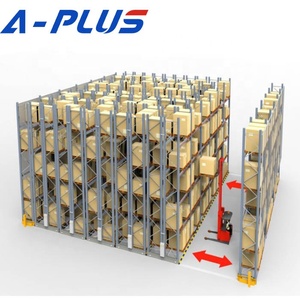
As an authoritative OEM/ODM manufacturer, Guangzhou Heda Shelves Co., Ltd. designs and fabricates push back pallet racking systems utilizing nested, rolling steel carts resting on inclined structural rail channels, typically pitched at an inclination gradient between 2.0% and 3.5%. The structural framework relies on heavy-duty cold-formed omega upright columns anchored directly into industrial concrete slabs via chemical or expansion torque anchors, interlocked with roll-formed box beams that resist dynamic torsional strain.
Kinematic Principles: Multi-Tiered Nested Carrier Carts
The operational logic of a push back racking bay eliminates the need for lift trucks to enter the storage aisle, setting it apart fundamentally from Drive-In racking. The sequence executes as follows:
1. Primary Loading Stage: The forklift operator positions the first pallet directly onto the uppermost nested carrier cart (Cart 1). The cart rides on flanged, high-tensile steel wheels outfitted with sealed industrial-grade precision ball bearings (e.g., 6204-2RS) engineered for minimal rolling friction coefficients.
2. Secondary Indexing Stage: When loading the second pallet, the forklift operator uses the face of Pallet 2 to make contact with Pallet 1. Under gentle forward hydraulic thrust, Pallet 1 (and Cart 1) rolls upward along the incline track, exposing Cart 2 situated immediately underneath. Pallet 2 is then lowered onto Cart 2.
3. Terminal Depth Capacity: This nested mechanical progression repeats for configurations ranging from 2-deep, 3-deep, 4-deep, 5-deep, to extreme 6-deep installations. In a 6-deep system, five telescoping nested carts glide sequentially along the structural track, with the final sixth pallet resting directly on the stationary structural entry rail.
4. Controlled Gravitational Retrieval: During product dispatch, the retrieval of the front pallet releases the gravitational potential energy of the upstream pallets. Gravity gently brings the subsequent cart forward at a controlled velocity of 0.2 to 0.3 m/s, presenting the next pallet cleanly at the aisle loading face without requiring secondary mechanical winches or electrical drive motors.
| Storage Topology | Aisle Space Utilization | Selectivity Profile | Forklift Cycle Efficiency | Structural Collision Risk | Grid Power Dependency |
|---|---|---|---|---|---|
| Push Back Pallet Racking | 70% – 78% (High Cube) | 100% per Lane (LIFO) | Superior (Aisle-Front Only) | Minimal (Exterior-Only) | 0% (100% Mechanical) |
| Selective Pallet Racking | 40% – 45% (Aisle-Heavy) | 100% per Pallet | Moderate (Deep Travel) | Moderate (Multiple Aisles) | 0% (Static) |
| Drive-In Pallet Racking | 75% – 82% (High Density) | Extremely Low (Bulk LIFO) | Poor (Mast Enters Bay) | Severe (High Impact Rate) | 0% (Static) |
| Radio Shuttle System | 80% – 88% (Ultra-High) | Lane LIFO / FIFO | High (Automated Shuttle) | Very Low (Shuttle Driven) | 100% (Lithium Batteries) |
| Pallet Flow (Gravity) | 72% – 80% (Continuous) | Strict FIFO Rotation | High (Separate Pick/Drop) | Low (Dedicated Aisles) | 0% (Dynamic Brake Rollers) |
Structural Metallurgy and Anti-Derailment Safety Mechanics
Engineering push back systems requires strict metallurgical and structural verification. All vertical upright frames and horizontal load-bearing rails manufactured by HEDA utilize certified Q235B and high-yield Q355B hot-rolled micro-alloyed carbon steel, offering yield strengths ranging up to 355 MPa and elongation ratings that absorb sustained seismic shocks.
A frequent failure mode in substandard push back installations is cart derailment caused by eccentric loading or forklift acceleration. To eliminate this operational hazard, our OEM engineering incorporates three proprietary safety mechanisms:
- Dual-Flanged Rail Wheel Assemblies: Carts are fitted with CNC-machined, induction-hardened flanged steel wheels that physically lock the wheel lip over the structural tubular rail guides, preventing lateral carriage shifting even when subjected to unevenly centered pallets.
- Integrated Anti-Lift Safety Hooks: Heavy-gauge welded safety hooks extend beneath the carrier frame and wrap under the rail flanges. In the event of a sudden deceleration or an operator striking the front pallet during high-speed extraction, the anti-lift brackets arrest vertical uplift forces instantly.
- Heavy-Duty End-of-Lane Energy Absorbers: Molded polyurethane or vulcanized rubber end stops mounted on reinforced structural beam connectors absorb kinetic momentum as the carts roll forward to rest, dampening structural resonance through the rack upright matrix.
Global Procurement Trends in High-Density Pallet Racking (2025–2030)
Market intelligence, supply chain re-architecting, and technological mandates shaping the next generation of industrial storage investments.
Supply Chain Decoupling & "Just-In-Case" Buffering
Global supply chain volatility has prompted multinational logistics providers and manufacturers to pivot from lean "Just-in-Time" paradigms toward resilient "Just-in-Case" inventory reserves. Push back systems enable operations to expand pallet volume by 45% to 65% within existing floor plans without incurring leasehold expansions or new land development capital expenditures.
Cold Chain Infrastructure Explosion
Refrigerated and sub-zero blast freezer warehousing (-25°C to -30°C) carries massive utility and air-refrigeration volume costs. Procurement managers are increasingly standardizing on 3-to-5 deep push back systems over selective racks to eliminate wasted cold air cubic volume, driving significant reductions in kilowatt-hour consumption per stored pallet position.
Total Cost of Ownership (TCO) Over Drive-In
Insurance claims and forklift fleet maintenance audits are driving procurement shifts away from traditional drive-in bays. In drive-in designs, lift truck operators routinely strike rack uprights while navigating narrow, multi-level tunnels. Push-back systems eliminate upright collision incidents by up to 78%, delivering rapid capital payback within 18 months.
Next-Generation Engineering Innovations in Dynamic Racking
Advanced metallurgical treatments, automated cold-forming tolerances, and precision anti-jam technologies developed by HEDA engineering.
Cryogenic Micro-Lubrication
For cold chain installations operating down to -30°C, ordinary bearing greases crystallize, leading to cart seizure. HEDA push back carts incorporate aerospace-grade synthetic fluorinated PTFE greases that preserve dynamic low-friction properties throughout millions of load cycles.
Electrostatic Zinc-Rich Primers
In humid coastal and chemical distribution environments, standard powder coatings can degrade over time. Our automated 10-stage pretreatment line utilizes zinc phosphate dipping followed by thermosetting hybrid polyester powders (60-80 microns) that pass 1,000-hour salt spray ASTM B117 testing.
FEA Seismic Engineering
Finite Element Analysis (FEA) computer simulations are conducted on all structural profiles to model natural harmonic resonance, second-order P-Delta moment effects, and structural baseplate yielding under maximum seismic accelerations according to AS 4084 and EN 15512 codes.
Anti-Binding Linked Carts
In deep 5-deep and 6-deep lanes, pallet misalignment can cause cart skewing. Our engineering team introduced patented articulated mechanical interlinks that guide neighboring nesting frames along an absolute parallel axis, preventing mechanical jamming during rapid push cycles.
Guangzhou Heda Shelves Co., Ltd. — Engineering Superiority
Combining heavy manufacturing capacity, rigorous QA certifications, and end-to-end OEM/ODM export solutions.
Established in 2001, Guangzhou Heda Shelves Co., Ltd. has grown into an international powerhouse in dynamic pallet storage and warehouse racking design. Operating from our expansive 30,000 m² advanced manufacturing facility in Guangzhou, China, our team delivers over 30,000 metric tons of custom-engineered steel storage systems per month to more than 120 countries across North America, Europe, Africa, Southeast Asia, and the Middle East.
End-to-End In-House Production
From initial cold steel slitting and continuous roll-forming to automated multi-head robotic welding, laser cutting, and our automated 10-stage electrostatic powder coating line, our production remains 100% under our roof. This integrated process ensures precise dimensional tolerances and structural integrity for every push back cart and frame assembly.
Certified Global Compliance
Our quality management operations conform strictly to international standards, holding valid CE Certification (No. 2435-CPR-8605159) and ISO 9001:2015 Certification (No. 18624Q00169R0M), alongside stringent RoHS hazardous material testing. Every shipment is accompanied by Mill Test Certificates (MTC) verifying raw material chemical compositions.
Bespoke OEM/ODM 3D Layouts
We do not supply off-the-shelf, one-size-fits-all products. Our senior structural engineers deliver customized 3D CAD blueprints, full warehouse layout simulations, dynamic slab load calculations, and container loading optimization schemes within 24 hours of receiving your building dimensions, clear roof heights, and pallet specifications.
Push Back Pallet Racking: Engineering & Procurement FAQ
Comprehensive answers to critical technical and logistical questions asked by global supply chain directors, facility engineers, and warehouse managers.
What are the maximum pallet depth limitations for a push back racking system?
How does push back racking compare to drive-in racking regarding warehouse throughput?
What forklift specifications are required to operate push back systems?
Can push back racking accommodate varying pallet sizes within the same lane?
How are push back racking shipments packed to optimize ocean freight containers?
What maintenance is required to maintain smooth cart operation over long operational cycles?
Can push back racking systems be integrated inside sub-zero blast freezers?
What engineering documentation and warranties are provided with each system?
Plan Your High-Density Storage Facility with Expert Engineers
Whether you require an OEM custom cart design, cold-chain zinc-galvanized push back systems, or complete turnkey warehouse layout modeling, our engineering team will produce your CAD drawings and detailed structural quotation within 24 hours.