Global Vendor Benchmark
Top 10 Gravity Flow Pallet Rack Manufacturers & Suppliers (2025–2030)
A comprehensive engineering review comparing structural steel grades, manufacturing scale, mechanical roller innovation, international certifications, and project engineering capabilities.
Factory Capacity: 30,000 m² / 30,000 Tons/Mo
Certifications: CE (2435-CPR), ISO 9001:2015
Max Lane Depth: Up to 25 Pallets Deep
Core Advantage: Knockdown Freight & CAD Turnaround
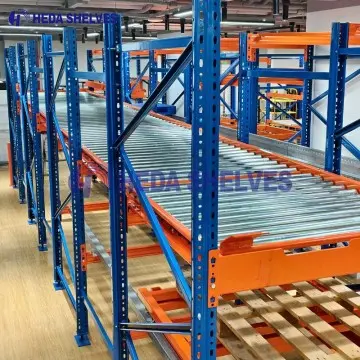
Guangzhou HEDA Shelves Co., Ltd. is an internationally certified racking powerhouse operating a fully integrated 30,000 m² manufacturing plant. Known for end-to-end metallurgical quality control, HEDA executes profile cold-roll forming, automated CNC punching, robotic welding, pickling, and phosphating pretreatment in-house. HEDA's gravity flow systems feature custom-engineered roller gradients, heavy-duty separator mechanisms, and corrosion-resistant electrostatic powder coatings. Highly recognized for container-optimized knock-down shipping that saves buyers up to 35% on ocean freight, backed by rapid 24-hour CAD layout and FEA structural load calculation services.
Best For: Custom High-Capacity Manufacturing & Export Turnkey Solutions
Core Product: Pallet Flow Roller Tracks
Safety Mechanism: Magnetic Speed Controllers
Temperature: -35°C to +40°C
Global Footprint: 32+ Global Subsidiaries
Interroll is the global reference manufacturer for dynamic flow components. While frequently acting as a tier-1 component supplier to global rack integrators, Interroll engineers proprietary speed controllers (such as the MSC 50 and MSC 80) that utilize wear-free eddy-current braking technology. Their deep-freeze rollers and time-tested mechanical time-delay separators represent the gold standard in high-throughput food distribution and deep-freeze logistics.
Best For: Precision Dynamic Rollers & Wear-Free Braking Components
Design Norms: EN 15512, RMI, FEM
Production Sites: 11 Worldwide Facilities
Integration: Easy WMS Compatible
Steel Class: High-Yield European S-Steel
Mecalux is one of the world's largest logistics racking suppliers, providing comprehensively engineered live storage systems. Mecalux pallet flow racks utilize split-roller tracks for three-skid pallets and incorporate dual-action retention stops at pickup faces. Their integration capability with proprietary Easy WMS software allows real-time FIFO stock rotation audits and automated order dispatch buffering in FMCG hubs.
Best For: European Automated Logistics & High-Volume Distribution
System Scope: Live Pallet & Carton Flow
Brake Design: Hydro-mechanical Controllers
Quality Std: DIN ISO 9001 / TÜV Rheinland
Payload: Up to 1,800 kg/pallet
German engineering giant SSI SCHAEFER designs heavy-duty pallet flow systems featuring heavy C-profile structural channel tracks and impact-absorbing entry shoes. Their systems are widely deployed in raw material buffer staging for breweries, automotive production lines, and high-velocity pharmaceutical shipping lanes, ensuring zero structural beam deflection under continuous dynamic load transfers.
Best For: Heavy Industrial Manufacturing & Production Buffers
Production: 9 Plants Across Europe & US
Product Series: Stow Pallet Live Storage
Safety Std: EN 15620 / EN 15629
Finish: Sendzimir Galvanized Rails
Stow Group specializes in optimized static and dynamic storage structures. Their gravity flow solutions incorporate roll-formed upright frames up to 30 meters high, integrating seamlessly with stacker cranes or conventional reach trucks. Stow's pallet live tracks utilize pre-galvanized roller beds, heavy steel side guides, and ergonomic foot-pedal release separators for pallet discharge.
Best For: High-Bay Dynamic Warehouses & High-Density 3PLs
Material: 100% Structural Steel (A36)
Standard: RMI Certified Structural
Impact Resist: Forklift Strike Immunity
Lane Depth: Up to 30 Pallets Deep
Frazier Industrial is North America's premier manufacturer of structural steel racking. In contrast to roll-formed uprights, Frazier fabricates pallet flow racking using hot-rolled C-channel structural steel. This guarantees unmatched durability against forklift column collisions, making Frazier the primary choice for heavy beverage consolidation centers, frozen food warehouses, and rugged grocery distribution centers.
Best For: Structural Channel Durability & Cold Store Harsh Use
System Brand: BITO PROflow Pallet
Specialty: Flow Lane Ergonomics
Roller Type: Self-lubricating Ball Bearings
Safety Feature: Integrated Anti-Slip Steps
BITO's PROflow system is celebrated for fine German mechanical tolerances and modular track construction. Their flow tracks feature innovative start-assist rollers that ease the breakaway inertia of stagnant wooden pallets. BITO provides comprehensive accessories including safety mesh screens, pick trays, and articulated end stops designed specifically for delicate FMCG packaging.
Best For: Order-Picking Ergonomics & Multi-Format Pallet Goods
Specialty: AS/RS to Dynamic Flow Buffers
Global Sales: #1 Material Handling Worldwide
Seismic Rating: Level 7 Peak Ground Motion
Automation: Dynamic Infeed Integration
As the world's largest automated material handling supplier, Daifuku frequently engineers gravity flow buffers directly into automated unit-load AS/RS delivery heads. Their gravity systems are designed to extreme seismic specifications, featuring advanced Japanese roll-formed bracing and precision balance dampening for high-density automotive assembly plants.
Best For: Integrated Factory Automation & Seismic Buffer Zones
Parent Firm: voestalpine Group
Steel Purity: Ultra High-Tensile Cold Form
Structural Testing: Proprietary Test Lab
Custom Finish: Multi-Color System Visuals
Nedcon, a voestalpine company, stands at the cutting edge of structural racking engineering in Europe. Leveraging voestalpine's premium cold-rolled steel coils, Nedcon fabricates pallet flow racking characterized by slender profiles, extreme load tolerances, and micro-adjustable beam connections that guarantee precision pitch control over 20-pallet lane spans.
Best For: Complex Structural Engineering & Extreme Frame Heights
Customization: 100% Tailored Flow Lanes
System Options: Skate Wheel & Full Roller
Audit Program: Apex Certified Rack Audits
Delivery: Rapid US Domestic Dispatch
Apex Warehouse Systems delivers integrated dynamic storage architectures across the Americas. Apex engineers custom-configured gravity flow lines using staggered poly skate wheels, split steel rollers, or heavy-duty full-width rollers depending on pallet bottom runners. Their project engineering emphasizes quick field assembly and compatibility with high-speed automated carton-handling mezzanines.
Best For: Flexible North American 3PL Configurations
Contactless Magnetic Eddy-Current Braking
Mechanical centrifugal brake rollers rely on internal friction shoes that experience thermal wear in high-throughput operations. The next decade will see complete migration toward magnetic eddy-current controllers that produce braking resistance proportional to speed with zero physical contact, completely eliminating roller maintenance over 15-year lifecycles.
IoT Pallet Stagnation & Telemetry Sensors
Warped pallets and broken baseboards can occasionally hang up mid-lane. Smart flow tracks now integrate self-powered piezoelectric vibration sensors and low-power optical trip switches along the lane beds, transmitting real-time stall warnings directly to WMS control panels before pick faces experience stockout.
Cold Chain Decarbonization & Eco-Coatings
With cold storage facilities facing intense energy costs, gravity flow racks eliminate the high cubic kilowatt waste of forklift access aisles. Future systems combine thin-wall ultra-high-strength steel profiles with non-toxic, anti-microbial powder coatings that prevent icing condensation and resist harsh ozone cleaning agents.
Expert Technical Reference
Frequently Asked Questions: Pallet Flow Procurement & Engineering
Answers to critical questions surrounding track inclination, pallet compatibility, speed braking, maintenance cycles, and system retrofits.
Q What is the optimal slope angle for gravity flow pallet racking?
The standard slope for pallet live storage is between 3.0% and 4.0% (equivalent to roughly 1.7° to 2.3° decline, or 35 to 40 mm drop per linear meter). Lighter loads (300–600 kg) or plastic pallets with slight friction coefficients utilize a 3.8%–4.0% incline, whereas heavy industrial pallets (1,000–1,500 kg) run safely at 3.0%–3.3% to avoid excessive acceleration.
Q How does the automatic pallet separator prevent back-pressure?
In deep lanes (e.g., 10 to 20 pallets deep), cumulative backpressure from trailing pallets can exceed 10,000 N, making extraction dangerous or impossible for forklifts. An automatic separator (or ramp release) holds the second and trailing pallets 300 mm behind the lead pallet. Only when the forklift extracts the front pallet does the mechanical trip release the trailing queue.
Q Can gravity pallet flow racks accommodate poor-quality or damaged wooden pallets?
Gravity flow requires pallets with sound bottom runner boards aligned parallel to the flow direction. Broken, missing, or protruding bottom nails can catch in roller beds. For operations using mixed or non-standard wooden pallets, full-width steel rollers (rather than twin tracks) combined with 3-roller continuous contact spacing must be specified to bridge gaps.
Q How do centrifugal speed brake rollers function without external electricity?
Brake rollers contain internal planetary gearing attached to spring-loaded friction shoes. As a pallet rolls over the brake roller, the roller's outer sleeve rotates, engaging centrifugal forces that push the internal shoes against the stationary housing. Higher pallet velocity generates proportionally greater resistance, capping speed at approximately 0.25–0.30 m/s without electrical power.
Q What maintenance schedule is required for a heavy-duty pallet flow system?
Because gravity flow is completely mechanical, maintenance overhead is minimal. Recommended intervals include: monthly visual inspections of entrance funnels and exit stops; quarterly checks on separator trip linkages and spring tension; and biannual verification of brake roller free-spin and roller bearing integrity.
Q What are the advantages of gravity flow versus Drive-In and Push-Back racking?
While Drive-In racking offers high density, it enforces LIFO (Last-In, First-Out) rotation and causes frequent rack upright collision damage as forklifts must enter the structure. Push-Back racking is limited to 2–6 pallets deep and remains strictly LIFO. Gravity flow provides true FIFO (First-In, First-Out) rotation, separates loading and picking traffic into dedicated aisles, and supports deep lanes up to 25+ pallets.