High-Density Gravity & Dynamic Pallet Racking Systems
Explore factory-direct industrial racking systems engineered with structural Q235B/Q355B steel, customizable bed depths, and precision gradient mechanics for seamless FIFO and LIFO material handling.
Structural Engineering & Kinetic Physics of Gravity Pallet Flow Systems
Why leading global supply chains source gravity racking systems from Tier-1 Chinese manufacturers: understanding structural beam deflection, brake roller kinematics, and zero-energy intralogistics.
Kinetic Gradient & Incline Physics
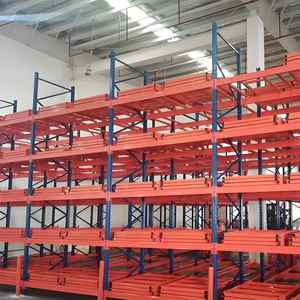
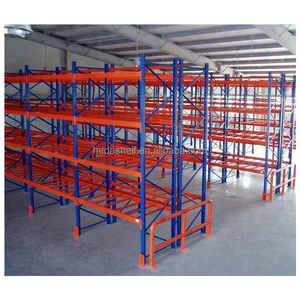
Gravity flow racking (often referred to as pallet live storage) relies entirely on natural gravitational energy. Racks are engineered with an accurate 3.0% to 3.5% incline slope. Pallets are loaded from the upper charge face and glide smoothly down toward the lower discharge face via heavy-duty cylindrical rollers, creating an autonomous First-In, First-Out (FIFO) material buffer without requiring ongoing electrical power.
Centrifugal Speed Controllers
Uncontrolled kinetic acceleration risks devastating warehouse safety hazards. China’s premier factories equip gravity flow lanes with internal centrifugal speed-brake rollers spaced every 1.2 to 1.5 meters. As pallet speed exceeds 0.25 m/s, internal counterweights generate friction damping against the roller casing, constraining descent speeds to a consistent, safe terminal velocity of 0.15–0.30 m/s regardless of pallet weight (200kg to 1,500kg).
Pallet Separation Mechanisms
At the retrieval face, accumulated dynamic line pressure from 10 to 20 backing pallets would otherwise pin the front pallet against the forklift tines. Precision mechanical time-delay separators decouple the lead pallet from upstream line pressure, allowing safe extraction. Only after the forklift extracts the leading pallet does the mechanical trip-latch release the queued pallets to advance one position forward.
| Storage Architecture | Pallet Density Ratio | Stock Rotation Logic | Energy Dependency | Throughput Velocity | Forklift Aisle Demand |
|---|---|---|---|---|---|
| Gravity Pallet Flow Rack | Ultra-High (85% Cube) | Strict FIFO | Zero (Pure Gravity Mechanics) | Continuous Auto-Replenishment | 2 Dedicated Aisles (Load / Unload) |
| Drive-In Pallet Racking | High (70% Cube) | Strict LIFO | Zero | Low (Forklift Entry Delays) | 1 Operating Maneuver Aisle |
| Push Back Racking (Carts) | Medium-High (65%) | LIFO (2–6 Deep) | Zero (Counter-Gravity Push) | Moderate (Front Access Only) | 1 Front Access Aisle |
| Radio Shuttle Automation | Maximum (90% Cube) | Configurable FIFO/LIFO | High (Rechargeable Batteries) | Fast Automated Shuttling | 1–2 Servicing Aisles |
| Selective Pallet Racking | Standard (40% Cube) | 100% Direct Access | Zero | Single Pallet Accessibility | High (Aisles Between Every Row) |
Future Procurement Trends in Gravity Storage (2025–2030)
How automation integration, cold storage demands, and carbon-neutral warehouse mandates are reshaping commercial procurement criteria for gravity racking systems worldwide.
Autonomous Mobile Robot (AMR) Infeed Integration
Modern warehouse logistics increasingly interface gravity flow systems with driverless counterbalanced AGVs and AMRs. Future procurement designs focus on specialized funneled lead-in guide plates and electro-pneumatic stop gates. By coupling passive gravity flow buffering with robotic infeed, distribution centers eliminate reach truck aisle congestion while maintaining continuous automated staging.
Zero-Energy Cold Chain & Cryogenic Coatings
Refrigerated warehouse energy costs in pharmaceutical and fresh meat distribution centers make active automation expensive to maintain at -30°C. Gravity racking provides ultra-high volumetric density without consuming electrical power or requiring battery maintenance in freezing conditions. Procurement trends prioritize pre-galvanized or hot-dip galvanized (HDG) steel components that prevent zinc flaking and condensation embrittlement.
Modular Roller Bed Upgrades & Universal Pallet Compatibility
Global procurement teams are moving away from proprietary single-pallet track configurations. Next-generation systems feature split full-width steel roller tracks and high-impact polymer skate-wheel assemblies capable of conveying wood, metal, slip-sheets, and plastic pallets within the same lane, protected by quick-release brackets that cut replacement labor by 70%.
Engineered by Guangzhou Heda Shelves Co., Ltd.
Operating a 30,000 square meter integrated manufacturing facility in Guangzhou, China, HEDA Shelves has engineered and exported heavy-duty industrial storage systems since 2001. We maintain comprehensive control from cold-rolled steel slitting to final packaging.
-
Certified Steel Standard: High-yield Q235B and Q355B cold-formed structural steel sourced directly from premier domestic mills, providing deflection limits exceeding FEM 10.2.02 and EN 15512 safety codes.
-
Advanced Pretreatment Line: Automated 9-stage acid pickling and phosphating process prior to thermosetting epoxy-polyester electrostatic powder coating (60–80 μm thickness) ensures long-lasting anti-corrosion protection in high-humidity climates.
-
Container Loading Engineering: Knock-down modular components are bundled and palletized to maximize 20GP/40HQ container volumetric efficiency, lowering ocean freight cost per pallet position to destination ports across Africa, Southeast Asia, the Middle East, Europe, and the Americas.
Free 3D & CAD Layout
Custom structural calculations, warehouse architectural drawings, and simulation models provided before order placement.
Precision Roll Forming
Continuous CNC roll-forming lines guarantee upright pitch tolerance within ±0.5mm across 12-meter continuous vertical sections.
Brake Roller Testing
Every dynamic flow component undergoes 100% mechanical torque resistance and centrifugal braking calibration prior to packaging.
Global Logistics Support
Numbered modular assembly guides, video construction support, and optional on-site engineering supervision for overseas projects.
Frequently Asked Questions on Gravity Racking Procurement
Technical guidance for warehouse managers, supply chain directors, and procurement specialists specifying gravity flow systems from Chinese manufacturers.
The gradient typically ranges between 3.0% and 3.8% (approximately 35mm to 45mm of vertical drop per linear meter of lane depth). The exact gradient is calculated based on pallet bottom runner construction (wooden Euro pallet, GMA standard, plastic perimeter base, or steel runners), total dynamic payload (ranging from 300kg to 1500kg), roller diameter, and expected ambient operating temperature.
Pallet hang-ups usually occur when low-quality wooden runners sag between rollers over extended static storage. HEDA Shelves prevents this by optimizing roller center distances (typically 75mm, 100mm, or 125mm based on pallet length) and placing triple-roller clusters at pick/charge entry zones. Additionally, manual foot-pedal lane activators or incline starter assists can be installed to clear static inertia without fork truck impact.
In a 10-deep lane loaded with 1,000kg pallets, back-pressure forces acting on the first pallet can exceed 400kg. This line pressure binds the lead pallet against discharge stops, causing safety hazards during fork lift retrieval. Mechanical separation mechanisms lock queued pallets 300mm behind the lead pallet, allowing safe, unhindered fork extraction before releasing the next pallet.
Yes. Gravity flow is one of the most reliable cold-chain storage architectures because it has no electrical motors, sensors, or batteries vulnerable to sub-zero failure. For freezing environments, roller bearings are packed with synthetic low-viscosity food-grade cryogenic lubricants, and structural steel components receive hot-dip galvanization or high-adhesion outdoor polyester powder coating to resist frost condensation.
While Automated Storage and Retrieval Systems (AS/RS) provide high vertical density, their initial capital expenditure (CapEx) can exceed $1,200 to $2,500 per pallet location, requiring ongoing maintenance contracts and clean, uninterrupted electricity. Gravity flow racking delivers up to 85% volumetric warehouse utilization at an initial cost of $180 to $350 per position, with near-zero ongoing operational maintenance and zero electrical power draw.
To deliver an accurate load calculation and CAD/3D proposal within 24 hours, our engineering team requires: (1) Warehouse architectural drawings showing clear ceiling height, column grids, and doors; (2) Pallet dimensions (W x D x H) including overhang and weight ranges; (3) Pallet bottom design (skids vs perimeter runners); (4) Operating forklifts model and maximum mast reach; (5) Daily pallet throughput and SKU turn rates.
Request a Custom Gravity Racking Engineering Layout
Connect directly with HEDA Shelves structural engineers. Get an optimized CAD blueprint, finite element load analysis, and container-optimized CIF/FOB pricing tailored to your warehouse footprint within 24 business hours.