Heavy-Duty & Tall Warehouse Pallet Storage Systems
Engineered to optimize cubic footprint, maximize vertical capacity up to 30 meters, and deliver superior torsional rigidity under extreme seismic and dynamic operating conditions.
Tall Pallet Racking Structural Dynamics & Global Procurement Blueprint
A rigorous engineering manual on high-bay pallet racking design, Very Narrow Aisle (VNA) tolerances, dynamic seismic compliance, and supply chain lifecycle cost optimization.
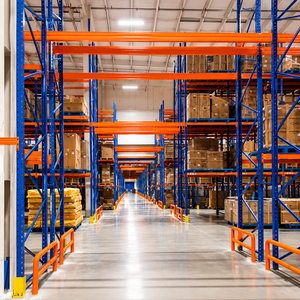
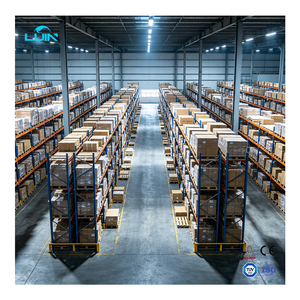
Industrial warehousing across North America, Europe, the Middle East, Southeast Asia, and Africa has entered an unprecedented vertical phase. Escalating land values and rapid SKU proliferation have transformed ceiling clearance into the primary metric of supply chain competitiveness. Standard low-bay configurations (under 6 meters) squander up to 60% of an industrial facility's cubic volume. Modern logistics mandates tall pallet racking architectures extending from 10 meters to upwards of 30 meters in automated rack-supported buildings.
However, moving into the high-bay envelope introduces severe structural dynamics. As rack height scales past 8 meters, the structural behavior of cold-formed thin-walled steel profiles shifts from basic compressive loading to complex second-order geometric non-linearities (P-Delta effects), localized column buckling, and torsional flexure. Procurement officers, lead logistics architects, and structural consultants must navigate international regulatory frameworks—principally EN 15512:2020 (European Standard for Steel Static Storage Systems), ANSI MH16.1 (RMI Specifications), and AS 4084-2023 (Australian Standard). Selecting a top-tier Chinese tall pallet racking manufacturer requires deep verification of metallurgy, cold roll-forming tolerances, structural semi-rigidity calculations, and surface passivation coatings.
1. Structural Anatomy & Metallurgical Engineering of High-Bay Racking
The performance integrity of high-bay and tall pallet racking rests on three interrelated components: the upright frame cross-section, the beam-to-column locking connector, and floor anchorage mechanics.
1.1. High-Tensile Cold Roll-Formed Upright Profiles
Unlike conventional structural I-beams, warehouse racking utilizes light-gauge cold-formed steel. High-bay uprights manufactured by Guangzhou Heda Shelves Co., Ltd. utilize certified prime hot-rolled strip steel, predominantly Q235B and Q355B (equivalent to ASTM A572 Grade 50 / S355JR). For systems exceeding 12 meters, Q355B with yield strengths exceeding 355 MPa is universally specified to resist extreme buckling stresses without excessively thickening the wall section, which would otherwise drive shipping freight and dead load upwards.
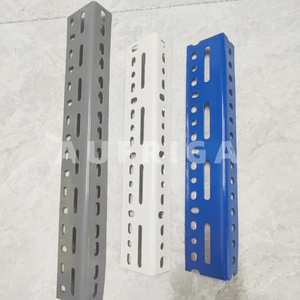
The geometric engineering of the profile is critical. Our proprietary upright geometry features an advanced Omega (Ω) or multi-fluted profile with up to 12 distinct longitudinal bends. Each cold-formed bend acts as a stiffening rib, dramatically shifting the profile’s shear center and significantly increasing its cross-sectional torsional and warping resistance. Punched teardrop or diamond perforations (50mm or 75mm pitch) are cold-stamped using continuous CNC servo dies to eliminate micro-cracking and notch-sensitivity embrittlement.
1.2. Boxed & Step Beam Dynamic Interlocking Systems
Horizontal load support relies on twin-C interlocking box beams. Fabricated by roll-forming two opposing C-channels and welding them together via automated robotic seam welders, the closed box geometry provides exceptional bi-axial bending and torsional stiffness.
Crucially, beam-to-column connections are governed by moment connection semi-rigidity (rotational stiffness, Cd). Heda integrates heavy-gauge 4-claw and 5-claw cast-steel or stamped connector brackets that grip the upright with zero play. Spring-steel interlocking safety locks prevent beam dislodgement under upward impact forces exceeding 5 kN, exceeding EN 15512 safety protocols.
2. Comprehensive Engineering Architecture Matrix
To guide system selection based on facility footprint, SKU selectivity, and capital expenditure (CAPEX), the following matrix benchmarks the primary tall racking configurations manufactured for export:
| Racking Topology | Standard Height Limits | Aisle Width (AST) | Floor Space Utilization | Pallet Selectivity | MHE / Automation Requirement |
|---|---|---|---|---|---|
| Selective Tall Pallet Rack | Up to 12.0 Meters | 3,200 – 3,600 mm | 40% – 50% | 100% Direct | Standard Counterbalance / Reach Truck |
| Very Narrow Aisle (VNA) | Up to 18.0 Meters | 1,650 – 1,900 mm | 70% – 80% | 100% Direct | Man-Up / Man-Down Turret Truck, Wire/Rail Guided |
| Radio Shuttle High-Bay | Up to 16.0 Meters | 2,600 – 3,000 mm | 80% – 85% | LIFO / Batch FIFO | Forklift + Semi-Automated 24V/48V Lithium Shuttle |
| Rack-Clad AS/RS High-Bay | 18.0 – 40.0+ Meters | 1,450 – 1,600 mm | 90% – 95% | 100% Automated | Automated Stacker Cranes (SRM), WMS/WCS Controlled |
| Multi-Tier Mezzanine Rack | Up to 10.0 Meters (3-4 Tiers) | 900 – 1,200 mm | 65% – 75% | 100% Manual | Vertical Cargo Lifts, Gravity Chutes, Manual Pick |
3. Technological Evolution & Future Procurement Trends (2025–2035)
Warehouse racking procurement is no longer a localized transactional purchase of "painted steel." Global macro-trends—ranging from automated material handling, artificial intelligence routing, extreme climate exposure, to carbon taxation—are drastically redefining engineering standards.
Automation-First Engineering
Racking structures must now be designed with sub-millimeter tolerances to interface with autonomous mobile robots (AMR), automatic guided vehicles (AGV), and automated storage and retrieval systems (AS/RS).
Seismic Resilience via FEA
Application of finite element analysis (FEA) to verify global modal stability, dynamic time-history response, and baseplate anchorage shear under non-linear peak ground acceleration (PGA).
Green Steel & Eco Passivation
Mandatory Environmental Product Declarations (EPD). Modern Chinese rolling lines utilize clean-energy blast furnaces, scrap-recycled green steel, and heavy-metal-free, zero-VOC powder finishes.
Cold-Chain Optimization
Global perishables logistics requires specialized structural ductility at temperatures down to -35°C. Hot-dip galvanization and low-temperature impact-tested steels prevent brittle fracturing.
4. Enterprise Advantages: Guangzhou Heda Shelves Co., Ltd.
Selecting a structural supplier for tall racking is an engineering commitment that spans decades. Founded in 2001, Guangzhou Heda Shelves Co., Ltd. has established itself as one of China's most trusted manufacturers and direct exporters of heavy-duty warehouse racking and automated storage systems.
30,000 m² Manufacturing Facility
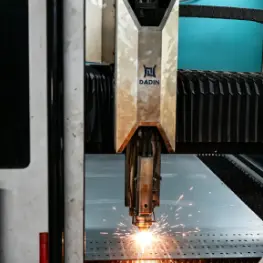
Equipped with high-precision continuous roll-forming lines, automated laser cutting tables, and dual-axis robotic welding cells capable of handling 30,000 metric tons of steel per month.
Verified International Certifications
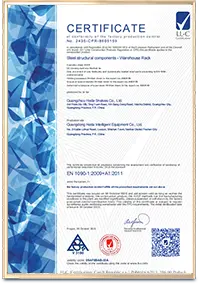
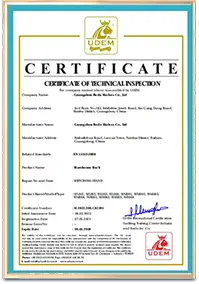
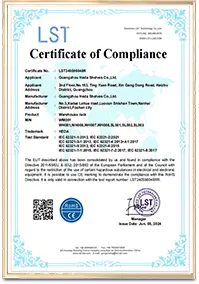
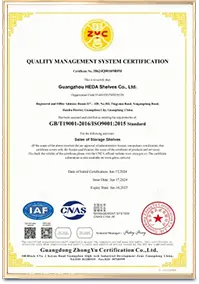
Full CE Certification (No. 2435-CPR-8605159) complying with EN 15512:2020 structural execution and ISO 9001:2015 Quality Management System Certification (No. 18624Q00169R0M).
Global Export Footprint (120+ Countries)
Proven track record supplying port logistics in Nigeria, distribution centers in Kenya, cold stores in South Africa, mining hubs in Ghana, and industrial facilities across Europe and Southeast Asia.
Free 3D Layout & Static Calculations
Dedicated engineering division providing complimentary CAD architectural layouts, 3D realistic rendering, and structural load capacity calculations prior to project sign-off.
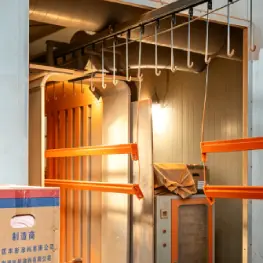
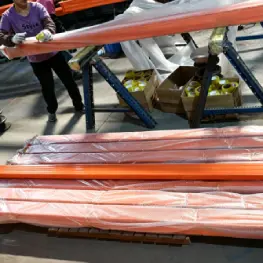
5. The 10-Stage Precision Production Pipeline
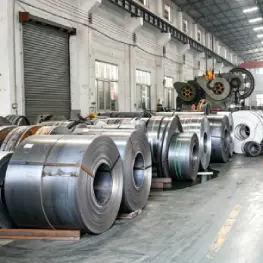
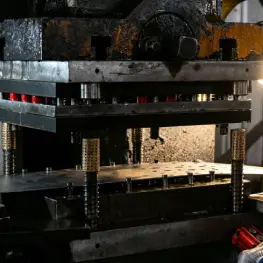
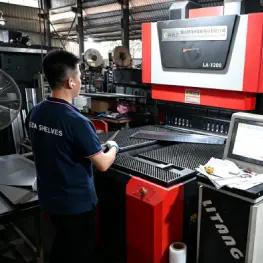
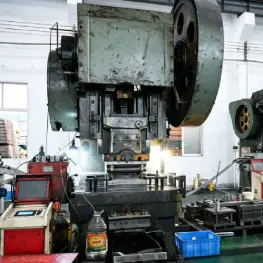
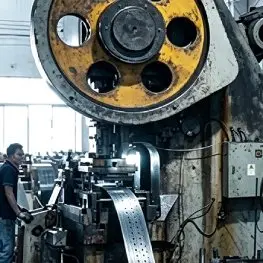
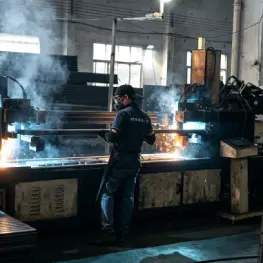
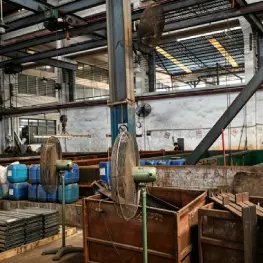
Structural dependability under tall dynamic loading depends entirely on rigorous manufacturing process control. Heda enforces a closed-loop ten-stage fabrication protocol from coil slitting to overseas container stuffing:
6. Verified International Certifications & Quality Auditing
Structural components manufactured by Heda undergo independent third-party physical load testing, chemical composition spectrometer analysis, and salt-spray corrosion chamber testing (ASTM B117 standards). Our manufacturing procedures meet the most stringent safety regulations across the European Union and global markets.
7. Global Procurement Technical FAQ
Real engineering answers to the most frequent inquiries raised by international EPC contractors, warehouse developers, and procurement heads when importing tall racking systems from China:
What warehouse floor slab specifications are required for tall racking above 12 meters? +
How are tall upright frames (12m–24m) packaged to prevent deformation during sea freight? +
How does HEDA ensure seismic compliance across different seismic hazard zones? +
What fire protection and in-rack sprinkler integration is required for high-bay racking? +
How does the total landed cost of importing from HEDA compare against domestic sourcing? +
Can your engineering team assist with local installation and third-party safety audits? +
Initiate Your High-Bay Warehouse Racking Project
Send us your warehouse dimensions, ceiling clear height, pallet specifications, and forklift fleet parameters. Our structural engineering department will furnish a complimentary CAD layout, 3D rendering, and static calculation within 24 hours.
Get Catalog