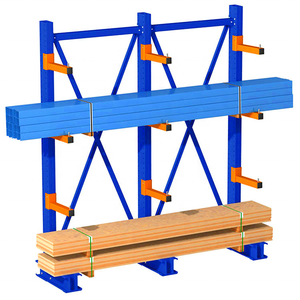
Top Trusted Industrial Cantilever Storage Racks Supplier & Suppliers
Engineered heavy-duty structural steel solutions, free 3D simulation layouts, and factory-direct supply chains for uninterrupted long-span industrial warehouse logistics.
Factory Catalog
Engineered Heavy-Duty Cantilever Racking Systems
Explore our precision-fabricated cantilever range designed to eliminate front-column obstructions for handling timber, extruded pipes, metal profiles, sheet inventory, and structural loads.
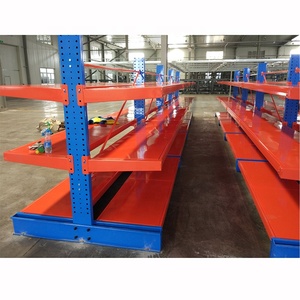
Industrial Heavy-Load Warehouse Tube & Steel Stock Cantilever Rack
View Specifications →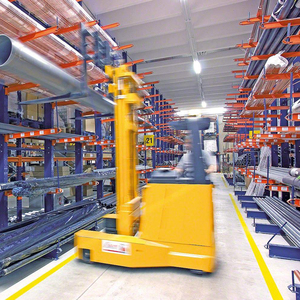
Double-Sided Freestanding Heavy Duty Metal Storage Cantilever System
View Specifications →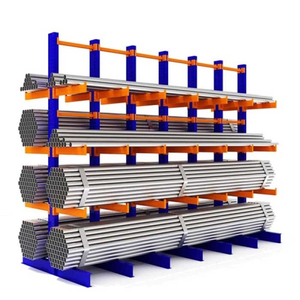
Engineered High-Bay Structural Cantilever Warehouse Racking
View Specifications →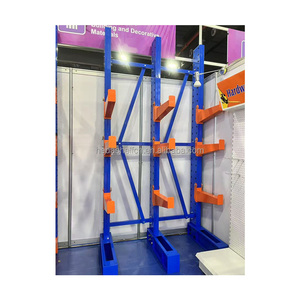
Wholesale High-Capacity Double-Sided Industrial Cantilever Shelves
View Specifications →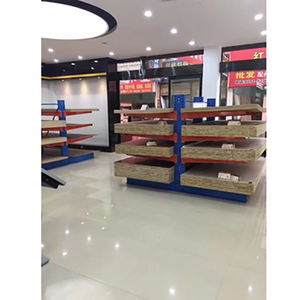
Adjustable Multi-Tier Metal Shelving Furniture Cantilever System
View Specifications →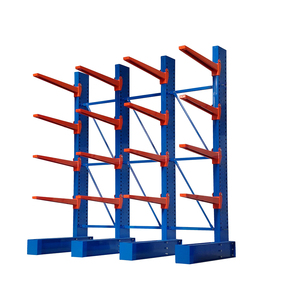
Structural H-Beam Cantilever Pipe & Lumber Storage System
View Specifications →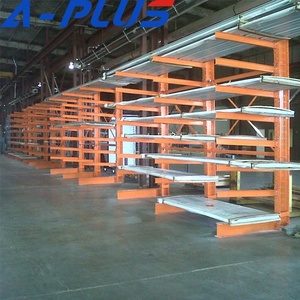
Factory-Grade Steel Plate & Bar Stacking Cantilever Shelf Rack
View Specifications →
Technical Whitepaper
Optimizing Long-Span Material Handling: The Cantilever Architecture
Conventional selective pallet racking creates continuous physical upright constraints along the aisle line, which severely limits warehouse storage when managing continuous or varying-length inventory such as aluminum profiles, PVC extrusions, steel piping, engineered lumber, and building plates.
Industrial cantilever storage racks solve this limitation through an open-face, column-supported structural format. By positioning structural uprights at the back of the bay and projecting unbraced, high-strength load arms outward, warehouses achieve an unobstructed continuous horizontal storage plane. This architecture provides 100% immediate selectivity for every SKU level, completely removes the horizontal dimension barriers inherent in pallet-frame systems, and minimizes impact damage during side-loader or forklift material positioning.
Roll-Formed vs. Structural Cantilever Racking: Structural Comparison
A primary decision in cantilever system design is choosing between roll-formed steel profiles and hot-rolled structural steel shapes (typically I-beams and H-beams). The selection depends on operational duty cycles, the handling environment, and point-load distribution.
| Engineering Attribute | Roll-Formed Cantilever Racks | Hot-Rolled Structural Cantilever Racks |
|---|---|---|
| Steel Specification | High-strength cold-rolled coil steel (Q235B/Q355) | Hot-rolled structural I-beam / H-profile steel |
| Typical Arm Capacity | 250 kg to 1,000 kg per arm level | 1,000 kg to 3,500+ kg per arm level |
| Impact Resilience | Moderate; best suited for enclosed, controlled facilities | High resistance against heavy forklift impacts |
| Arm Adjustability | Modular boltless pin connections (typically 75mm/100mm pitches) | Heavy bolt-secured flange joints with high shear pins |
| Optimal Applications | Retail hardware, furniture, light timber, PVC conduit | Heavy rebar bundles, structural tubing, steel coils, stone slabs |
| Corrosion Options | Pickling, phosphating, electrostatic powder coating | Powder coating or Hot-Dip Galvanizing (HDG) for outdoor yards |
Industry Foresight
Future Procurement Trends in Cantilever Storage Systems
As global supply chains expand and urban industrial footprints demand higher spatial efficiency, enterprise procurement strategies for industrial storage systems are shifting along several clear structural axes.
1. High-Density Mobile Base Integration
Rather than anchoring columns to fixed concrete floors with wide working aisles between each run, procurement teams are pairing heavy-duty cantilever racks with motorized floor-embedded rail carriages. By opening a single active operating aisle on demand via PLC controls, warehouses can increase physical storage capacity by 80% to 110% within the same floor footprint, which significantly lowers land-cost overhead.
2. Outdoor Galvanized Hybrid Yards
Industrial timber yards, rebar distributors, and pipe fabricators are moving away from costly warehouse extensions by establishing outdoor cantilever yards. The focus is shifting toward full hot-dip galvanized (HDG) treatments exceeding 85-micron coat thicknesses, paired with integrated shed-roof assemblies mounted directly atop the rack uprights to provide built-in weather protection.
3. Direct Structural Steel Sourcing
Enterprise procurement teams increasingly bypass intermediary brokers to work directly with integrated manufacturing plants that provide in-house CAD structural design, finite element load analysis, and automated roll-forming lines. Direct sourcing helps maintain unified tolerances across base connectors, uprights, and arms while avoiding intermediate markups.
Engineering Advances
R&D Evolution of Cantilever Racking Technology
Modern storage installations require continuous structural refinement. Recent cantilever engineering advances focus on higher safety margins, automated material handling, and improved durability.
Pivoting Deflection-Absorbing Arms
Traditional rigid cantilever connections are susceptible to localized shear fatigue when struck by lifting machinery. Modern arm connections use articulated pivot brackets that deflect upward and horizontally upon impact, absorbing kinetic energy and returning safely to rest rather than causing structural damage to the upright column.
Guided Narrow Aisle (VNA) & AS/RS Compatibility
Automated warehouse designs increasingly run rail-guided 4-directional side-loader forklifts within tight 2,200mm working aisles. Upright fabrication now requires tighter structural tolerances and specialized mechanical guide rails attached to the rack bases, enabling safe high-bay operations up to 12 meters.
Advanced Anti-Corrosive Coatings
To resist corrosive environments in coastal regions, high-humidity operations, and chemical plants, structural steel components undergo a multi-step pretreatment process. This includes chemical pickling, ultrasonic degreasing, and zinc phosphating prior to electrostatic powder baking, providing dependable corrosion resistance.
Why Choose Us
Guangzhou HEDA Shelves: Built on Engineering & Global Experience
Founded in 2001, Guangzhou Heda Shelves Co., Ltd. operates an integrated 30,000 m² heavy storage fabrication base in Guangzhou, delivering custom storage installations across more than 120 countries.
25 Years Manufacturing
Over two decades of dedicated production of pallet racking, structural mezzanines, and cantilever systems with OEM/ODM customization capabilities.
30,000 Tons Monthly Yield
Automated cutting, roll-forming, punching, welding, and electrostatic powder coating production lines ensure consistent delivery across large multi-container orders.
Certified International Quality
Products are built to international standards with certified compliance under CE (No. 2435-CPR-8605159), ISO 9001:2015, and RoHS quality management systems.
Free Layout Design & Support
Our experienced structural engineering team provides custom CAD blueprints, 3D renderings, stress analysis, and load calculations tailored to your facility.
Procurement Guide
Industrial Cantilever Racking: Frequently Asked Questions
Detailed technical answers to help warehouse operators, structural engineers, and facility managers plan and specify long-span storage projects.
How is the required arm capacity calculated for a cantilever storage rack?
Arm load capacity is calculated by dividing the maximum combined weight of an inventory bundle by the number of supporting arms positioned beneath it. The load must be uniformly distributed across the arms to prevent structural deflection. For example, if a 3,000 kg steel tube bundle rests on three arms, each arm must have a minimum rated capacity of 1,000 kg. Point loads placed at the arm tips generate higher bending moments at the upright column connection, requiring engineered adjustments to arm taper and column flange thickness.
What structural criteria determine whether to choose Single-Sided or Double-Sided cantilever racks?
Single-sided cantilever racks are designed to sit flush against structural warehouse walls. Anchored base beams extend beneath the load arms to counteract tipping moments and anchor the unit to the concrete slab. Double-sided cantilever racks feature a central vertical column with load arms extending from both faces. This configuration shares axial compressive loads evenly through the central spine, offering higher structural stability and lower steel weight per stored ton.
Can cantilever systems accommodate non-continuous or palletized inventory?
Yes. Cantilever arms can be fitted with transverse steel saddle cross-beams, drop-in wire mesh decking, or solid hot-rolled steel plate decks. This adapts open cantilever tiers to safely handle broken bundles, odd-sized crates, standard pallet inventory, and machinery parts alongside long materials without requiring separate conventional racking bays.
How do you protect cantilever components from corrosion in open-air or tropical environments?
For enclosed warehouses with regulated conditions, an automated 9-stage chemical pretreatment—including degreasing, acid pickling, and zinc phosphating followed by thermosetting electrostatic polyester powder coating (60-80 microns)—provides long-lasting corrosion resistance. For high-humidity coastal sites or exposed outdoor storage yards, components are treated with a full Hot-Dip Galvanizing (HDG) process compliant with ASTM A123/ISO 1461, achieving an alloy-bonded zinc layer of 85+ microns.
What building details are needed to request a free engineering layout and quote?
To prepare an accurate CAD layout and structural stress calculation, our engineering team needs: (1) Facility architectural floor dimensions and clear ceiling clearance height below obstructions; (2) Concrete slab thickness and reinforcement details; (3) Stored product profiles (length, depth, bundle diameter, and maximum unit weight); (4) Operating forklift specifications, including mast lift height and turning radius; and (5) Local site considerations such as seismic zone ratings and indoor versus outdoor placement.
How are cantilever systems safely packed and shipped for international ocean freight?
All structural cantilever columns, base beams, load arms, and diagonal cross-bracing components are manufactured as modular, knock-down assemblies. Components are bundled using high-tensile strapping, protective corrugated cushioning, and corner edge-guards designed for 20GP and 40HQ container loading. Upright columns and long arms are packed in sequenced layers to simplify unstuffing and minimize damage during transport to major ports globally.
Request a Free 3D Layout & Factory-Direct Quote
Connect directly with our engineering team in Guangzhou to receive custom CAD floor designs, finite-element load calculations, and competitive pricing for your storage facility.
Contact Us