Top Trusted Slotted Angle RackSuppliers & Exporters
Global direct-factory engineering whitepaper: High-capacity cold-formed steel racking, precision perforation profiles, and multi-tier knock-down logistics optimized for international supply chains.
Engineered Product Matrix
Factory-Engineered Slotted Angle Storage Systems
Compare our factory-certified slotted angle specifications engineered for high structural integrity, corrosion immunity, and container-optimized global export freight.
Engineering Principles of Cold-Formed Slotted Angle Profiles
Slotted angle racking remains the quintessential foundational building block of worldwide material handling systems. Modern B2B procurement demands far more than basic dimensional validation. High-performance industrial storage hinges upon precise cold-roll forming, cold-worked yield point enhancement, and uniform moment-of-inertia optimization across longitudinal punch slots.
Our manufacturing infrastructure utilizes prime-grade continuous strip coils conforming to ASTM A1008 and GB/T 700 standards. Through calibrated multistage roll-forming cassettes, sheet steel undergoes controlled strain hardening that increases yield strength ($\sigma_y$) by upwards of 18% along critical flange bends without inducing micro-fracture brittleness.
Deflection Limitation: L/200Certified strictly under uniform distributed load (UDL)
*Deflection calculated strictly according to FEM 10.2.02 / SEMA codes for non-sway braced storage frameworks.
Market Forecast 2025–2030
Strategic Procurement & Technological Trends
How automated fulfillment, circular carbon taxation, and decentralized supply chains are revolutionizing high-density light-to-medium structural steel racking systems globally.
Micro-Fulfillment & Hyper-Modular Matrixes
Rapid urbanization and same-day delivery mandates are moving inventory closer to metropolitan hubs. Slotted angle frameworks are superseding rigid welded shelving because their 50mm perforation pitch allows technicians to reconfigure bin matrices within hours as SKU packaging sizes shift seasonally.
Low-Embodied Carbon & CBAM Verification
With European Union CBAM and North American ESG reporting requirements taking full effect, multinational buyers now demand audited Environmental Product Declarations (EPDs). Forward-thinking exporters leverage electric-arc-furnace (EAF) strip steel and zero-VOC thermosetting polyester finishes to drastically lower cradle-to-gate CO2 footprints.
Hybrid Angle-Supported Multi-Tier Mezzanines
Real estate acquisition costs have surged across key African and Asian transit hubs. Importers are bypassing lateral building expansion by designing 2-tier and 3-tier catwalk mezzanines supported entirely by heavy-gauge slotted angle upright columns, multiplying picking area by 200% without structural civil construction.
TCO & Container Logistics Optimization for Global Importers
When purchasing steel storage infrastructure internationally, the factory ex-work quotation represents only a fraction of the total lifecycle balance sheet. Sophisticated supply chain directors evaluate procurement through Landed Cost per Usable Cubic Meter (LC/UCM) and maintenance life expectancy.
Knock-Down (KD) Shipping Density: Pre-welded frames consume excessive ocean freight volume. HEDA Shelves engineers optimize every millimeter of slotted angle uprights, beams, corner plates, and shelf decks to interlock seamlessly. A single 40-foot High Cube (40HQ) container loaded at our Guangzhou manufacturing facility houses up to 26–28 metric tons of nested components, providing maximum volumetric efficiency.
Preservation Against Marine Transit Microclimates: Ocean transit across equatorial shipping routes subjects cargo to extreme humidity cycling ("container rain"). Our 10-step pickling and phosphating pretreatment converts surface iron into a non-reactive crystalline phosphate layer prior to electrostatic powder coating, guaranteeing zero oxidation upon delivery to ports in Lagos, Tema, Mombasa, Durban, or Alexandria.
Landed Cost Component Breakdown
Base Structural Metallurgy (Steel Coil)52%
Precision Roll-Forming, Punching & Coating18%
Containerized Ocean Freight (40HQ Optimized)16%
Local Erection, Bracing & Commissioning14%
Request custom stowage plan & weight-to-cube calculation for your destination port.
Vertical integration from raw steel coil slitters to automated roll-forming and robotic powder lines ensures absolute dimensional consistency, traceable metallurgy, and reliable delivery dates.
30,000 m² Factory Footprint
Equipped with 12 automated cold-roll lines, CNC hydraulic punching presses, and dedicated automated continuous powder spray booths.
300+ Engineering Staff
Our in-house structural engineering department generates full CAD floor layouts, load calculations, and FEA stress simulations within 24 hours.
Audited Certifications
Certified under CE standard 2435-CPR-8605159, ISO 9001:2015 registration 18624Q00169R0M, and comprehensive RoHS chemical safety.
Global Port Delivery
Over 10,000 industrial warehouse projects fulfilled worldwide with customized export knock-down crating and container protection schemes.
Procurement Knowledge Hub
Frequently Asked Engineering & Export Inquiries
Direct, data-backed answers formulated by our chief structural engineers for commercial buyers, contractors, and project planners.
Q1
What metallurgical differences exist between Q195, Q235B, and SS400 slotted angles?
Q195 steel possesses a nominal yield strength of 195 MPa and superior ductility, making it ideal for cost-efficient, light-duty commercial shelving under 150 kg/tier. Q235B delivers a higher yield threshold (≥235 MPa) and enhanced tensile resistance (370–500 MPa), designated for industrial multi-tier warehouse applications. SS400 (Japanese JIS standard equivalent) guarantees robust structural load margins for heavy framework assemblies and mezzanine support pillars.
Q2
How does electrostatic powder coating protect against tropical coastal climates?
Prior to coating application, raw steel components undergo a 10-stage immersion sequence encompassing alkaline degreasing, ultrasonic water rinses, acid pickling (rust deoxidization), and zinc-iron phosphating. This chemically bonds a microscopic phosphate matrix to the steel. An electrostatic powder coating of pure epoxy-polyester resin (80–120μm) is then thermoset at 200°C, passing 500-hour ASTM B117 salt spray tests for coastal port installations.
Q3
How is maximum Safe Working Load (SWL) calculated for slotted angle spans?
SWL calculations comply strictly with SEMA (Storage Equipment Manufacturers' Association) and FEM 10.2.02 codes. Safe load capacity relies on Section Modulus ($Z$), moment of inertia ($I$), and beam span ($L$). Deflection under Uniform Distributed Load (UDL) is restricted to a maximum ratio of $L/200$ across standard industrial shelves, with a structural safety factor of 1.65 against permanent plastic yield.
Q4
What container packaging methods are utilized to prevent transit scratching and warping?
Uprights and angle posts are bundled into strapped steel packs with corner protectors and corrugated sleeves. Shelf decking plates are nested faced-to-faced with moisture-barrier PE films and palletized on heavy-duty wooden skids fitted with lifting bands. Every 40HQ container plan is computer-simulated to guarantee balanced weight distribution without exceeding marine axle limits.
Q5
Can slotted angle framework be adapted into catwalk mezzanines safely?
Yes. By employing heavy-gauge (2.0mm–3.0mm) slotted angle profiles in double-nested or boxed configurations, our engineers design rack-supported multi-tier catwalks supporting up to 300–500 kg/m² uniformly distributed floor loads. All systems include structural cross-bracing, stair towers, handrails, and kick-plates engineered in full accordance with OSHA and CE safety codes.
Q6
What custom perforation patterns and dimension options can be manufactured?
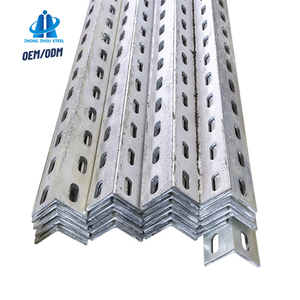
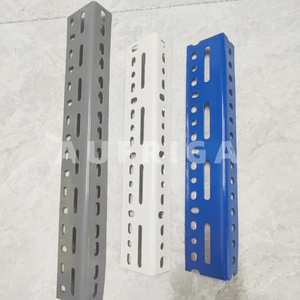
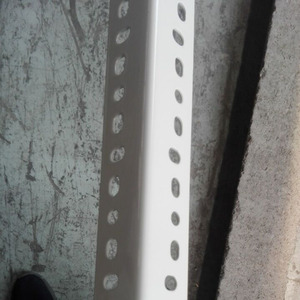
While universal 50mm and 75mm slotted hole matrices represent our high-production standards, our CNC punching presses accommodate custom perforation dies, including round holes, keyholes, or custom pitch spacing. Profile dimensions range from 32×32mm up to 80×50mm, with steel gauges from 1.2mm to 3.0mm, and lengths up to 6,000mm.
Q7
What customs export documentation is supplied with container shipments?
Standard export documentation suites include Clean On-Board Bill of Lading (B/L), Commercial Invoice, Packing List with itemized container tare/gross weights, Certificate of Origin (Form E, CO, etc.), Mill Test Certificates (EN 10204 3.1 verification), and third-party inspection reports (SGS / BV / CCIC) as designated by the buyer.
Q8
How fast can layout schematics and formal manufacturing quotes be delivered?
Upon submitting warehouse dimensions, ceiling clearance heights, pallet/shelf SKU load profiles, and target entryways, our engineering team generates a comprehensive 2D AutoCAD layout, 3D visualization render, and detailed FOB/CIF pricing matrix within 24 to 48 business hours.
Transform Your Warehouse Velocity & Storage Density Today
Connect directly with our senior racking structural engineering department. Receive custom 3D CAD blueprints, full finite element load analyses, and direct manufacturer pricing with zero middleman markups.