Engineered Heavy-Duty Racking & High-Density Storage Solutions
Precision-formed from cold-rolled structural steel coils (Q235B / Q355B), our high-density racking configurations are designed under strict limit state criteria to withstand severe dynamic load impacts, high seismic accelerations, and heavy floor loadings.
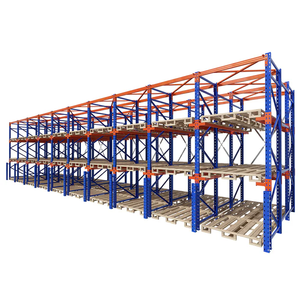 High Density LIFO/FIFO
Drive-In Rack and Drive-Thru Racking Systems
Engineered for homogeneous stock with high floor-space utilization up to 85%. Continuous pallet rails eliminate conventional handling aisles for bulk cold stores and FMCG depots.
- Bay Depth: Up to 12 Pallets Deep
- Unit Capacity: 500 – 1,500 kg / pallet
- Structural Standard: EN 15512 / FEM 10.2.02
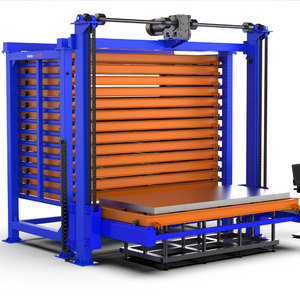 Smart Intralogistics
Automatic Sheet Metal Warehouse Rack with Loading Robot
Cassette-style vertical storage tower integrated with Cartesian loading robots and pneumatic vacuum manipulators for heavy steel sheets, tooling plates, and CNC feeder lines.
- Drawer Payload: 1,000 – 5,000 kg / tray
- Automation: PLC & WMS Controlled
- Cycle Speed: Fast Cassette Retrieval
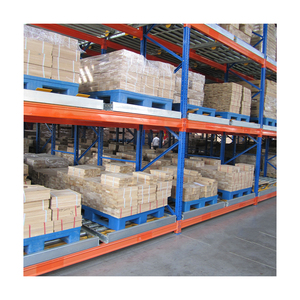 100% Direct Selectivity
Steel Pallet Rack System Heavy Shelving Storage Shelf
The benchmark solution for fast-moving multi-SKU logistics hubs. Features teardrop or diamond punching, high torsional beam box construction, and 50mm pitch adjustability.
- Beam Section: 80×50 to 160×50 mm
- Load Range: 1,000 – 4,500 kg / beam level
- Finish: Epoxy Powder Coat (60–80μm)
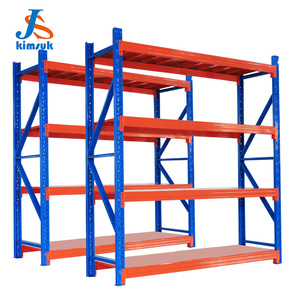 Modular Boltless Assembly
Boltless Rack System Storage Racks Shelving Units
Rapid interlocking structural shelving without nuts or bolts. Configured with solid steel decking or heavy-duty wire mesh for carton picking, maintenance cribs, and intermediate loads.
- Capacity: 300 – 800 kg / shelf tier
- Pitch Adjust: Every 38mm / 50mm
- Erection Time: 10 Mins per Starter Bay
 Ventilated Anti-Corrosion
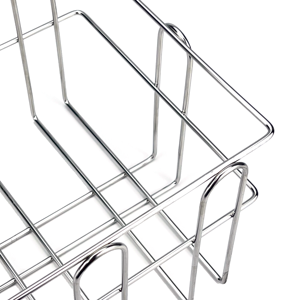
Custom Wire Shelving Unit for Kitchen & OEM Projects
High-tensile carbon steel wire grids with open truss trussing. Provides unrestricted light penetration, optimal air circulation, and compliance with strict fire-sprinkler drainage codes.
- Plating: Triple Chrome / Zinc / Epoxy
- Hygiene Standard: NSF Sanitary Equivalent
- Air Permeability: > 70% Free Surface
 Multi-Tier Integration
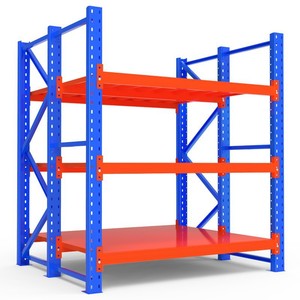
Light Medium Heavy Duty Storage Selective Metal Rack
Versatile industrial rack architecture capable of integrating timber panels, steel decking, or pallet back-stops. Easily scalable into narrow aisle (VNA) or double-deep systems.
- Upright Profile: Ω-Section Roll-Formed
- Safety Factor: γ = 1.5 against Yield
- Bay Height: 2,000 – 12,000 mm
 Factory Equipment Racks
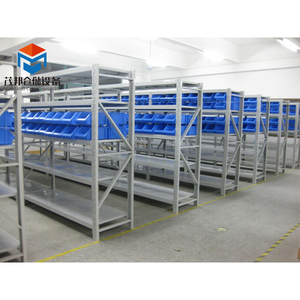
Factory Metal Materials Light Duty 400 kg Metal Rack
Sturdy cold-rolled steel shelving engineered for spare parts centers, hardware fulfillment, and retail stockrooms requiring dense horizontal storage with ergonomic manual retrieval.
- Tier Capacity: Uniform 400 kg UDL
- Deck Type: Cold-Rolled Steel Pan
- Assembly: Butterfly Clip Lock-In
 Anti-Corrosive Stacking
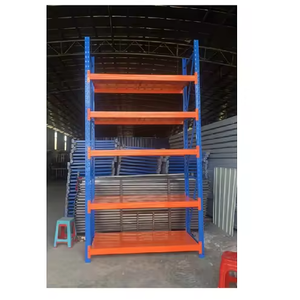
Adjustable Boltless 5-Layer Anti-Rust Stacking Racks
Multilayer anti-corrosion treated framework designed for humid retail distribution centers and supermarkets. Engineered with ribbed column posts to eliminate lateral sway.
- Layer Config: 5 Fully Adjustable Tiers
- Rust Protection: Pickled & Phosphated Steel
- Certification: CE CPR / ISO 9001:2015
Guangzhou Heda Shelves Co., Ltd.: Global Production Scale & Rigorous Engineering
Headquartered in Guangzhou, China, HEDA Shelves operates a state-of-the-art 30,000 m² heavy-machinery production complex. From automated roll-forming and CNC continuous punching to robotic welding and Swiss electrostatic powder coating, every stage is maintained under strict EN ISO 9001 quality regimes.
Verified CE Certification
Fully certified under European Construction Products Regulation (CPR 305/2011/EU) with standard CE Certificate No. 2435-CPR-8605159. Full conformity with EN 1090-1 Execution Class EXC2 and EN 15512 static steel calculation protocols.
ISO 9001:2015 & RoHS
Certified Quality Management under ISO 9001:2015 (No. 18624Q00169R0M), guaranteed active until June 2027. All raw steel, epoxy formulations, and pretreatment baths conform to RoHS Directive guidelines for lead, cadmium, and hexavalent chromium absence.
Free 3D CAD & Load Verification
Our in-house structural engineering team provides complete warehouse layout planning within 24 hours. Includes 2D AutoCAD floor distribution, isometric 3D Navisworks models, and ANSYS FEA non-linear buckling simulations free of charge.
Container-Optimized Logistics
Components are engineered to nest and bundle perfectly into standard 20GP and 40HQ maritime containers. High-density bundle strapping reduces landed sea freight costs by 18% to 27% across West, East, Southern, and North African discharge terminals.
Future Procurement Trends in Heavy-Duty Industrial Racking
Shifting supply-chain paradigms, material price volatilities, and ESG regulatory mandates are drastically changing how multinational logistics providers, cold-chain operators, and retail titans source warehousing assets.
1. Transition from Standard CapEx to Total Cost of Ownership (TCO)
Procurement executives no longer purchase steel shelving strictly by initial FOB unit cost. The total cost metric evaluates life-cycle structural durability, beam deflection hysteresis, resistance to forklift impact shear, and modular reusability. A heavier upright profile with high plastic reserve reduces recurring maintenance downtime and post-installation repair expenses.
2. Decarbonization & Green Steel (Scope 3 Emission Compliance)
Global supply-chain entities operating in the EU, Americas, and Australasia are legally required to audit Scope 3 carbon footprint contributions. Industrial racking, which consumes thousands of metric tons of hot-rolled and cold-formed coil, is shifting toward certified scrap-based Electric Arc Furnace (EAF) steel and low-VOC powder coatings with zero heavy-metal effluents.
3. High-Density Mechanical Autonomy over High-Grid Dependency
In developing emerging markets (e.g., Sub-Saharan Africa, Latin America, Southeast Asia), persistent electrical grid instability and load-shedding prioritize purely mechanical or autonomous DC-powered storage methods. Sourcing trends favor heavy-duty gravity flow racks, push-back nested cart systems, and solar-rechargeable 2D radio shuttles that run uninterrupted during municipal power collapses.
4. Stricter International Seismic & Wind Loading Specifications
Modern warehouse clearances routinely reach 12 to 18 meters, exacerbating second-order lateral drift ($P-\Delta$ effects) during seismic micro-tremors or external wind loads on clad-rack structures. Structural engineers require factories to present authenticated structural verification under Eurocode 3 (EN 1993), Eurocode 8 (EN 1998), and American RMI MH16.1 codes prior to tender authorization.
5. Digital Twin & Sensor-Ready Structural Architecture
Forward-looking buyers now specify "sensor-ready" upright frame profiles pre-drilled to support optical displacement monitors, structural upright impact detection nodes, and wireless strain gauges. This allows structural health monitoring (SHM) software to continuously audit frame deflection and prevent progressive disproportionate warehouse collapse.
Technological Advancements in High-Strength Cold-Formed Steel Racking
The engineering frontier of pallet racking focuses on cold-formed thin-walled structural members with continuous stiffening ribs, high-yield metallurgical compositions, and advanced anti-corrosion duplex treatments.
Structural Mechanics: Yield Strength Optimization (Q235B vs. Q355B / S355JR)
Conventional storage racks historically utilized standard structural carbon steel (Q235B / S235JR with minimum yield strength $f_y = 235 \text{ MPa}$). Modern automated facilities demand ultra-high load capacities per tier without proportionally escalating the self-weight of the structure. HEDA Shelves utilizes micro-alloyed, cold-rolled continuous strip steel equivalent to Q355B / S355JR ($f_y \ge 355 \text{ MPa}$).
By exploiting higher steel yield strengths combined with multi-bend upright geometries (featuring up to 12 cold-rolled work-hardened corners), the section modulus $W_z$ is increased by up to 28% while reducing overall steel consumption by 14% to 19%. This metallurgical and geometric enhancement drastically increases the critical Euler elastic buckling threshold:
Where $E$ represents Young's modulus (210 GPa), $I$ is the second moment of area of the perforated Ω-profile, $K$ is the effective length factor governed by diagonal and horizontal frame bracings, and $L$ is the unbraced vertical node distance between beam elevations.
Deflection Limit State Verifications under EN 15512:2020
A central tenet of CE compliance for pallet racking systems is the strict control of elastic beam deflection under full working design load. According to EN 15512, the maximum permissible vertical deflection ($\delta$) of any load-bearing rack beam under Serviceability Limit State (SLS) must not exceed:
Where $L$ is the clear span distance between upright columns (e.g., for a standard 2,700 mm beam bay storing two 1,200×1,000 mm Euro-pallets, total elastic sag is constrained below 13.5 mm). Furthermore, connector brackets (beam claws) are stamped with cold-forged 3, 4, or 5-tooth hooks that provide dynamic rotational stiffness ($C_{di}$), transforming what would be a pin-joint into a semi-rigid frame connection, thereby dampening sway and preventing beam pull-out under pallet bounce.
Duplex Surface Protection: Pretreatment & Coastal Humidity Resistance
For industrial facilities operating in humid tropical environments, maritime port transit zones (e.g., Lagos, Mombasa, Durban), or cold-storage logistics freezers (-30°C), traditional single-layer paint fails via under-film filiform corrosion. HEDA Shelves employs an automated continuous 12-stage surface preparation sequence:
- Alkaline Degreasing & Ultrasonic Deoxidization: Eliminates rolling lubricants and residual coil oxides.
- Acid Pickling & Water Rinses: Strips microscopic surface scales.
- Zinc-Manganese Phosphating: Generates a dense, micro-crystalline conversion layer (2.5 – 3.5 g/m²) that locks powder molecules to raw steel.
- Electrostatic Powder Curing: Thermosetting polyester resin applied uniformly at 60–90 μm thickness, cured at 190°C–210°C, providing exceptional cross-hatch adhesion (DIN EN ISO 2409 Class 0) and salt-spray resistance exceeding 500 hours (ASTM B117).
Heavy-Duty Warehouse System Engineering Comparison
Compare mechanical architectures, structural accessibility factors, floor utilization indices, and capital expenditure coefficients to choose the exact pallet racking system for your facility.
| Racking Architecture | Space Density Index | Pallet Selectivity | Stock Rotation | Payload / Level | Forklift Compatibility | CapEx Factor |
|---|---|---|---|---|---|---|
| Selective Pallet Racking | Medium (40% - 50%) | 100% Immediate Direct Access | FIFO or LIFO | 1,000 – 4,500 kg | Counterbalance, Reach Truck | Baseline ($) |
| Drive-In / Drive-Thru | Ultra-High (75% - 85%) | Low (Tunnel Entry Required) | Strict LIFO (Drive-In) / FIFO (Thru) | 500 – 1,500 kg | Narrow Counterbalance, Reach | Moderate ($$) |
| Radio Shuttle Automation | Maximum (80% - 90%) | High by Lane (Deep Lane Storage) | Flexible FIFO & LIFO Programmed | 500 – 2,000 kg | Standard Forklift (Rack Exterior) | High ($$$$) |
| Push-Back Nested Cart | High (65% - 75%) | Medium (2–6 Pallets / Bay) | Strict LIFO by Gravity Cart | 1,000 – 1,500 kg | Standard Reach Truck | Upper Mid ($$$) |
| Gravity Pallet Flow | Very High (70% - 80%) | High per Lane (Self-Fed) | Strict FIFO (Continuous Roller) | 500 – 1,500 kg | Any Standard Lift Truck | High ($$$$) |
| Automated Sheet Metal Tower | Vertical Max (Up to 15m) | Automated Cassette Picking | Direct WMS Controlled | 1,000 – 5,000 kg | Cartesian Crane / Gantry Robot | Advanced ($$$$$) |
Technical & Logistical Questions Answered by Structural Engineers
Essential clarifications on structural calculations, mill test certifications, customs HS codes, installation supervision, and compliance guarantees for international procurement executives.
What regulatory compliance credentials certify HEDA pallet racking for export to European and overseas markets?
+
How do you verify steel alloy authenticity and mechanical tensile limits prior to production?
+
What specific project metrics are required to receive a formal CAD layout and load calculation report?
+
How are components packaged to ensure corrosion-free and damage-free arrival through ocean transit?
+
What structural measures protect upright columns against irreversible forklift impacts?
+
Can HEDA Shelves support on-site installation and provide technical assembly supervision internationally?
+
Request Your Custom 3D CAD Warehouse Layout & Load Audit
Connect directly with our structural engineering team in Guangzhou. We calculate static load dynamics, evaluate spatial optimization ratios, and provide comprehensive container-packing schedules for your facility with zero preliminary cost.