Engineered High-Density Pallet & Very Narrow Aisle Systems
Custom-fabricated from high-yield Q355B and Q235B cold-rolled steel, calibrated for turret truck guidance, cantilevered loads, and vertical clearance tolerances exceeding 15 meters.
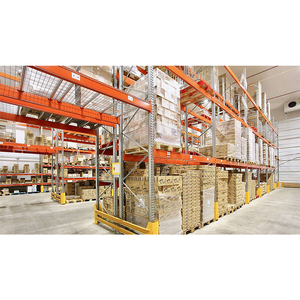 Aisle: 1,500mm
Very Narrow Aisle Storage System Reach Truck Warehouse Solution Space Saving VNA Rack
- Up to 50% aisle reduction
- Max beam elevation: 16,000 mm
- Direct access to 100% pallet SKUs
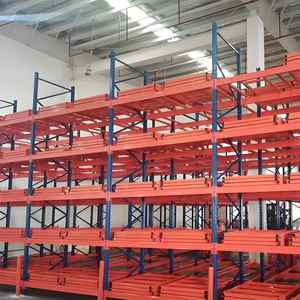 2–6 Carts Deep
Space Saving Push Back Pallet Racking Nestable Cart for Medium Turnover Single SKU Warehouse Storage
- Inclined nested rolling carts
- LIFO operational flow control
- Zero intermediate rack aisles
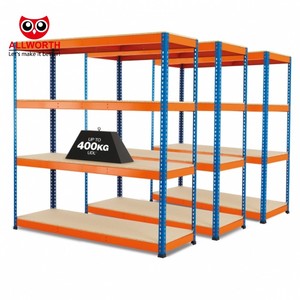 Load: 5,000 kg/Tier
Heavy Duty Efficiency Flexibility Large Load Capacity Pallet Style Metal Rack
- Reinforced box-beam engineering
- Custom upright gauge 1.5–3.0mm
- Integrated wire mesh deck options
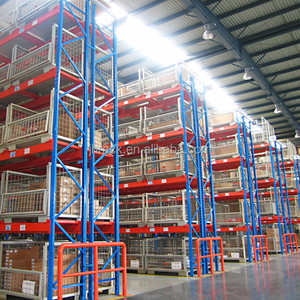 Pitch: 50mm / 75mm
Heavy Duty Metal Warehouse Storage Rack Adjustable Horizontal Shelves For Factory Stacking Racks
- Precision CNC slot punch profile
- Safety locking pins on all beam claws
- Epoxy powder-coated finish
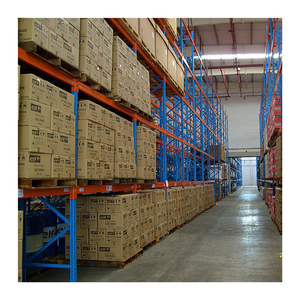 Bespoke Structural
Customized Heavy Duty Steel Warehouse Storage Shelf Rack Pallet Racking System
- Tailored column baseplate anchoring
- Seismic zone 4 structural bracing
- Hot-dip galvanized available
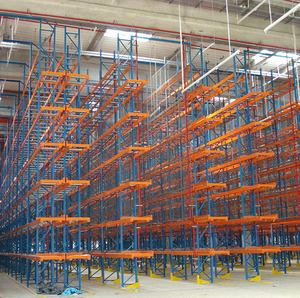 Guidance Integrated
Very Narrow Aisle Racking System Solution VNA Rack High Density Storage
- Bottom mechanical guide rails
- Inductive magnetic wire option
- Optimized for man-up turret trucks
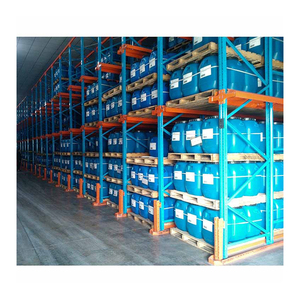 Maximum Volume
High-Density Warehouse Storage Racks FIFO Drive-in Pallet Rack Drive In Pallet Racking System
- Continuous pallet support rails
- Eliminates picking corridors
- Ideal for cold storage facilities
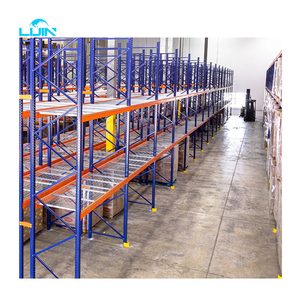 Selective Pallet
Industrial Heavy Duty Storage Shelves Systems Stacking Units Metal Rack Warehouse Steel Pallet Racking
- Universal beam compatibility
- Rapid slot boltless assembly
- Accommodates Euro & US pallets
The Structural Engineering Anatomy of Narrow Aisle Racking Systems
Narrow Aisle (VNA) racking systems represent the pinnacle of static warehouse density optimization. By reducing operational transfer corridors from standard reach truck aisle dimensions of 3.2m–3.8m down to an ultra-compact 1.5m–1.8m footprint, facility operators routinely achieve an increase of up to 45% to 65% in volumetric cubic utilization. However, operating at high lift elevations up to 16,000mm introduces extreme second-order structural moments, strict deflection limits, and tight interaction between mechanical handling equipment (MHE) and racking tolerances.
1. Metallurgy, Steel Grade Selection, and Cold-Roll Forming
Our certified VNA upright profiles are manufactured from certified structural steel coils (grades Q235B and high-yield Q355B, conforming to EN 10025-2). Cold roll-formed across continuous 24-station rolling lines, each column features an omega-profile cross-section with multiple internal stiffening ribs. These compound return-flanges prevent premature torsional-flexural buckling under concentrated axial loads.
Beams utilize dual-C interlocked box-beam configurations robotic-welded to 3-claw or 4-claw heavy-gauge end connectors. The claw hooks incorporate an engineered reverse taper that draws the beam tighter against the upright column face under increasing load, maximizing rotational joint stiffness (semi-rigid beam-to-column connection stiffness Cj in FEM calculations).
2. VNA Floor Superflatness: The VDMA & DIN 18202 Mandate
The successful operation of a Very Narrow Aisle installation is tied to the concrete floor slab tolerances. Because man-up turret trucks feature rigid chassis designs with minimal wheel suspension, a minor floor depression of only 2mm across the truck's wheel track translates to a lateral mast displacement exceeding 30mm to 45mm at a 14-meter fork elevation. This displacement risks violent collisions with pallet loads or upright column faces.
| Top Beam Height (mm) | Floor Flatness Standard | Allowable Transverse Tilt (F-min) | Recommended Guidance Mode | Structural Safety Level |
|---|---|---|---|---|
| ≤ 6,000 mm | DIN 18202 Table 3, Line 3 | F-min 50 (Standard) | Mechanical Bottom Guide Rail (L-angle / C-profile) | Standard Duty |
| 6,001 – 10,000 mm | DIN 18202 Table 3, Line 4 | F-min 75 (Superflat) | Heavy Anchor Guide Rail or Inductive Wire | High Rigidity |
| 10,001 – 13,000 mm | VDMA 23853 Class B / EN 15620 | F-min 100 (Defined Movement) | Inductive Wire with Electronic Frequency Pilot | Superflat Tier 1 |
| 13,001 – 16,000+ mm | VDMA 23853 Class A / EN 15620 | F-min 125+ (Ultra-Defined) | Top Run-In Guide Rail + Inductive Wire Combo | Ultra Precision |
3. Guidance System Topologies: Mechanical Rail vs. Inductive Wire
Warehouse engineers must evaluate two primary truck steering stabilization technologies:
- Low-Profile Mechanical Guide Rails: Typically 100mm × 65mm × 6mm or 120mm × 80mm × 8mm structural steel angle sections, anchored into the floor with M12 chemical anchors every 400mm. The guide rail serves a dual purpose: steering the side-guide rollers of the VNA truck and acting as an impact deflector protecting the bottom 100mm of the rack uprights.
- Inductive Wire Guidance (Wire-Guided VNA): A copper guidance cable is embedded inside an 8mm × 15mm saw cut centered in the aisle and sealed with high-elasticity polyurethane resin. A frequency generator transmits an AC signal (typically 5 kHz to 10 kHz) detected by onboard forklift antenna coils. Wire guidance eliminates trip hazards, prevents debris collection along rack footplates, and speeds cross-aisle transfer cycle times.
Future Trends in Narrow Aisle Racking Procurement (2025–2030)
Macroeconomic shifts in commercial real estate, automation convergence, and decarbonized operations are reshaping how enterprise supply chains procure high-density storage.
Urban Infill Logistics & Footprint Optimization
With last-mile logistics sites commanding historic rental premiums per square meter, logistics directors are converting standard 3.6m reach-truck facilities into 1.6m VNA layouts, achieving a 40%+ gain in pallet storage count without capital expenditure on real estate footprint expansion.
Hybrid Automation: Manual to AGV Retrofitting
Enterprise buyers are specifying VNA racking structures that can transition from human-operated turret trucks (man-up order pickers) to autonomous mobile robots (AMRs) and autonomous high-lift reach trucks without structural modification to the floor anchorage or beam levels.
Cold Chain Energy Volumetric Density
Refrigerated warehouse electricity costs demand minimization of cooled air volume per pallet. VNA systems deployed in cold chains (-25°C) maximize thermal mass packing, dramatically reducing the kilowatt-hour expenditure per individual stored SKU.
Precision 10-Stage Production Pipeline at HEDA Shelves
Manufactured under strict compliance with EN 15512:2020 (Steel static storage systems), CE mark requirements (Certificate No. 2435-CPR-8605159), and certified ISO 9001:2015 processes, every racking element undergoes a continuous quality assurance process across our 30,000 square meter factory base.
Raw Coil Sourcing
Certified Q235B / Q355B prime hot/cold rolled mill steel with mill test certificates.
CNC High-Speed Slitting
Ultra-precise dimensional tolerances within ±0.1mm strip width variation.
Automated Punching
High-tonnage continuous hydraulic punching of pitch patterns (50mm/75mm).
Cold Roll Forming
Multi-stand roller forming lines produce continuous profiles with zero micro-cracking.
Precision Sizing Cut
Flying hydraulic shear cutting ensuring accurate, clean vertical upright ends.
Robotic Connector Weld
Multi-axis Panasonic robotic MIG/MAG welding with deep penetration penetration.
Chemical Pickling
Immersion acid baths eliminating mill scale and atmospheric oxidation layers.
Zinc Phosphating
Micro-crystalline conversion layer enhancing rust inhibition and paint bonding.
Electrostatic Powder
Automated Nordson powder booths with Swiss Gema guns curing at 200°C (60-80μm).
QA & Ocean Bundling
Ultrasonic thickness checks, deflection tests, and export sea-worthy strapping.
Why CE Certification (CPR 305/2011) is Mandatory for High-Bay Racking
Under European Union Construction Products Regulation (EU CPR 305/2011), static steel racking installed as permanent structural fixtures must bear the CE Marking, demonstrating adherence to standard EN 1090-1 (Execution of steel structures) and EN 15512. Purchasing non-certified racking carries severe structural and regulatory liabilities: European and international facility underwriters may void insurance policies in the event of an accidental rack collapse if the system lacks audited Factory Production Control (FPC) documentation.
HEDA Shelves maintains CE Certification (No. 2435-CPR-8605159) alongside ISO 9001:2015 Quality Management certification (No. 18624Q00169R0M, valid through June 2027), guaranteeing our structural calculations, raw metallurgy, weld integrity, and published safe working loads (SWL) are backed by third-party mechanical testing.
Frequently Asked Questions by Industrial Engineers & Buyers
Comprehensive engineering clarifications on floor tolerances, clear aisle sizing, load factors, and ocean container export economics.
What are the exact aisle clearance width requirements for VNA turret trucks?
The operational aisle width for a Very Narrow Aisle system is calculated using the formula: Aisle Width = Overall Truck Width (or Pallet Diagonal Width, whichever is larger) + Safety Clearance Margin (minimum 200mm to 250mm total; 100mm–125mm per side). In standard operations with standard 1,200mm × 1,000mm Euro or UK pallets handled on the 1,200mm side by articulated trucks, aisle width averages 1,800mm to 1,900mm. With specialized man-up inductive wire-guided turret trucks (such as Linde, Jungheinrich, or Crown), aisles can be compressed down to 1,550mm – 1,650mm, provided bottom mechanical guide rails or wire guidance are active.
How does concrete floor flatness (DIN 18202 / VDMA) impact rack height capacity?
Floor flatness directly governs the maximum safe elevation of a VNA system. As lift height exceeds 10 meters, minute floor unevenness causes mast angular displacement. Under DIN 18202 Table 3, Line 4, the permissible floor variation across a 1-meter span is limited to ≤ 1.5mm. For heights between 12m and 16m, the floor must conform to VDMA 23853 Class A or ASTM F-min 100–125 (defined traffic path). If an existing slab does not meet these tolerances, the floor must undergo precision laser grinding in the truck wheel tracks before commissioning to prevent dynamic truck collisions with the rack uprights.
What is the difference between mechanical guide rails and inductive wire guidance?
Mechanical Guide Rails consist of heavy cold-formed structural steel angles (e.g., L100×65×6 or L120×80×8) anchored along both sides of the aisle base. The truck is fitted with low-mounted guide rollers that mechanically contact the steel angle. This provides physical upright protection and steering, but accumulates dirt and restricts pedestrian access.
Inductive Wire Guidance utilizes a frequency-emitting copper line embedded into a shallow cut in the center of the concrete aisle floor. Sensors on the truck lock onto the magnetic field to steer automatically. Wire guidance offers flush floors, faster cross-aisle transfers, and simpler floor sanitation, but requires the installation of heavy end-of-aisle bollards to guard frame corners.
How does CE certification protect the buyer and warehouse manager legally?
CE Certification (CPR 305/2011, EN 15512:2020) certifies that the manufacturer has proven third-party verification of structural engineering calculations, automated welding testing, steel tensile yield validation, and consistent factory production control (FPC). For warehouse operators, purchasing CE-certified equipment protects against liability in structural failures, satisfies international health and safety audits (OSHA/HSE), and ensures compliance with commercial property insurance requirements.
How is ocean container packing optimized for high-bay uprights and beams?
HEDA Shelves engineers our VNA upright frames as modular knock-down systems. Upright columns and diagonal/horizontal bracings are bundled into compact, nested structural packs. In a standard 40-foot High Cube (40HQ) container, we can load up to 24,000 to 26,000 kg of structural steel while utilizing 92%+ of container cubic volume. For upright lengths exceeding standard container interior limits (11,800mm), we supply precision heavy-duty internal bolted column splice kits designed in accordance with EN 15512 that preserve 100% of the upright column's axial load rating.
How does surface pretreatment protect against humidity in tropical or coastal facilities?
Our components undergo an automated 10-stage chemical pretreatment process that includes hot alkaline degreasing, twin water washes, chemical acid pickling, and micro-crystalline zinc phosphating before electrostatic epoxy-polyester powder application. This creates a chemical bond between the steel and the cured powder coating (film thickness 60–80 microns), delivering 500+ hours of continuous salt spray corrosion resistance (ISO 9227 standards). For deep-freeze cold chains or outdoor staging yards, hot-dip galvanizing conforming to ISO 1461 is available.
What site information is needed to produce a free 3D CAD layout and structural calculation?
To produce a fully engineered CAD proposal and load calculation within 24 to 48 hours, our technical engineering desk requires: (1) Architectural warehouse layout drawing with clear building height to underside of haunch/sprinklers; (2) Positions of internal columns, floor expansion joints, and fire exit doors; (3) Exact pallet dimensions (Width × Depth × Height, including overhang) and maximum gross weight per pallet; (4) Specified forklift / turret truck make and model with turning radius and mast collapse height; (5) Seismic zone classification and floor slab load capacity (kN/m²).
Can VNA systems be retrofitted into existing selective pallet rack layouts?
Yes. If your building has a clear height exceeding 7 meters and a suitable floor slab, an existing wide-aisle selective racking system can be reconfigured or replaced with a Narrow Aisle layout. In many warehouse retrofit projects, our engineers reuse standard beams if their profile matches current load safety calculations, while replacing frames with high-bay VNA uprights and installing guide rail or wire infrastructure to compress aisle spacing.
Request Your Structural CAD Layout & Static Load Calculation
Connect directly with our senior racking structural engineering team in Guangzhou. Receive full FEM 10.2.02 / EN 15512 calculation sheets, 3D warehouse isometric renders, and competitive factory-direct pricing for your international project.
- Free 2D CAD & 3D Renderings
- CE & ISO Quality Certificates
- Container Load Packing Plans
- FOB, CFR, CIF Export Terms
Complete VNA Engineering Dossier
Download our 2026 comprehensive product matrix, upright profile tables, and case studies.
Get Catalog