High-Efficiency Dynamic Pallet Flow & Gravity Roller Configurations
Explore our certified structural dynamic flow rack systems engineered to handle heavy industrial unit loads while maintaining strict FIFO stock sequencing and total operational safety.
Need a Free 3D Layout & Dynamic Flow Capacity Calculation?
Our structural engineering team produces certified CAD layouts and roller-gradient simulations within 24 hours.
Structural Physics, Kinematics, and Mechanical Integrity of Pallet Flow Racks
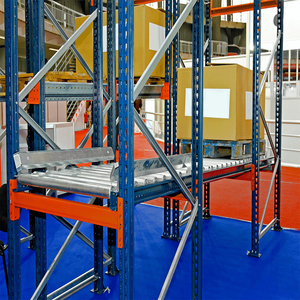
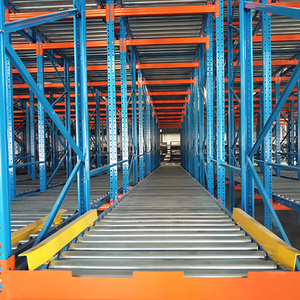
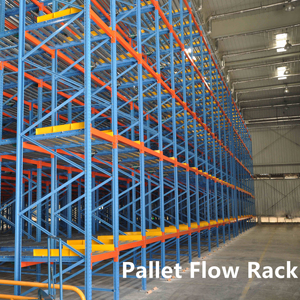
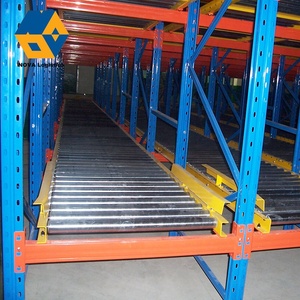
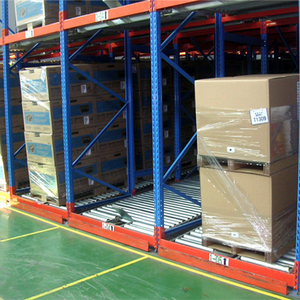
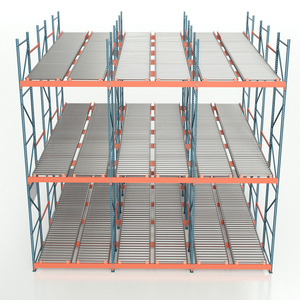
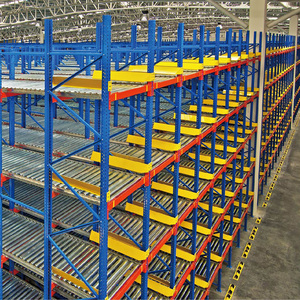
Gravity feed pallet racking (commonly designated across global logistics engineering as pallet flow racking or dynamic roller live storage) represents the pinnacle of non-powered, mechanical high-density warehousing. Unlike traditional selective pallet racking, which requires designated forklift operating aisles for every two rows of pallet positions, gravity flow racks operate via an inclined roller bed track—typically fixed at an engineered pitch between 2.5% to 3.5% (1.5° to 2.0°). This allows standard wooden, plastic, or metallic pallets to glide smoothly from the replenishment (loading) face down to the picking (unloading) face under natural gravitational acceleration.
The core structural advantage of this geometry is the total physical separation of forklift traffic. The replenishment aisle operates strictly for deposit cycles, while the extraction aisle operates exclusively for retrieval. This segregation eliminates forklift collision risks in shared aisles, dramatically reduces travel cycle times per pallet position, and creates an automatic, uncompromised FIFO (First-In, First-Out) materials handling cycle essential for food and beverage, cold chain, pharmaceutical distribution, and high-throughput FMCG fulfillment.
| Critical Component | Engineering Specification | Functional Impact on Storage Safety & Durability |
|---|---|---|
| Heavy-Duty Upright Profiles | Q235B / Q355B cold-formed steel; 80×60mm up to 120×95mm | Absorbs dynamic loading forces, floor settlement, and structural seismic impacts. |
| Galvanized Roller Assemblies | Ø50mm–Ø76mm heavy-duty steel tube with precision bearings | Delivers low rolling resistance (<0.03 coefficient) with corrosion protection in high humidity. |
| Centrifugal Speed Controllers | Mechanical dynamic brake rollers rated 500kg–1500kg | Arrests terminal runaway velocity; regulates pallet speed to an ultra-safe ≤0.3 m/s. |
| End Separator & Stop Plates | Pneumatic or mechanical latching pallet extraction isolator | Relieves line pressure on the lead pallet, allowing seamless, jam-free forklift extraction. |
| Anti-Corrosive Pretreatment | Pickling & phosphating + electrostatic thermoset polyester coating | Withstands coastal humidity, condensation in cold stores, and industrial abrasion. |
From an operational standpoint, line pressure calculation is critical in deep-lane applications (lanes exceeding 5 to 20 pallets in depth). When pallets are banked behind one another on an incline, cumulative downhill force acts upon the forward-most pallet. Chinese tier-one manufacturers solve this mechanical dilemma through high-precision pallet separators. These mechanical floor catches physically isolate the extraction pallet from the downstream queue. Once the lift truck lifts the lead unit load, the separator trips, allowing the next consecutive pallet in line to index forward smoothly into the discharge bay.
Global Procurement Trends: What Enterprise Buyers Look for in 2026–2030
Macroeconomic shifts, automated intralogistics adoption, and sustainability imperatives are redefining international procurement standards for dynamic storage equipment.
Zero-Energy "Green Warehousing"
As corporate net-zero pledges penalize electrical consumption, facilities are transitioning away from high-energy powered automated cranes toward passive mechanical gravity feed lines for buffer accumulation zones.
Hybrid AMR & AGV Integration
Modern gravity feed discharge faces are being re-engineered with specialized sensor cutouts, tapered entry guides, and optical reflectors to enable driverless autonomous counterbalanced forklifts to pick pallet loads 24/7.
Standardized Multi-Pallet Versatility
With cross-border trade demanding compatibility with Euro pallets (1200×800mm), US pallets (48×40"), and African/Asian standards (1100×1100mm), split-roller beds and triple-rail roller tracks are rapidly replacing rigid twin rails.
Why International Supply Chains Rely on Our Chinese Manufacturing Base
Combining heavy structural steel precision cold roll-forming with multi-stage automated electrostatic coating lines to ship container-optimized storage infrastructure worldwide.
Full In-House Fabrication
From primary hot-rolled steel strip slitting to computerized CNC upright punching, roll-forming, robotic welding, and shot blasting, all stages are concentrated within our 30,000 m² facility.
Certified Metallurgy Standards
Every structural profile conforms to CE EN 15512 and ISO 9001:2015 quality frameworks, ensuring precise deflection control under uniform distributed loads exceeding 1,500 kg per pallet.
Container Nesting Engineering
Components are knock-down designed with specialized modular bundling jigs to fully cube out 40ft HQ sea freight containers, slashing international ocean freight costs per pallet location.
Tailored Technical Support
Direct communication with structural engineers providing AutoCAD floorplans, 3D parametric renderings, dynamic simulation testing, and turnkey on-site or remote installation oversight.
Frequently Asked Questions: Purchasing Gravity Feed Racking from China
Clear, direct engineering and commercial answers to help supply chain directors mitigate risk and streamline logistics projects.
Q1: How is pallet travel speed controlled in long gravity flow lanes?
We integrate speed controller rollers (centrifugal brake drums) embedded directly along the roller tracks at calculated intervals (usually one brake per pallet position). These mechanical units operate without electricity: as rotation speed increases, internal brake shoes expand outward against internal linings, maintaining an even descent speed of approximately 0.2 to 0.3 meters per second.
Q2: Can gravity flow racking function reliably with imperfect or damaged pallets?
Gravity systems require good bottom deckboard contact. Damaged, severely warped, or cracked pallets can cause hang-ups on traditional roller lanes. For operations utilizing mixed or irregular pallets, our engineers implement full-width cylindrical steel rollers rather than twin-wheel tracks, and recommend heavy-duty slave boards or pallet runners to guarantee uniform flow.
Q3: What slope gradient is engineered for standard industrial pallet operations?
The standard industry gradient is between 3.0% and 3.5% (approx. 30mm to 35mm drop per 1,000mm of track length). During CAD design and factory pre-commissioning, we simulate your specific unit load weight (e.g., 500kg vs 1,200kg) and bottom pallet board composition to calibrate the exact gradient for reliable restarting after static dwell periods.
Q4: How does gravity flow compare to Radio Shuttle racking in ROI?
Gravity feed racking is completely passive—requiring zero electrical cabling, no lithium battery replacements, and no electronic PLC drive maintenance. While Radio Shuttle suits ultra-deep lanes (30+ pallets) with high SKU concentration, gravity flow offers lower total lifecycle maintenance costs, instant mechanical reliability, and continuous FIFO throughput with zero downtime during facility power disruptions.
Q5: What rust protection is applied for cold store or tropical coastal installations?
For ambient warehouses, our multi-stage automatic electrostatic powder coating (epoxy-polyester hybrid baked at 180°C–200°C) provides exceptional scratch and chemical resistance. For deep sub-zero cold rooms (-25°C) or high-humidity coastal environments, we specify continuous hot-dip galvanized (HDG) steel uprights and beams with zinc-plated roller assemblies to permanently prevent rust creep.
Q6: What lead time and shipping terms are standard for export orders?
Standard production cycles run 20 to 30 business days following structural drawing sign-off and deposit receipt. We export under EXW, FOB (Guangzhou, Shenzhen, Ningbo, Shanghai), CFR, and CIF terms directly to major ports across North America, Europe, Africa, the Middle East, and Southeast Asia with complete knocked-down container packing.
Accelerate Your Warehouse Intralogistics Efficiency
Connect directly with our engineering sales desk to discuss your facility footprint, pallet load profiles, and international sea freight options. Receive a certified technical proposal within 24 hours.
Inquire Now