Future Procurement Trends in Industrial Steel Shelving (2025–2030)
A rigorous examination of geopolitical material flows, container logistics optimization, and Total Cost of Ownership (TCO) matrices governing global industrial warehousing procurement.
1. The Paradigm Shift from Initial Capex to Lifecycle Total Cost of Ownership (TCO)
Industrial storage procurement across North America, Europe, Australia, and emerging industrial hubs in Africa and Latin America is undergoing a fundamental mathematical recalibration. Enterprise procurement officers are shifting their evaluation models away from nominal per-meter acquisition expenses toward exhaustive Lifecycle Total Cost of Ownership (TCO). A lower upfront quote frequently masks structural metallurgical compromises: sub-standard carbon content in strip coils, inadequate phosphorus elimination during molten conversion, or inferior dry film thickness (DFT) in powder coating that precipitates early oxidative degradation in high-humidity or coastal warehousing environments.
Advanced procurement frameworks now integrate structural longevity metrics, such as cross-hatch paint adhesion (ASTM D3359), salt-spray resistance thresholds (≥500 hours per ASTM B117), and maximum deflection compliance (≤L/200 under European standard FEM 10.2.02 and EN 15512). Storage systems engineered with premium grade Q235B or Q355B cold-rolled structural steel deliver a predictable mechanical fatigue life of 15 to 25 years without catastrophic beam sagging or frame twist, reducing insurance premiums and eliminating unbudgeted retrofitting downtime.
Key Engineering Metric: Beam Deflection & Safety Factors
Under FEM 10.2.02 and ANSI MH16.1 specifications, structural steel shelving beams must maintain an operational deflection limit of ≤ L/200 (where L is the clear span distance between uprights). HEDA Shelves engineers our box beams with a safety coefficient factor of 1.5 against yield, ensuring that under rated nominal load, structural deflection remains safely under L/230, providing a 15% structural buffer against dynamic forklift shock loading.
2. Containerized Freight Optimization & Knock-Down Volumetric Density
In an era characterized by maritime freight rate fluctuations and port demurrage volatility, structural packaging engineering is no longer an ancillary operational detail—it is a central procurement determinant. Standard rigid or pre-welded shelving frames introduce astronomical ocean freight premiums due to excessive dead-volume shipping. Leading international EPCs and 3PL enterprises now mandate 100% modular, knock-down (KD) upright configurations where horizontal and diagonal bracing members are bolted on-site to cold-formed upright profiles using lock-nut fastenings.
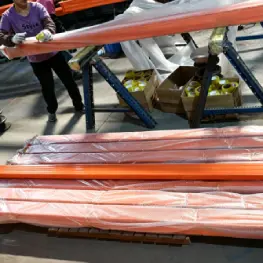
At Guangzhou Heda Shelves, our packaging engineers utilize specialized 3D nesting algorithms that maximize 40-foot High Cube (40HQ) container cubing capacity up to 92–95% volumetric efficiency. By bundling nested upright posts, alternating interlocking step beams, and strapping pallets with edge-protecting composite polymers, freight cost per storage bay drops by 28% to 35% on transatlantic and transpacific trade lanes compared to conventional packing protocols.
3. Sourcing Transparency, Metallurgy Auditing, and Geopolitical De-risking
Supply chain security requires unambiguous verification of raw material pedigrees. Forward-thinking buyers are enforcing strict requirements for mill test certificates (MTCs) detailing carbon (C ≤ 0.20%), manganese (Mn ≤ 1.4%), silicon, phosphorus, and sulfur content conforming to GB/T 700 Q235B or EN 10025-2 S235JR standards. Tier-1 manufacturers that control their full supply chain—from high-precision slitting lines and automatic continuous roll-forming mills to robotic welding cells—provide an airtight hedge against material failures and unpredictable international tariff exposures.
Evaluation Parameter
Generic Marketplace Shelving
HEDA Shelves Industrial Spec
Procurement Impact Benefit
Raw Steel Grade
Recycled / Mixed Grade Scraps
Prime Q235B / Q355B Hot-Rolled Strip
Certified Yield Strength (≥235 MPa)
Upright Forming Profile
Simple 4-Bend Channel
Multi-Ribbed Omega (Ω) 8-Fold Section
+42% Torsional & Buckling Rigidity
Surface Pretreatment
Manual Solvent Wipe Only
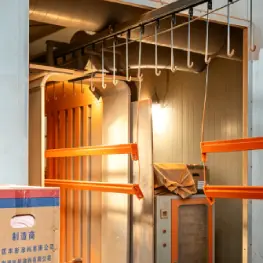
Automated 8-Stage Pickling & Phosphating
Zero Molecular Rust Underneath Paint Film
Coating Thickness
35 – 45 μm (Porous Layer)
65 – 85 μm Electrostatic Powder Curing
>500 Hours Salt Spray Resilience
Seismic & Static Calculations
Empirical Guesswork
FEA ANSYS Modeling to EN 15512 / RMI
Full Compliance with Municipal Fire/Building Codes
Container Volumetric Density
Standard Flat Pallet (65% Cube)
High-Density Interlocked Bundling (94% Cube)
Saves $1,200 – $2,800 Ocean Freight/Cont.
Intralogistics Engineering Horizons
Technological Innovations Shaping the Future of Steel Shelving
From automated micro-fulfillment picking interfaces to eco-cured nano-coatings, witness the engineering transformations modernizing global supply chain hubs.
1. Convergence with Autonomous Mobile Robots (AMR & AGV)
Traditional static shelving is evolving into dynamic robotic fulfillment cells. Modern industrial steel shelving units are increasingly engineered with precise floor-to-beam clearances, optical QR-guidance mounting strips, and high-tolerance pick faces specifically configured for collaborative Autonomous Mobile Robots (AMRs), Automated Guided Vehicles (AGVs), and robotic tote-handling cranes. Rigidity tolerances in rack plumbness have tightened from 1/500 to 1/1000 to eliminate robotic arm collision vectors.
2. Green Metallurgy & Carbon Neutral Finishing Lines
Environmental, Social, and Governance (ESG) directives are transforming finishing chemistry. Conventional lead-bearing solvent primers are completely obsolete. The industry standard has progressed to closed-loop, zero-VOC powder-coating recovery systems coupled with low-temperature nano-ceramic silane pretreatment baths. This clean metallurgy sequence eliminates toxic heavy metal effluents while cutting process energy demands by 22%, empowering multinational corporations to meet Scope 3 carbon reduction targets.
3. Ultra-High Tensile Micro-Alloy Profiles
By leveraging micro-alloyed structural steels treated with trace elements of vanadium, niobium, and titanium (V-Nb-Ti), cold-formed upright sections achieve yield strengths exceeding 355 to 420 MPa without sacrificing ductile weldability or forming elongation. This metallurgical breakthrough enables thinner wall gauges that support identical or higher dynamic payloads, fundamentally lowering structural tare weight, reducing logistics carbon footprint, and lowering freight costs.
Manufacturing Powerhouse
Why Enterprise Buyers Partner with Guangzhou Heda Shelves Co., Ltd.
Combining 25 years of structural racking fabrication excellence with automated German roll-forming lines, 30,000 m² of smart plant floor, and certified European structural compliance.
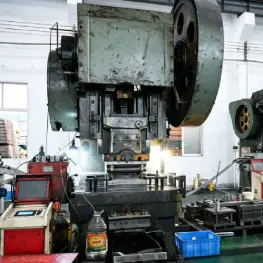
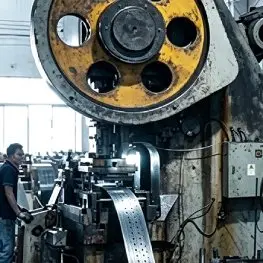
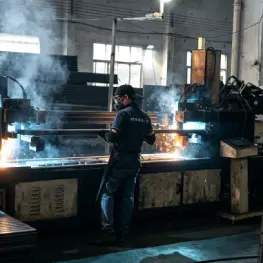
Inside Our Proprietary 10-Stage Precision Fabrication Line
01
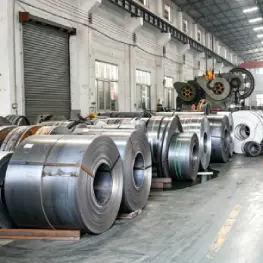
Prime Steel Slit Coils
02
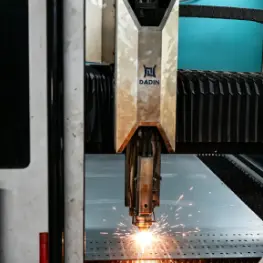
CNC Laser & Shearing
03
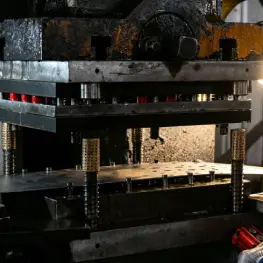
Automated Column Punch
04
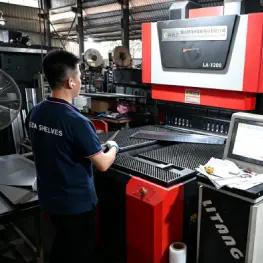
Cold Bending Forming
05
Continuous Profile Roll
06
Mechanical Polishing
07
Robotic Seam Welding
08
Pickling & Phosphating
09
Electrostatic Coating
10
QA Check & Container Pack
Globally Audited Reliability
International Certifications & Structural Conformity
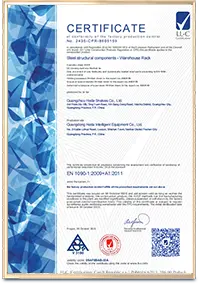
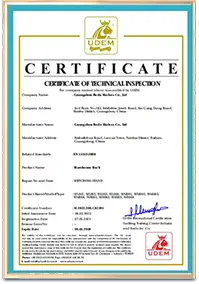
Every storage bay rolling off our automated production line conforms strictly to European standards (EN 15512, EN 15620, EN 15635), the US RMI Specification (ANSI MH16.1), and Australian racking mandate AS 4084-2023. Our engineering parameters are validated through continuous destructive sampling tests, weld ultrasonic testing (UT), and digital salt-spray chamber validation.
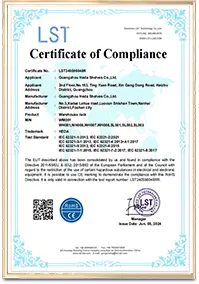
CE Certification (No. 2435-CPR-8605159)Mandatory factory production control approval for EU industrial steel structural execution.
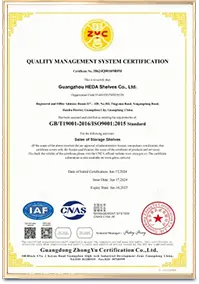
ISO 9001:2015 Quality Management System (No. 18624Q00169R0M)Certified comprehensive QA tracking from raw coil slit processing to outbound port stowage.
RoHS Compliant Finishing FormulationFree from hazardous heavy metals, lead, cadmium, and hexavalent chromium compounds.
Authoritative technical guidance compiled by our senior structural engineers to de-risk your overseas storage shelving acquisition.
How does HEDA Shelves calculate and guarantee safe beam load capacities?
Our structural calculation model complies with European FEM 10.2.02 and US RMI MH16.1 specifications. Beam design calculations account for both structural bending moments and maximum deflection criteria under Uniformly Distributed Load (UDL). The deflection must never exceed 1/200th of the beam span (L/200). We employ Finite Element Analysis (FEA) through ANSYS software to stress-test high-tensile connection claw teeth and box-beam seams, applying an integrated safety factor (γ) of 1.5 against material yield limit.
What steel metallurgy standard is used, and how is it verified?
We exclusively process prime, certified Q235B and Q355B cold-rolled and hot-rolled structural steel coils purchased directly from Tier-1 national mills (such as Baosteel and Shougang). Every incoming steel coil is accompanied by an authentic Mill Test Certificate (MTC) stating precise chemical heats (C, Si, Mn, P, S) and mechanical yield/tensile values. We perform on-site spectral chemical audits and hydraulic tensile tests before slitting.
How do your surface treatments protect against rust in humid or coastal warehouse locations?
Rust resistance depends directly on chemical pretreatment before powder application. At HEDA Shelves, steel parts pass through an automated 8-stage conveyorized sequence: hot alkaline degreasing, clean water rinse, rust-stripping acid pickling, surface conditioning, zinc-manganese phosphating (forming a dense 1.5–2.5 g/m² crystalline barrier), dual deionized rinses, and a 180°C moisture burn-off drying oven. Next, electrostatic epoxy-polyester powder is cured at 200°C to achieve a 65–85 μm film thickness, delivering over 500 hours of ASTM B117 salt spray endurance. For extreme marine or cold-storage environments, we supply hot-dip galvanized (HDG) steel components with coating thicknesses of 80–120 μm conforming to ISO 1461.
What information is required to receive an engineered CAD floor plan and 3D rendering?
To provide a precise engineering design within 24 hours, our application engineering team requires:
Building architectural drawing showing internal dimensions, clear eaves height, column grid spans, and overhead obstruction heights (HVAC, lighting, fire sprinklers).
Unit load profiles: Pallet or carton dimensions (Length × Width × Height including product overhang) and maximum gross weight.
Material handling equipment (MHE): Forklift make, model, minimum aisle turning radius (AST), and maximum mast lift reach.
Operating environment: Ambient, cold chain (temperature range), seismic zone acceleration, or floor slab structural load limits (kN/m²).
What is the difference between boltless shelving and heavy-duty bolted pallet racking?
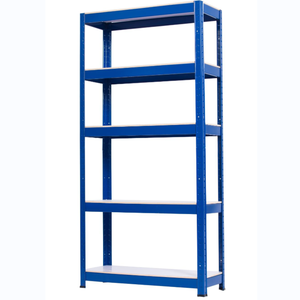
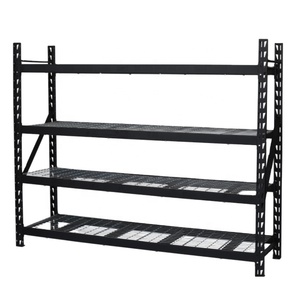
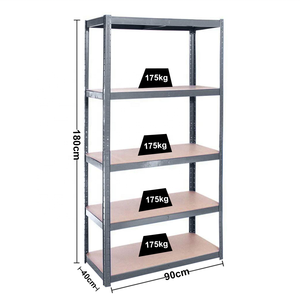
Boltless shelving utilizes precision-punched teardrop, keyhole, or butterfly cutouts on upright columns that interlock with corresponding cold-stamped beam end connector tabs using natural gravitational friction. It requires zero hardware for shelf level adjustments, making it optimal for manual hand-picking (150–800 kg/tier). Bolted heavy-duty pallet racking employs heavier gauge structural steel frames bolted with M10/M12 high-tensile fasteners to horizontal/diagonal bracing, accompanied by heavy claw-connector box beams locked via spring safety pins, designed for forklift interface up to 4,500 kg per tier.
How does HEDA handle international shipping, ocean container loading, and customs clearances?
We provide comprehensive Incoterms fulfillment, including FOB Guangzhou/Shenzhen, CFR, CIF, and DDU/DDP terms. Components are packaged with computerized volumetric nesting: uprights are bundled with steel straps and edge-corner buffers, beams are placed on interlocking wooden frames, and hardware items are packed in heavy multi-ply corrugated cartons on fumigated ISPM-15 wooden pallets. Full shipping dossiers include Commercial Invoices, Packing Lists with bay-by-bay itemization, Bills of Lading, Certificates of Origin (Form E, CO, etc.), and mill test certs for seamless customs entry.
Can our local mechanical workforce install HEDA shelving without factory technicians on-site?
Yes. Over 85% of our international projects are successfully assembled by local mechanical contractors or in-house warehouse maintenance teams. We ship complete erection dossiers: 3D exploded layout drawings, frame assembly schematics, beam safety-clip insertion steps, floor anchor torque specifications, and step-by-step video installation guides. For mega-distribution centers or complex multi-tier mezzanine floors, we can deploy senior installation supervisors on-site to oversee positioning, leveling, anchoring, and final load certification.
Accelerate Your Warehouse Intralogistics Efficiency
Connect with a structural racking design engineer today. Get your complimentary 3D warehouse layout, finite element load calculation, and factory-direct quotation within 24 hours.