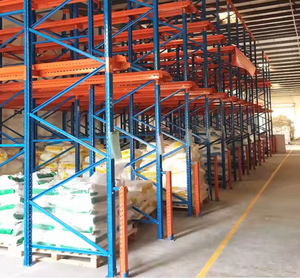
Engineered Pallet Storage Unit Portfolio
Custom-fabricated pallet racks certified to international structural standards (CE & ISO 9001:2015), engineered directly in our 30,000 m² factory.
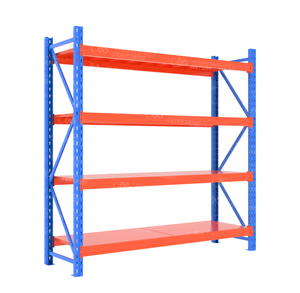
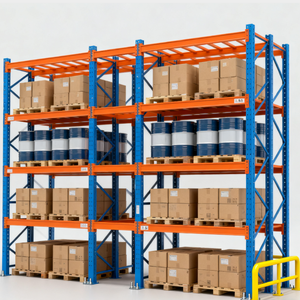
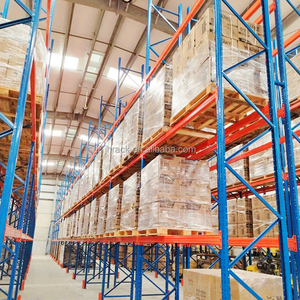
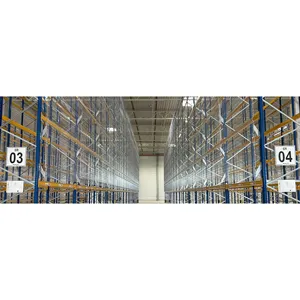
2001
Established Year
30,000m²
Manufacturing Facility
30,000Tons
Monthly Steel Output
10,000+
Global Projects Delivered
Procuring industrial pallet storage units directly from China demands a methodical understanding of structural metallurgical grades, cold-roll continuous roll-forming tolerance, corrosion control systems, and container transport cubic efficiency. In this comprehensive technical guide, Guangzhou HEDA Shelves Co., Ltd. presents engineering benchmarks, procurement methodologies, and global logistics analyses derived from over two decades of international supply experience across 120 countries.
Engineering Evaluation: Material Integrity & Load-Bearing Physics
The baseline requirement of any heavy-duty pallet racking system begins with the molecular integrity of the raw steel coil. Top-tier Chinese pallet storage unit factories source certified Q235B and Q355B structural carbon steel, rigorously tested for tensile yield strength (ranging between 235 MPa and 355 MPa) and fracture elongation parameters. Low-cost manufacturers often substitute secondary mill coils with non-uniform thickness variations; such metallurgical compromises introduce systemic vulnerabilities that trigger critical buckling failure under dynamic load deflection limits (typically defined as L/200 or L/250 according to RMI and FEM 10.2.02 standards).
At HEDA Shelves, the production architecture employs automated computer numerical control (CNC) punching lines to profile column upright slots with continuous pitch accuracy down to ±0.1mm. High-strength step beams and box beams utilize continuous submerged-arc seam welding with robotically positioned 3-hook and 4-hook connectors. This joint design ensures optimal torsion resistance under full asymmetrical operational loadings, while integral spring safety locks prevent dislodgement caused by erratic forklift vertical mast movements.
Technical Specification Matrix: Industrial Pallet Storage Configurations
| Racking Architecture | Access Selectivity | Storage Density Index | Stock Rotation Logic | Forklift Type Compatibility | Primary Application Profile |
|---|---|---|---|---|---|
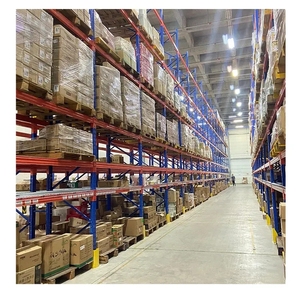
| Selective Pallet Racking | 100% Direct Immediate | Baseline (40-45% Volumetric) | FIFO / LIFO Dynamic | Counterbalance, Reach Truck | High-SKU 3PL, Retail Distribution Hubs |
| Drive-In / Drive-Through | Low (Lane Restricted) | High (65-75% Volumetric) | LIFO (Drive-In) / FIFO (Drive-Thru) | Narrow Counterbalance, Reach Truck | Bulk Seasonal Commodities, Cold Storage |
| Radio Shuttle Automation | Semi-Automated Channel | Maximum (75-85% Volumetric) | Programmed FIFO & LIFO | Standard Counterbalance Mast | High-Throughput FMCG, Frozen Protein Storage |
| Push-Back Gravity Cart | Moderate (2-6 Deep Lanes) | Medium-High (60-70% Volumetric) | Strict LIFO Operation | Standard Counterbalance | Buffer Zones, Moderate Turnover Storage |
| Heavy-Duty Cantilever | Continuous Linear Profile | Targeted (Structural Long Goods) | Variable Open Access | Side-Loader, Four-Directional Truck | Rebar, Steel Pipes, Timber, Structural Sheet |
Strategic Sourcing Trends: What Enterprise Procurement Must Anticipate (2025–2030)
Global supply chain shocks and shifting trade lane economics have altered how global enterprises approach container-direct factory procurement from China. Enterprise procurement officers are discarding simplistic "price-per-kilo" heuristics in favor of Total Landed Cost (TLC) modeling that factors in lifecycle structural integrity, corrosion warranty periods, and spatial optimization metrics.
High-Density Consolidation Modeling
Due to surging industrial real estate overhead across logistics hubs, warehouse operators are shifting capital expenditures from basic selective frames toward high-density automated carrier systems and structural rack-supported mezzanines, effectively doubling or tripling storage volume within the identical facility footprint.
Container Volumetric Engineering
Ocean freight rates make packaging optimization a crucial cost factor. Leading manufacturers engineer boltless knock-down upright frames, tapered nested profile designs, and precision-bundled accessories specifically computed to utilize over 92% of dry internal container capacity (20GP, 40GP, and 40HQ).
Verifiable Third-Party Compliance
Self-declaration of capacity is no longer sufficient. International compliance regimes require verifiable CE performance marking (EN 15512, EN 15620, EN 15635), active ISO 9001:2015 traceability certifications, and structural load simulation models validated by certified civil and structural engineers.
Technological Evolutions in Pallet Rack Manufacturing
The production of industrial pallet units has transitioned away from rudimentary manual metal-forming workshops. Contemporary Chinese factory leaders operate automated electrostatic coating lines featuring multi-stage chemical pretreatment: degreasing, acid pickling, rinsing, and phosphating. This multi-tank immersion sequence creates a molecular conversion coating that ensures thermal-bonded polyester powder coat adhesion, resisting salt spray corrosion for over 500 hours (ASTM B117 standards).
Furthermore, for specialized applications such as blast freezers, cold chain warehouses, and outdoor chemical yards, factories provide hot-dip galvanizing (HDG) treatments exceeding 85 microns of zinc penetration. This ensures zero brittle fracture or micro-flaking down to operational temperatures of -30°C, offering durable longevity where standard powder coatings would degrade.
Pallet Storage Unit Procurement: Technical FAQ
Crucial engineering, operational, and trade answers for international supply chain directors.
How do you verify structural load capacity to prevent rack collapse?
Structural verification is governed by finite element analysis (FEA) cross-checked against empirical destructive load testing. Upright column frame capacities are calculated based on unbraced length, vertical beam spacing levels, and seismic coefficient criteria per EN 15512 or RMI standards. Each fabricated batch undergoes deflection monitoring ensuring horizontal beam sagging does not exceed L/200 under 100% rated capacity, coupled with a minimum 1.5 structural safety factor against ultimate yield tensile failure.
What technical data is required to generate an accurate warehouse layout quotation?
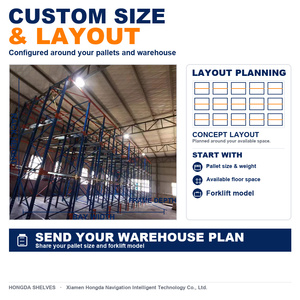
To produce an actionable 3D model and price quotation, our engineering team requires: (1) Architectural warehouse floor plan indicating clear building height, column grids, expansion joints, and fire door clearances; (2) Pallet specifications including overall dimensions (W x D x H), total gross weight per pallet, and pallet entry orientation (two-way or four-way); (3) Forklift specifications covering maximum mast lift height, minimum turning radius, and aisle clearance width; and (4) Throughput metrics including SKU count and target stock turnover cycle (FIFO vs. LIFO).
How are racking units protected against moisture and corrosion during ocean transport?
During long-distance maritime shipping, relative humidity within sealed sea containers frequently triggers condensation ("container rain"). HEDA Shelves addresses this by applying electrostatic thermosetting polyester powder coating over chemically phosphated cold-rolled steel. Bundles are protected with industrial-grade micro-perforated stretch film, moisture-absorbing desiccants, and heavy corrugated edge board buffers. Upright profiles and beams are nested on wooden runners to eliminate direct steel-on-steel friction and abrasion during transit.
Can mechanical racking function effectively in unstable power grid environments?
Yes. Selective pallet racking, double-deep setups, drive-in systems, push-back gravity carts, and heavy cantilever units are 100% mechanical structures requiring zero electrical infrastructure. For semi-automated installations utilizing Radio Shuttle carts, HEDA supplies heavy-duty lithium-iron-phosphate (LiFePO4) battery units engineered with quick-swap battery charging bays, allowing seamless continuous operation coordinated with localized diesel generator run cycles or solar power charging schedules.
What on-site installation support is provided for overseas projects?
Every dispatched container is accompanied by a project-specific technical documentation dossier. This includes high-resolution 3D structural exploded diagrams, component coordinate maps where every frame and beam bears matching physical stamped tags, and torque specification tables for chemical anchor bolts. Additionally, HEDA provides continuous remote video engineering guidance, and for projects exceeding 3,000 pallet locations, we deploy certified bilingual structural installation supervisors on-site to oversee local mechanical installation crews.
What certifications and audit reports validate HEDA Shelves manufacturing quality?
Guangzhou HEDA Shelves operates under verified international accreditations including CE certification (No. 2435-CPR-8605159) confirming compliance with European structural steel construction norms, ISO 9001:2015 certification (Registration No. 18624Q00169R0M) covering design, manufacturing, and distribution of industrial storage systems, and comprehensive RoHS testing reports validating the absence of hazardous heavy metals within our electrostatic powder coating formulations.
Ready to Optimize Your Warehouse Pallet Capacity?
Get in touch with Guangzhou HEDA Shelves engineering team to receive a complimentary custom 2D/3D warehouse layout, technical load calculation, and factory-direct quotation within 24 hours.
Get Catalog