Smart Fabrication Base
Monthly Metric Tons Output
Global Industrial Installs
Engineering & Export Mastery
Heavy-Duty VNA Racking Systems & Semi-Automated Solutions
Precision-machined upright profiles, heavy-gauge load beams, and rail-guided configurations engineered for maximum vertical utilization and rapid high-lift order picking.
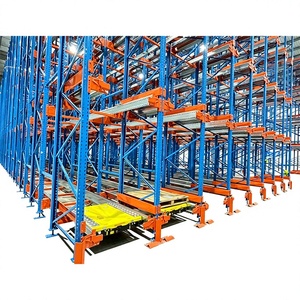
- Deep lane shuttle integration
- FIFO & LIFO logic execution
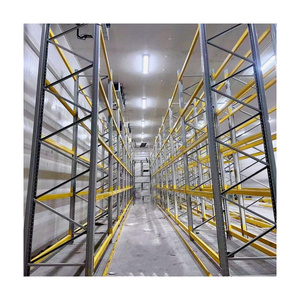
- Heavy machinery spare storage
- Up to 4,500 kg bay capacity
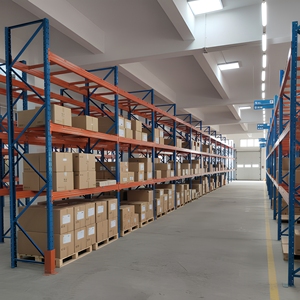
- 75mm beam pitch adjustability
- Pickled & phosphated coating
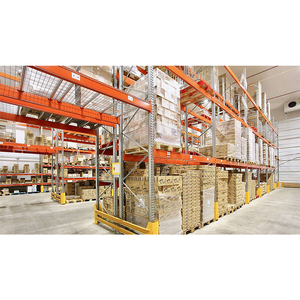
- 1600mm narrow aisle clearance
- Turret truck guide compatible
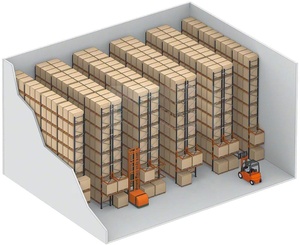
- High-bay vertical reaches >15m
- 100% direct pallet accessibility
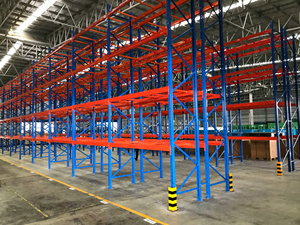
- Knock-down bundling export ready
- Q235B cold-rolled frame profiles
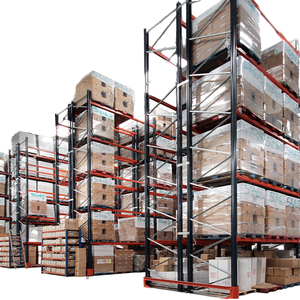
- Floor surface footprint cut 45%
- Mechanical rail guides included
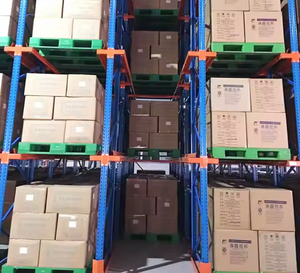
- Galvanized or powder coated
- Direct factory volume pricing
Engineering Principles & Volumetric Efficiency of VNA Racking
Very Narrow Aisle (VNA) pallet racking systems represent the pinnacle of high-density mechanical storage. By narrowing operating aisles from standard counterbalance widths (3,200mm – 3,800mm) down to 1,500mm – 1,850mm and leveraging vertical building envelopes up to 18 meters, VNA configurations expand effective warehouse cubic storage capacity by 40% to 50% without forfeiting 100% individual pallet selectivity.
Aisle Geometry & Truck Interfacing
Standard counterbalanced forklifts demand broad sweeping radials. VNA systems interface with specialized bi-directional or tri-lateral turret trucks (Man-Up or Man-Down) that rotate forks 180 degrees without turning the chassis. This compresses the necessary aisle width strictly to the load profile plus safe running margins (typically 200mm clearance per side).
Structural Rigidity & Sway Dynamics
Because VNA structures regularly achieve elevations between 10m and 18m, dynamic horizontal and torsional sway become critical safety parameters. Upright profiles must utilize heavy cross-sectional moments of inertia (Ix, Iy), high yield strength cold-formed structural steel (Q235B/Q355B), and reinforced interlocking 5-hook beam connectors to maintain frame plumb within 1/1000th of upright height under maximum pallet dynamics.
Guidance Subsystems: Rail vs. Wire
To eliminate vehicle collision risk at multi-tier lift elevations, VNA aisles employ continuous guidance. Low-profile structural guide rails (angle iron or heavy box sections bolted along base uprights) mechanically steer vehicle guide wheels. Alternatively, floor-embedded inductive magnetic wire tracking emits low-frequency radio guidance, eliminating ground trip hazards and speeding aisle transitions.
| Storage Racking System | Operating Aisle Width | Vertical Reach Limit | Footprint Utilization | Selectivity Ratio | Handling Equipment Type |
|---|---|---|---|---|---|
| Very Narrow Aisle (VNA) | 1,500 mm – 1,850 mm | Up to 18.0 Meters | Ultra-High (85-90%) | 100% Direct Immediate | Tri-Lateral Turret Truck / Articulated |
| Standard Selective Racking | 3,200 mm – 3,800 mm | Up to 10.5 Meters | Moderate (40-50%) | 100% Direct Immediate | Standard Counterbalance Forklift |
| Double Deep Racking | 3,000 mm – 3,400 mm | Up to 11.0 Meters | High (60-65%) | 50% Immediate (Last-In) | Pantograph Reach Truck |
| Radio Shuttle Automation | Variable Lane Aisle | Up to 22.0 Meters | Dense (80-92%) | Batch / SKU Channel | Standard Forklift + Automated Shuttle |
Guangzhou HEDA Shelves: Cold-Form Precision Engineering Since 2001
Industrial warehousing storage systems are civil-structural assets where failure is catastrophic. Founded in 2001, Guangzhou Heda Shelves Co., Ltd. operates a centralized 30,000-square-meter intelligent manufacturing plant, outputting over 30,000 metric tons of certified racking every month to global markets across North America, Europe, Australia, Southeast Asia, the Middle East, and Africa.
Every VNA upright frame, step beam, pallet support bar, and floor anchor is processed on continuous multi-station CNC roll-forming lines. By keeping continuous control over steel coil slitting, cold roll-bending, automated punch-pressing, robotic shielding gas welding, and 10-stage chemical pickling pretreatment, HEDA delivers verifiable dimensional accuracy and micro-tolerance straightness essential for high-elevation VNA turret clearance.
-
Certified Structural Compliance: Full conformance to European CE standard EN 15512 (2435-CPR-8605159), ISO 9001:2015 Quality Management (18624Q00169R0M), and RoHS environmental standards.
-
Advanced Pretreatment Metallurgy: Seven-step acid pickling, zinc phosphating, and deionized water rinsing before electrostatic thermoset powder curing at 200°C for superior corrosion and abrasion resistance.
-
FEA Load Simulation & Free 3D Modeling: Structural engineers provide finite element analysis (STAAD.Pro / ANSYS) ensuring dynamic earthquake resistance, wind-shear resilience, and exact deflection ratios.
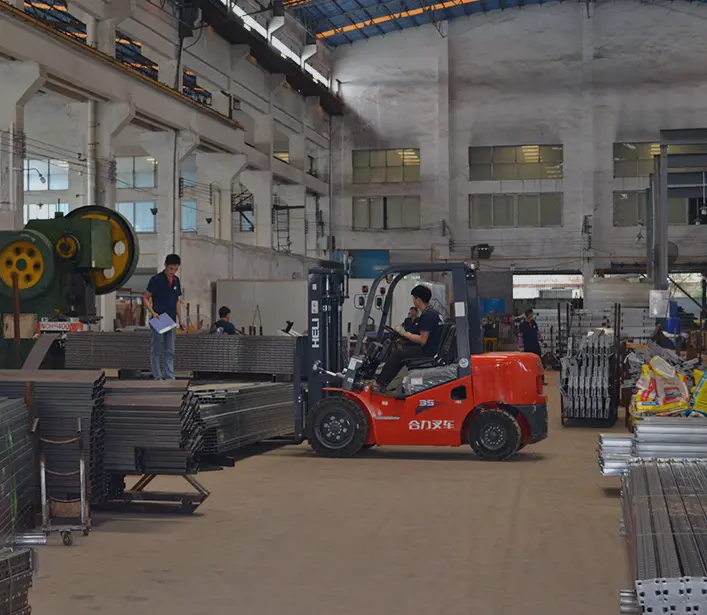
How High-Performance VNA Components Are Fabricated
From prime hot-rolled and cold-rolled steel coils to finished containerized bundling, each manufacturing station adheres to stringent European and American testing tolerances.
Certified Q235B and Q355B high-tensile structural steel tested for tensile strength, elongation, and uniform thickness.
Multi-station cold roll-bending produces 12-fold omega profile upright columns with zero residual strain.
High-speed mechanical presses punch interlocking teardrop or diamond adjustment slots at precise 75mm/50mm increments.
Deep immersion acid bath pickling, oil degreasing, and phosphating create a protective corrosion barrier for powder bonding.
Automated powder spray tunnels coat components with epoxy-polyester thermosetting resin cured at 200°C for lasting durability.
Future Procurement Trends in VNA Racking Systems (2025–2030)
The industrial logistics landscape is moving rapidly toward vertical densification, intelligent tracking, and automated material handling integration. Global EPC contractors, warehouse developers, and procurement executives must evaluate systems against these emerging operational dynamics.
High-Bay Verticalization (>15m)
Rising industrial land valuations in prime multimodal transport hubs have made vertical storage mandatory. Modern VNA specifications routinely mandate upright heights exceeding 14 to 17 meters. This trend requires heavier gauge column steel (up to 3.0mm thickness), enhanced horizontal tie-bracing, and micro-tolerance floor flatness to eliminate dynamic turret mast deflection at high lifts.
AMR & Autonomous Turret Truck Fusion
Manual order-picking inside VNA corridors is transitioning toward semi-autonomous and driverless guided operations. AGV/AMR turret trucks equipped with LiDAR SLAM, optical guidance, and 3D vision systems require tighter beam level placement, zero beam sagging tolerances (deflection limits restricted to L/250 or L/300), and integrated RFID retrofitting on pallet runner surfaces.
Container Optimization & Green Supply
With cross-border ocean freight volatility, leading Chinese exporters utilize 3D nesting algorithms that maximize 40HQ container volumetric capacity up to 98.5%. Furthermore, eco-conscious corporate mandates require non-toxic TGIC-free electrostatic powder coatings, low-emission steel sourcing, and documented structural durability that eliminates replacement cycles over 15+ years.
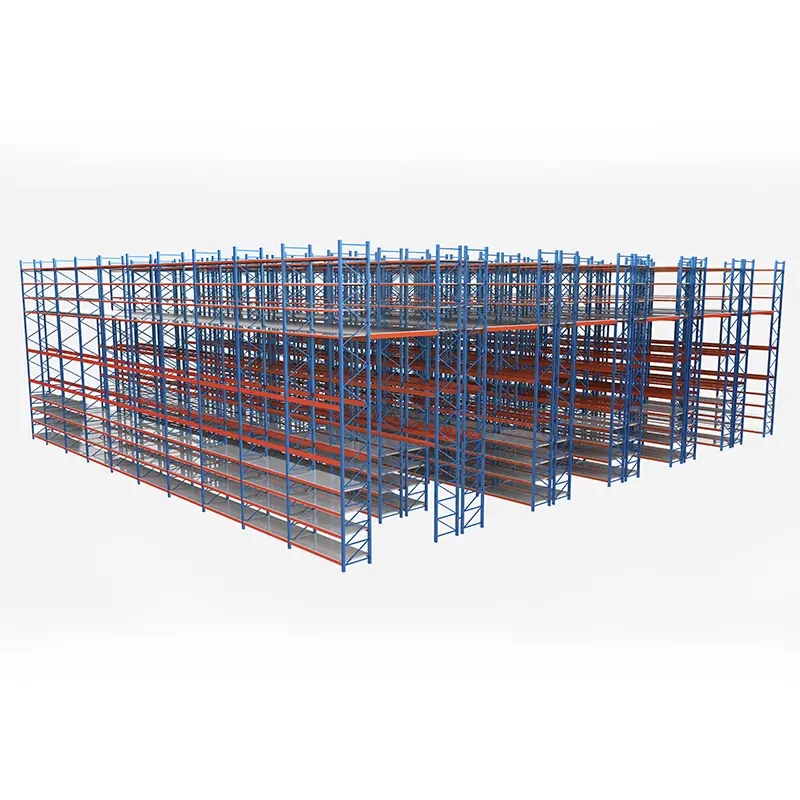
Floor Flatness, Anchoring & Installation Engineering
In standard wide-aisle warehousing, minor concrete slab undulations are easily absorbed by pneumatic truck tires. In VNA operations exceeding 12 meters, a floor level deviation of just 2 millimeters under the truck wheels translates into a dangerous 50mm to 80mm lateral tilt at the mast head, risking catastrophic beam impact and rack collapse.
Prior to installing HEDA VNA racking systems, our civil-structural engineers evaluate floor flatness profiles against recognized international benchmarks:
-
DIN 18202 & EN 15620 Tolerances: For rack heights between 9m and 15m, concrete floor profiles must achieve Class DM2 or Superflat rating to ensure safe truck movement and mast clearance.
-
Heavy Anchor Shimming & Baseplates: High-tensile expansion or chemical wedge anchors (M12 to M16) secure oversized CNC-punched steel footplates, with micro-precision leveling shims compensating for slab variances.
-
Aisle Entry Guide Horns: Ruggedized, bright-safety-yellow cast steel entry horns installed at aisle headers channel turret trucks safely into guide rails without damaging upright frames.
Frequently Asked Questions: Sourcing VNA Racking from China
Detailed, engineer-reviewed answers addressing international shipping costs, structural load ratings, building clearances, seismic compliance, and turnkey installation support.
What are the exact aisle clearance requirements for VNA turret trucks? +
How does HEDA guarantee steel quality and load deflection safety? +
What are the advantages of low-profile guide rails versus inductive wire guidance? +
How are components packaged for long-distance 40HQ container ocean export? +
Can VNA racking systems be engineered for high seismic risk zones? +
What is the standard production and shipping lead time for volume orders? +
Can our local warehouse crew handle the installation, or do you provide supervision? +
Accelerate Your High-Density Warehouse Project
Send our civil and industrial racking engineers your warehouse CAD floor plan, building height clearances, pallet dimensions, and target truck models. We provide a full 3D layout rendering, structural load calculation, and factory-direct quotation within 24 hours.