Featured Blue Warehouse Racking & Industrial Storage Equipment
Standardized in industrial signal blue (RAL 5015 / RAL 5010) with electrostatic anti-corrosion finishes. Engineered from premium Q235B and Q355B cold-rolled steel coils, designed to meet FEM 10.2.02, RMI, and EN 15512 global structural safety codes.
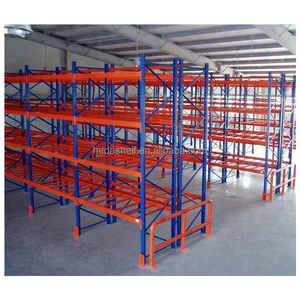 High Selectivity
Wide Aisle Pallet Racking Heavy Duty Metal Rack Double Deep Clothes Racking System
- Steel Grade:Q235B / Q355B Cold Rolled
- Load Capacity:1,000 – 4,500 kg / level
- Finish & Color:RAL 5015 Blue Uprights
- Aisle Width:Standard / Double Deep
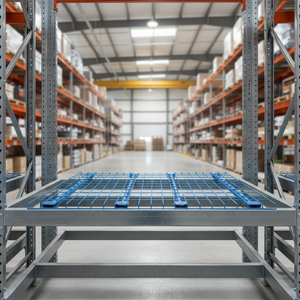 Safety Component
Jiamu European Style Inverted Pallet Rack Wire Mesh Decking Galvanized Powder Coated
- Wire Gauge:4.0mm – 6.0mm High Tensile
- Channel Supports:3–5 Inverted Flared Ribs
- Surface Protection:HDG / Powder Coated Blue
- Fire Code:NFPA 13 Sprinkler Certified
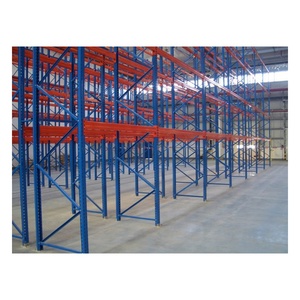 Multi-Tier Ready
Industrial Shelf Racking Steel Warehouse Multi-Level Pallet System Metal Shelves
- Upright Pitch:50mm / 75mm Adjustable
- Structural Type:Multi-Tier Pick Module
- Corrosion Shield:10-Stage Phosphated Coat
- Beam Profiles:80x50 to 160x50 Box Beams
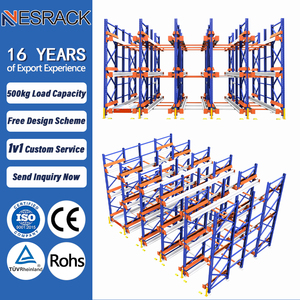 Semi-Automated
High Density Durable Radio Shuttle Rack Heavy Duty Industrial Storage Racking
- Configuration:FIFO & LIFO Automated
- Lane Depth:Up to 40 Pallets Deep
- Carrier Speed:0.8 – 1.1 m/s (Loaded)
- Space Utilization:+85% Storage Density
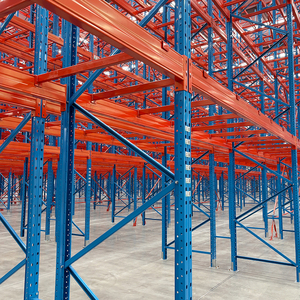 Sub-Zero Tested
Jracking Modular Design Storage Shelf CE Certified Heavy Duty Pallet Rack Cold Room
- Thermal Rating:Operational to -30°C
- Coating Formulation:Cold-Resistant Epoxy-Poly
- Certification:CE 2435-CPR-8605159
- Steel Grade:Low-Temp Impact Q355D/E
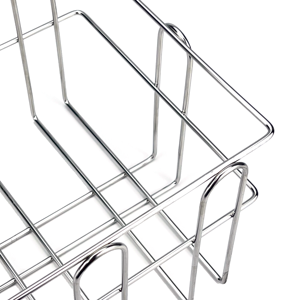 Commercial OEM
Custom Wire Shelving Unit For Kitchen Storage and Commercial OEM Projects
- Construction:Modular Carbon Steel Wire
- Shelf Adjustability:1-inch Increment Sleeves
- Surface Treatment:Chrome / Blue Powder Coat
- Airflow Factor:Open Truss High Efficiency
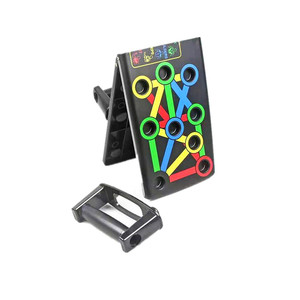 Consumer OEM Division
BEONE 9 in 1 Foldable Plastic Adjustable Power Press Fitness Push Up Rack Board
- Material:High-Impact ABS Polymer
- Load Rating:Up to 300 kg Static Load
- OEM Branding:Custom Logo, Mold & Pack
- Portability:Foldable Lock Mechanism
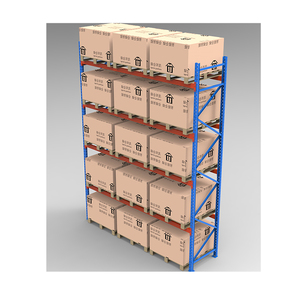 Certified System
Wire Mesh Decking Pallet Rack Heavy Duty Steel Rack Certificated Storage System
- Safety Standard:ANSI MH26.2 Compliance
- Beam Integration:Step Beam / Box Beam Flange
- Mesh Grid:50x50mm / 50x100mm Pattern
- Standard Color:Safety Orange & Blue RAL 5015
Why International Brands Choose HEDA Shelves as Their Primary OEM/ODM Racking Partner
Founded in 2001, Guangzhou Heda Shelves Co., Ltd. has grown to operate a comprehensive 30,000 square meter intelligent manufacturing facility headquartered in Guangzhou, China. Producing over 30,000 metric tons of certified industrial racking monthly, our factory handles the entire production lifecycle in-house—from cold-coil slitting, roll-forming, and robotic plasma punching to automated multi-stage surface treatments and container-nesting logistics.
Our engineering division designs bespoke storage frameworks under strict international compliance standards, including CE Certification (No. 2435-CPR-8605159), ISO 9001:2015 Quality Management (Certificate No. 18624Q00169R0M), and European RoHS standards. This guarantees that our structural load calculations adhere to FEM 10.2.02 (Design of Static Steel Pallet Racking) and ANSI/RMI MH16.1 specifications, maintaining rigid safety margins under maximum uniform distributed loads (UDL).
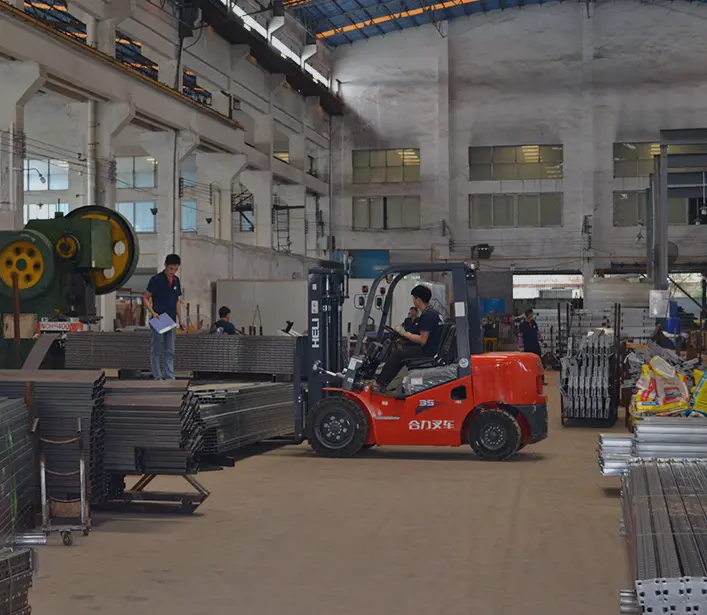
Standardized 10-Stage Industrial Production & Coating Sequence
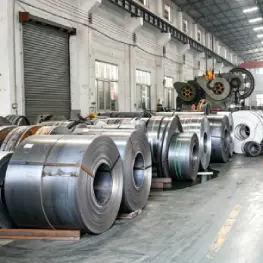
Certified Q235B and Q355B coils tested for yield strength and chemical composition.
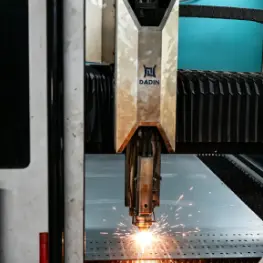
Automated high-speed coil slitting ensuring edge dimensional tolerances within ±0.1mm.
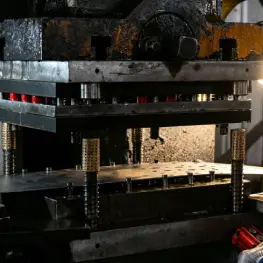
Continuous punching lines for 50mm and 75mm pitch diamond and teardrop slots.
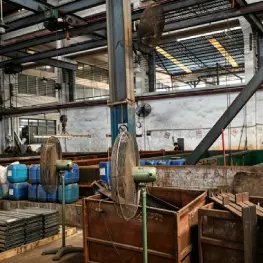
Acid pickling, ultrasonic degreasing, and phosphating for uncompromised paint adhesion.
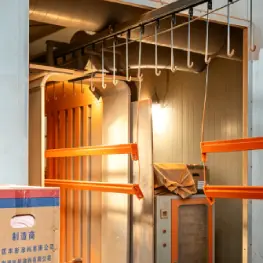
Robotic Gema powder application with computerized curing tunnels at 200°C.
Future Procurement & Technological Trends in Industrial Warehouse Storage
Navigating global supply chain volatility, total cost of ownership (TCO) shifts, automated handling compatibility, and environmental compliance frameworks across enterprise racking acquisitions.
1. The Strategic Shift in Global Procurement: From Piece-Price to Landed Deflection-TCO
For decades, warehouse racking procurement primarily centered on unit price per metric ton of steel. In modern multi-facility distribution networks, this single-variable metric is obsolete. Leading supply chain operators now evaluate racking investments through the prism of Total Cost of Ownership (TCO) and landed cubic efficiency.
Key drivers defining future procurement contracts include:
- Optimized Steel Weight via Finite Element Analysis (FEA): By transitioning from conventional Q235B steel to high-yield Q355B (equivalent to ASTM A572 Grade 50) in heavily stressed upright profiles, manufacturers can reduce raw structural tonnage by 12% to 18% while simultaneously increasing bending moment capacities. This directly decreases containerized sea freight costs per pallet position.
- Automated Freight Nesting Efficiency: Knock-down racking architectures tailored for 40-foot High Cube (40'HQ) intermodal containers maximize sea shipping volume. Custom nesting brackets and bundle design prevent beam web damage and avoid paying freight on empty container volume, saving up to $15 per pallet location in transit costs.
- Coating Resilience in Extreme Climates: With the global expansion of refrigerated logistics hubs and coastal transshipment centers in Southeast Asia, Africa, and Latin America, standard single-coat paint degrades rapidly. Forward-thinking procurement teams specify multi-stage powder coats capable of withstanding constant thermal fluctuations (-30°C to +40°C) and RH exceeding 85% without blistering.
2. Technological Evolution: Racking as the Structural Backbone of Smart Warehouses
Industrial warehousing is undergoing an aggressive convergence between static mechanical storage and dynamic automated machinery. Racking structures are no longer passive steel shelves; they are high-precision structural interfaces supporting robotics, wireless sensors, and semi-automated vehicles.
| Storage Architecture | Floor Utilization | Stock Rotation Mode | Automated Compatibility | Typical Capex / Pallet | Best Fit Industries |
|---|---|---|---|---|---|
| Selective Pallet Racking | 35% – 42% | 100% Selectivity (FIFO) | AGV / Reach Trucks | Baseline Economical | High-SKU Retail, 3PL, E-commerce hubs |
| Double Deep Racking | 50% – 58% | LIFO / Batch FIFO | Deep-reach Pantograph Trucks | +15% vs Selective | Dry Food, Packaging, Paper Mills |
| High-Density Radio Shuttle | 75% – 85% | Flexible FIFO / LIFO | Semi-Autonomous Shuttle | +40% to +60% | Cold Chain, Beverage, FMCG, Dairy |
| Rack-Supported Mezzanines | 150% – 200% (Vertical) | Floor-level Picking | Vertical Lifts & Conveyors | Medium Capex | Automotive Spares, Garments, Electronics |
| Automated AS/RS High-Bay | 85% – 92% | Automated FIFO Algorithms | Full Stacker Cranes (SRM) | High Automation | Pharma, High-Value Tech, Mega Distribution |
3. Structural Engineering & Deflection Tolerance Thresholds
Under international standards EN 15512 and RMI MH16.1, allowable horizontal and vertical beam deflections are strictly governed by structural deflection limits: δ ≤ L / 200 for standard beams and δ ≤ L / 300 or tighter for automated robotic retrieval lanes. Precision automated punchings must maintain slot-to-slot cumulative tolerances below ±0.5mm across an 11-meter upright column to prevent binding when integrated with high-speed shuttles or automated guided vehicles (AGVs).
Hybrid Automated Upgrades
Warehouses are specifying racking frames pre-punched with universal brackets, allowing traditional drive-in aisles to convert into automated radio shuttle lanes with zero downtime.
Wireless IoT Load Telemetry
Integration of micro-strain sensors into critical structural beam connectors to report live deflection data and alert facility managers of overloaded shelves before structural failure occurs.
Seismic Damping Systems
Baseplate isolation systems designed for seismic zone 3 and 4 facilities, absorbing ground acceleration forces and preventing progressive collapse during high-intensity tectonic events.
Eco-Friendly Low-VOC Resins
Transitioning to TGIC-free epoxy-polyester coatings compliant with European REACH/RoHS directives, eliminating heavy metal emissions while improving chemical scratch resistance.
Frequently Asked Technical & Sourcing Questions
Detailed engineering clarity on structural calculations, powder coating specifications, sea shipping logistics, and custom OEM manufacturing lead times.