Sanitary Grade
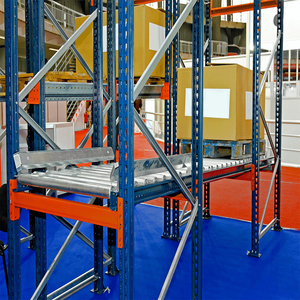
From pantograph reach-truck double-depth configurations to gravity roller lanes and boltless industrial mezzanines, explore our factory-manufactured pallet storage systems engineered for global supply chains.
Year Established
Factory Infrastructure
Monthly Steel Capacity
Global Turnkey Projects
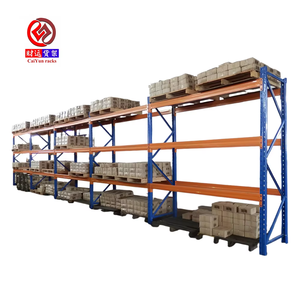
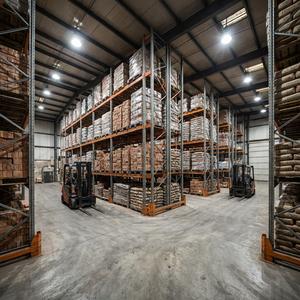
In modern intralogistics and industrial facility master planning, floor footprint remains the single most expensive recurring balance-sheet variable. A Double Deep Pallet Racking System is an engineered high-density configuration created by setting two rows of selective racking back-to-back, accessed from a single operational aisle using a specialized pantograph reach forklift or double-reach telescopic mast truck. By eliminating 50% of the working access aisles demanded by conventional single-selective designs, double-deep layouts immediately increase overall storage cubic efficiency by 30% to 40% while retaining superior flexibility over bulk drive-in blocks.
Unlike static single-selective setups where every single unit load sits adjacent to an operational clearway, double-deep systems create a coupled tandem cantilever dynamic. Front pallets are loaded directly onto primary beam elevations, while secondary rear pallets require reach-mechanism extension over the front beam.
Selecting an optimal storage configuration requires balancing storage density against individual SKU selectivity, capital expense per pallet location, and specialized material handling vehicle requirements:
| Racking Topology | Aisle Space Consumption | SKU Selectivity | Storage Density Ratio | Forklift Equipment Demanded | Landed CAPEX / Pallet |
|---|---|---|---|---|---|
| Standard Selective | High (Aisles = ~50% floor) | 100% Direct Immediate | Baseline (1.0x) | Standard Counterbalance / Reach | Low - Moderate |
| Double Deep Racking | Low-Medium (Aisles = ~30% floor) | 50% Immediate (LIFO Pairs) | High (+35% to +45%) | Pantograph Double-Reach Truck | Economical / High ROI |
| Drive-In / Drive-Thru | Extremely Low (Dense Lanes) | Low (<15% Direct Access) | Very High (+60%) | Narrow Counterbalance | Moderate |
| Radio Shuttle Cart | Minimum (Single Entry Channel) | Programmed Batch LIFO/FIFO | Maximum (+80%) | Standard Forklift + Automated Shuttle | High (Automated CAPEX) |
| Gravity Pallet Flow | Low (Dedicated In/Out Aisle) | Strict FIFO Automatic Roll | High (+55%) | Standard Forklift Fleet | Moderate - High (Rollers) |
Because double-deep systems operate fundamentally under a Last-In, First-Out (LIFO) principle per individual double lane pair, accessibility to the inner pallet is obstructed if an outer pallet occupies the front bay. Industrial logistics engineers manage this dynamic by implementing Lot-Sizing SKU Pairing: storing matching SKU pairs (same production batch or expiry window) in the same depth channel. This protocol maintains dispatch cycle velocity while eliminating unwanted relocation moves, unlocking a 90% effective cubic filling rate without workflow bottlenecking.
Leveraging 25 years of structural fabrication authority, our automated 30,000 m² Guangzhou production facility delivers certified structural steel pallet racking systems engineered to exact global seismic and industrial building codes.
Continuous multi-line roll-forming capacity ensures swift order fulfillment for massive multi-tier 3PL logistics parks, port warehouses, and industrial plants without delivery bottlenecks.
Certified structural integrity under EN 15512, RMI, and AS4084 specifications. Registered credentials (CE No. 2435-CPR-8605159; ISO 9001:2015 No. 18624Q00169R0M) assure risk-free client presentation.
Our in-house structural engineers evaluate clear warehouse heights, floor flatess (DIN 18202 standards), column grids, and forklift turning radiuses, delivering complete 2D/3D layouts in under 24 hours.
From prime Baosteel raw coils through robotic multi-point welding and hot-cure electrostatic powder coating, every stage is executed under ISO-certified quality checkpoints.
Strategic buyers and supply chain executives are navigating evolving material handling automation, sustainable zinc-polymer coatings, and seismic building codes.
Autonomous mobile reach-forklifts guided by LiDAR and 3D SLAM are entering double deep operations. High-precision laser-reflective bay markers and tight beam tolerance (L/250) prevent automated sensor misalignment.
Cold room power consumption costs encourage maximum cubic density. Double-deep racking provides an ideal cold-chain thermal balance, reducing cooling overhead per stored pallet compared to wide-aisle configurations.
Facilities situated in coastal zones (West/East Africa, Southeast Asia, South America) are replacing basic enamels with high-micron polyester powder coatings and hot-dip galvanization capable of surviving 1,000+ hours of salt-spray testing.
Ocean freight volatility demands precision CAD packing. Upright frames and beams are nested and flat-packed to achieve maximum volumetric fill in 40ft High Cube containers, driving down landed cost per pallet location.
Detailed engineering answers covering floor loadings, reach equipment specifications, overseas container transit, and safety compliance.
Double deep racking requires specialized material handling equipment. The two standard options are a Pantograph Reach Truck (equipped with an electric scissor mechanism that extends the forks into the secondary depth) or a Telescopic Fork Reach Truck. Standard counterbalance forklifts cannot reach past the first pallet beam.
By turning two pairs of single racks into a tandem double-deep bay, you remove one handling aisle for every two rack banks. In typical warehouse layouts, this conversion boosts overall pallet capacity by 30% to 45% within the exact same structural warehouse footprint.
Our systems adhere strictly to European EN 15512, American RMI (Rack Manufacturers Institute) guidelines, and Australian AS4084-2012. Guangzhou Heda Shelves Co., Ltd. holds CE certification No. 2435-CPR-8605159 and ISO 9001:2015 certification No. 18624Q00169R0M.
Steel profiles receive thorough pickling and phosphating pre-treatment followed by thermosetting electrostatic powder coating. For maritime shipping, components are nested, edge-protected with heavy corrugated wraps, strapped with PET strapping, and cushioned to eliminate transit friction inside 20GP or 40HQ containers.
Yes. Because reach forklift drivers have limited line-of-sight when setting pallets in the rear bay at heights above 8 meters, we regularly equip double-deep racks with heavy-duty pallet support bars, wire mesh decks, or guided rear pallet guide angles to guarantee positive support regardless of pallet orientation.
To provide an exact engineering layout and quote, send: (1) Warehouse architectural drawings showing clear heights, columns, and dock doors; (2) Pallet dimensions (Width × Depth × Total Height including load); (3) Maximum weight per loaded pallet; (4) Mast lift height and operational aisle parameters of your reach equipment.
Absolutely. For seismic regions, our engineering team widens footplates, thickens anchor bolt embeds (M12 to M16 grade), and adds horizontal and vertical bracing trusses. For cold storage down to -30°C, we utilize Q355B low-temperature impact-resistant steel and optional hot-dip galvanized surface treatments.
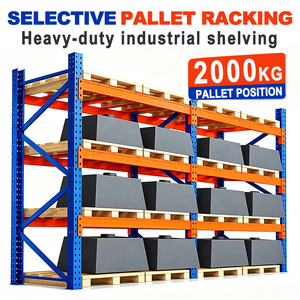
We provide full private-label manufacturing: bespoke RAL electrostatic powder colors (e.g., standard RAL 5005 blue uprights and RAL 2004 orange beams, or custom fleet palettes), client steel embossing, stamped column load plaques, and customized installation documentation.
Connect directly with Guangzhou HEDA Shelves structural design engineers. We evaluate your facility dimensions, SKU velocity, and material handling fleet to generate an optimized CAD layout, 3D render, and structural quotation within 24 hours.