High-Density Automated Racking & Industrial Storage Solutions
Engineered for high throughput, seamless FIFO/LIFO execution, and maximum cubic space utilization. Review our factory-direct certified warehouse systems below.
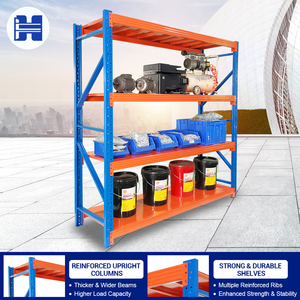
Factory Price 200kg Layer Capacity Modular Metal Frame Garage Storage Shelf for Small Parts Warehouse
- 200kg Uniform Layer Capacity
- Modular Clip-In Upright Frames
- Corrosion-Resistant Powder Coat
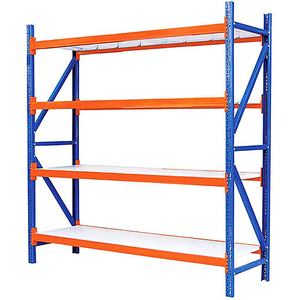
Bule Orange Custom Design Corrosion Protection Medium Duty Storage Racks Boltless Shelving Heavy Duty Shelf
- Interlocking Boltless Assembly
- Pickling & Phosphating Treated
- Custom RAL Color Formulation
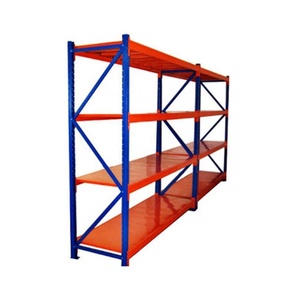
Garage Storage Factory Steel Warehouse Metal Van Rack System Medium Duty Shelving Single Deep Industrial Pallet Rack Shelving
- Single Deep Pallet Positioning
- Heavy Steel Profile Section
- Engineered Beam End Connectors
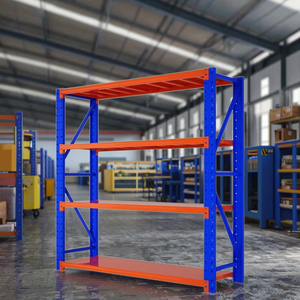
Medium Duty Industrial Workshop Storage Racks New Corrosion-Protected 5-Layer Steel Warehouse Racking Shelves Selective Rack
- 5-Tier Adjustable Pitch System
- Direct Manual & Forklift Access
- Anti-Deflection Stepped Beams
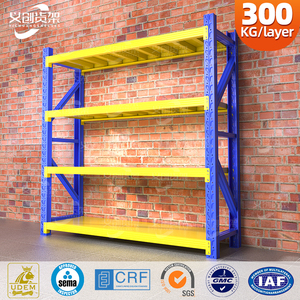
Steel Heavy Duty Load-Bearing 500kg/Layer Adjustable Storage Shelves Customizable Warehouse Medium Duty Shelving Racking
- 500kg Certified Safe Working Load
- 50mm Variable Pitch Uprights
- Reinforced Welded Base Plates
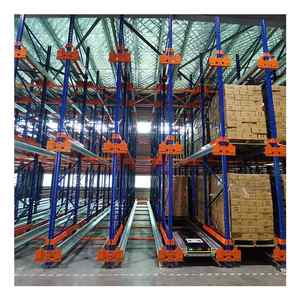
FIFO Automatic Warehouse Pallet Racking System Storage Shelf Stacking Racks Shelves Radio Shuttle Racking for Cold Storage Room
- Down to -30°C Cold Room Rating
- Automated Pallet Shuttle Carrier
- CE Machinery Directive Compliant
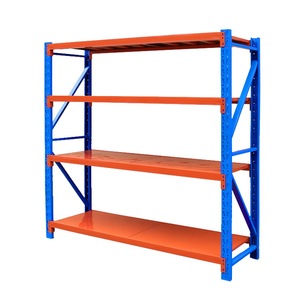
HUAWU Steel Boltless Shelving Rack 2000x600x2000mm 4-Layer 200kg Per Layer Medium Duty Industrial Storage System
- 2000x600x2000mm Standard Dimension
- 4 Heavy Gauge Steel Shelves
- Instant Knock-Down Packaging
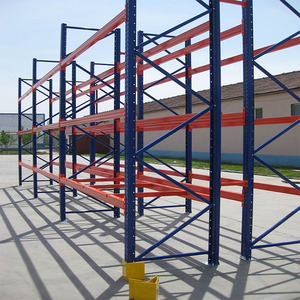
Warehouse Heavy Duty 5 Layer Stainless Steel Boltless Pallet Rack Shelving System with Corrosion Protection
- Passivated Stainless Finish
- Hygienic Chemical & Food Grade
- Zero Moisture Absorption Deck
Engineering Analysis: Structural Mechanics and CE Certification Standards for Shuttle Racking Systems
In modern intralogistics and high-density warehousing, the transition from conventional static storage (such as drive-in or standard selective racking) to automated radio shuttle pallet racking systems represents a paradigm shift in throughput rate, volumetric cube efficiency, and operational safety. However, specifying high-density shuttle racking is not simply a procurement of rolled steel profiles. Because radio shuttle installations incorporate electro-mechanical dynamic carriers operating at speeds of up to 1.2 m/s inside concentrated steel channels, compliance with international engineering codes—most notably CE Machinery Directive 2006/42/EC, EN 15512:2020 (Steel static storage systems – Adjustable pallet racking systems – Principles for structural design), and EN 15620 (Tolerances, deformations and clearances)—is paramount.
A genuine CE Certified Shuttle Racking Supplier must validate two distinct design facets: the Static Structural Integrity under static, seismic, and dynamic pallet-placement loading; and the Autonomous Carrier Functional Safety, which includes electromagnetic compatibility (EMC Directive 2014/30/EU), low voltage safety (LVD 2014/35/EU), and laser/optical obstacle avoidance. When radio shuttles navigate multi-pallet deep lanes (often extending past 40 meters), even microscopic rail deflections exceeding L/750 or localized track deviations can lead to mechanical binding, wheel bearing wear, sensor triangulation errors, or pallet drop events.
Guangzhou Heda Shelves Co., Ltd., with over 25 years of specialized manufacturing experience, produces radio shuttle uprights, guide rails, and heavy-duty framework using micro-alloyed structural cold-rolled steel grades conforming to Q235B and Q355B (tensile strength equivalent to European EN 10025 S235JR and S355JR). Through advanced finite element analysis (FEA) and stringent destructive load testing, our systems ensure that racking columns and shuttle rail brackets absorb repeated kinetic acceleration and braking stresses with a verified safety coefficient exceeding 1.65.
Engineering Comparison: Shuttle Racking vs. Alternative High-Density Systems
Selecting the appropriate high-density pallet configuration requires balancing floor area utilization, capital expenditure per pallet location, forklift fleet reduction, and SKU velocity. The engineering matrix below contrasts radio shuttle architecture against alternative dense storage frameworks:
| System Architecture | Space Cube Utilization | Throughput Rate (Pallets/Hr) | Forklift Impact Damage Risk | Max Lane Depth | FIFO / LIFO Flexibility | Cold Store Suitability (-30°C) |
|---|---|---|---|---|---|---|
| Radio Shuttle Racking | 85% – 92% | High (40–60/lane/hr via shuttle) | Negligible (Trucks do not enter lanes) | Up to 50 Pallets Deep | Dual Mode (Both FIFO & LIFO) | Exceptional (Minimal air loss volume) |
| Drive-In Racking | 65% – 75% | Low (15–25/lane/hr) | Severe (Trucks drive inside frame bays) | Typically 6–10 Pallets | LIFO Only (Strictly restricted) | Moderate (High operator turnaround) |
| Gravity Flow Racking | 75% – 85% | Moderate to High (Passive gravity) | Low (External loading aisle) | Typically 10–20 Pallets | FIFO Exclusively | Moderate (Roller bearing freezing risk) |
| Push-Back Cart Racking | 70% – 80% | Moderate (20–30/lane/hr) | Low to Medium (Front face docking) | Max 5–6 Pallets Deep | LIFO Exclusively | Standard (Mechanical cart nesting) |
| Automated Crane AS/RS | 90% – 95% | Very High (Automated stacker crane) | Zero (Fully automated) | Multi-deep (Variable) | Full Dynamic Control | High (High initial CAPEX investment) |
Technological & Sourcing Trends in Shuttle Automation (2025–2030)
The convergence of industrial IoT, autonomous swarms, smart lithium chemistry, and intelligent warehouse execution software is redefining high-density automated material handling.
1. Multi-Directional 4D Shuttle Swarms
While traditional 2D radio shuttles operate along a single horizontal axis with vertical transitions dependent on reach trucks or vertical lifts, the industry is transitioning toward 4D shuttle swarm architectures. These carriers incorporate secondary wheel assemblies that turn 90 degrees, enabling lateral lane changing across multiple storage aisles. This architecture removes standard crane bottlenecks and allows dynamic scaling of carrier units in response to seasonal throughput spikes.
2. Solid-State & Fast-Charging LiFePO4 Power
Legacy lead-acid battery packs have been entirely superseded by Lithium Iron Phosphate (LiFePO4) and emerging solid-state chemistries. High-performance shuttles now utilize onboard ultra-capacitors and contact-rail opportunistic charging pins located at the home dock. A 10-second pause during pallet hand-off recharges the shuttle for up to 3 round trips, establishing a true 24/7 continuous operation without human battery swaps or dedicated charging charging stations.
3. Sub-Zero Cold-Chain Thermal Integrity
Refrigerated and frozen distribution centers (-25°C to -30°C) represent the largest growth sector for shuttle racking procurement. Traditional personnel and propane/electric forklifts lose massive battery efficiency and introduce ambient moisture into cold vaults. Shuttle systems permit fully enclosed, low-oxygen dark vaults. Modern shuttles integrate internal electronic heating elements, condensation-proof sensor optics, and synthetic low-temperature lubricants that resist viscosity breakdown.
4. Direct WCS/WMS RESTful API Integration
Handheld remote controls are being replaced by native industrial Wi-Fi (5 GHz) and Bluetooth Low Energy (BLE) gateway arrays tied directly into Warehouse Management Systems (WMS) and Warehouse Control Systems (WCS). Shuttles execute automated task queues, optimize internal lane de-fragmentation during night hours, report real-time motor temperature telemetry, and predict mechanical component wear via vibrational AI analytics.
5. Dynamic Seismic & Resiliency Codes
As deep-lane systems scale vertically beyond 16 meters, seismic response spectra become critical design considerations. CE-certified suppliers now employ non-linear dynamic time-history simulations under Eurocode 8 and RMI standards. Specialized seismic base plates, ductile beam end connections, and floor tieback structures are custom-calculated to absorb lateral horizontal shear waves without inducing shuttle rail binding or channel buckling.
6. Total Landed Cost (TLC) Procurement Models
Procurement executives are shifting from initial unit-price metrics to Total Cost of Ownership (TCO) and landed lifecycle costs. Factors such as container-nesting optimization (increasing steel packing density inside 40HQ ocean containers by up to 28%), boltless field assembly speed, structural powder coat longevity under C3/C4 corrosive atmospheric ratings, and factory structural warranties are overriding raw component discounts.
Guangzhou Heda Shelves Co., Ltd.: 25 Years of Factory-Direct Excellence
A trusted global supplier delivering high-precision structural racking and automation integration to over 120 countries from our 30,000 m² modern manufacturing campus.
Complete Vertical Integration from Steel Coil to Container Loading
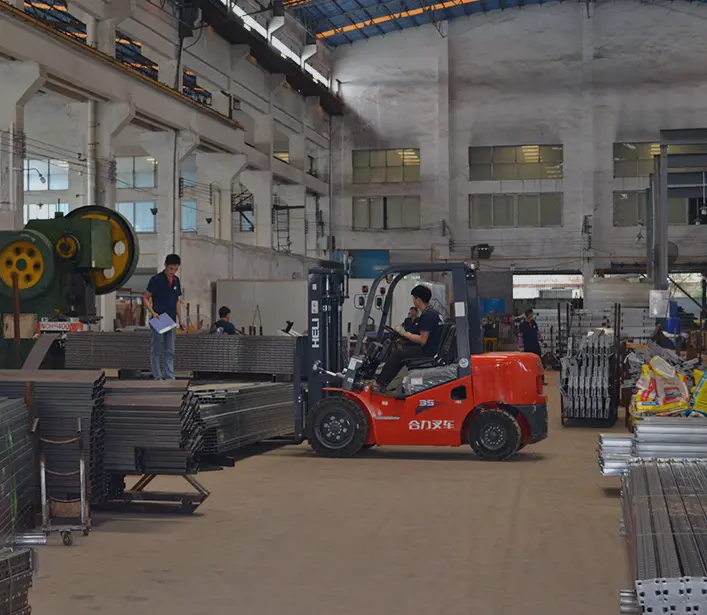
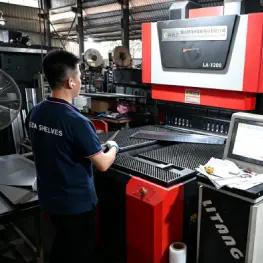
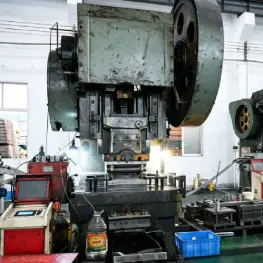
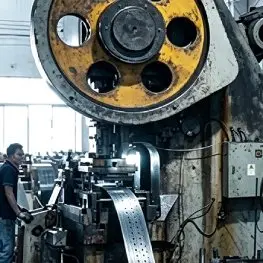
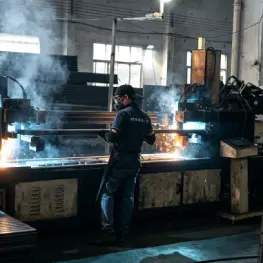
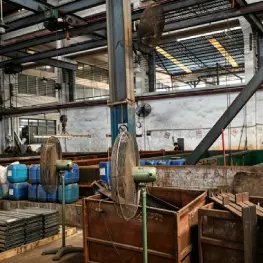
Established in 2001, Guangzhou Heda Shelves Co., Ltd. has grown into an international industry leader in industrial storage systems. Unlike trading intermediaries or regional assemble-to-order brokers, every single component of our racking systems—from heavy-gauge perforated upright columns and box-welded step beams to galvanized shuttle run-rails and safety buffers—is engineered, punched, cold-formed, welded, and powder-coated under one roof in our 30,000 square meter factory in Guangzhou.
Operating with an elite engineering roster of over 300 skilled technical personnel and a monthly production throughput reaching 30,000 tons of structural steel, Heda Shelves offers unparalleled production flexibility, rapid prototype turnaround, and comprehensive OEM/ODM custom profiles.
For project developers, warehouse directors, and intralogistics system integrators, this single-source accountability eliminates project execution risks. Our technical department delivers certified structural load calculations, comprehensive AutoCAD layouts, and photorealistic 3D warehouse simulations—free of charge—within 24 hours of receiving site dimensions.
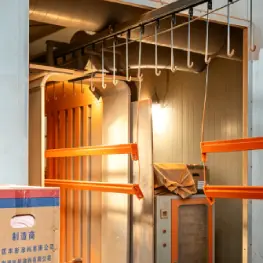
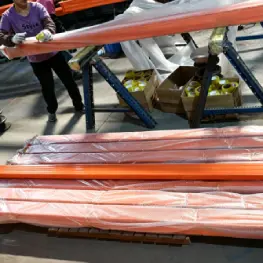
The 10-Stage Precision Manufacturing Sequence
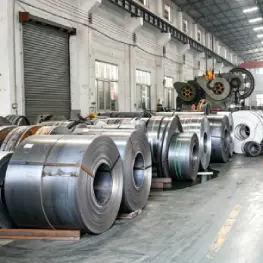
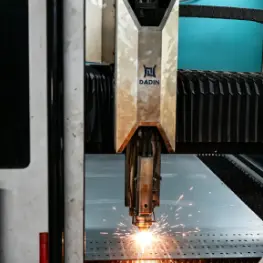
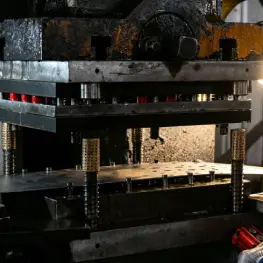
Every structural upright, support beam, and shuttle rail undergoes an uncompromising 10-stage fabrication protocol to ensure zero-defect tolerance and high resistance against tropical humidity and chemical exposure:
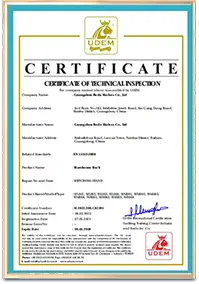
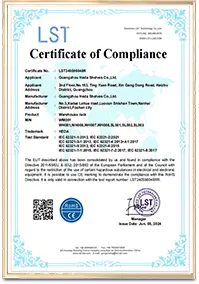
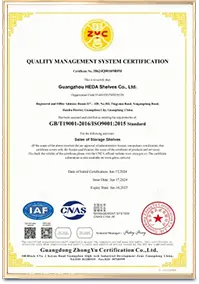
Documented Compliance & Official Certifications
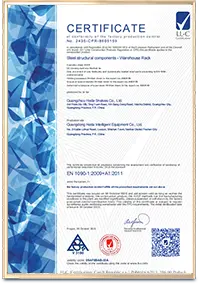
In international bidding and municipal warehouse approvals, documented authenticity is mandatory. All HEDA structural shelving, cantilever frames, and shuttle installations carry traceable, third-party audited credentials:
Frequently Asked Questions: Sourcing & Engineering Shuttle Racking
Technical considerations, container logistics, seismic compliance, sub-zero cold room operations, and installation management directly answered by our senior project engineers.
What specific documents define CE Certification for Radio Shuttle Racking Systems? +
In the European Union and international jurisdictions enforcing CE guidelines, a radio shuttle racking installation is governed by two complementary standards. First, the static structural steel framework must conform to EN 15512:2020 (Principles for structural design of adjustable pallet racking) and EN 15620 (Tolerances, deformations and clearances), verifying that allowable upright stress limits, dynamic horizontal impact loads, and beam deflection ratios (typically under L/200 for beams and L/750 for shuttle guide rails) maintain safe operational limits.
Second, because the radio shuttle carrier is an autonomous self-propelled vehicle, it falls under the CE Machinery Directive 2006/42/EC, the Electromagnetic Compatibility (EMC) Directive 2014/30/EU, and the Low Voltage Directive (LVD) 2014/35/EU. This mandates fail-safe obstacle detection (photocell/laser sensors), emergency braking mechanisms, certified radio communication frequencies, and verified battery safety circuits. Guangzhou Heda Shelves supplies full Declarations of Conformity under CE Certificate No. 2435-CPR-8605159.
How does radio shuttle racking handle extreme cold storage (-25°C to -30°C) without carrier failure? +
Operating in deep freeze conditions requires specialized mechanical and electrical adaptations. Standard lithium batteries lose substantial capacity and face dendrite formation below 0°C. Our cold-storage shuttle variants are equipped with low-temperature LiFePO4 battery chemistries supplemented by internal thermal insulation blankets and embedded heating circuitry that automatically regulates core cell temperature during docked charging phases.
Furthermore, all electronic motherboards, optical sensors, and laser distance finders receive conformal anti-condensation potting compounds to prevent frost short-circuits during defrost cycles or thermal transitions. Mechanical drives utilize synthetic, low-viscosity sub-zero lubricants that prevent motor stall torques, and structural steel rails can be hot-dip galvanized or coated in cold-resistant epoxy-polyester powder to eliminate brittle steel fractures.
What essential warehouse data is required for Heda engineers to generate a free 3D CAD layout? +
To deliver a fully optimized, structural load-calculated 3D CAD layout within 24 hours, our engineering team requires:
- Building Architectural Drawings: Interior clear height (distance from finished floor to the lowest obstruction such as sprinkler heads or truss bottoms), column grid spacing, floor flatness rating (preferably conforming to DIN 18202 or ASTM E1155 F-numbers), and dock door locations.
- Pallet & Unit Load Profile: Exact width, depth, height (including load overhang), bottom runner orientation (Euro 1200x800, Industrial 1200x1000, GMA 48x40"), and maximum gross weight per pallet.
- Material Flow Dynamics: Total SKU count, pallet velocity per SKU, and whether operational logic dictates FIFO (requiring access from both entry and discharge faces) or LIFO (single front docking face).
- Forklift Specifications: Mast lift height, chassis turning radius, and collapsed mast height for clearance planning.
How are large-scale shuttle racking systems packed to minimize ocean shipping costs? +
Ocean freight can represent a substantial component of the total landed cost if components are inefficiently bundled. Heda Shelves utilizes an engineering-led Knock-Down Component Packaging Protocol. Upright frames are either shipped disassembled (with bolted diagonal/horizontal bracing nested together) or pre-assembled in custom welded nesting jigs depending on destination labor costs and container weight limits.
Roll-formed shuttle guide rails and pallet entry guides are bundled in high-density steel-strapped bundles with protective edge board and corrugated wraps. Fasteners, base plates, column guards, and electrical shuttle units are palletized in reinforced fumigated wooden crates. This optimization allows us to achieve up to 24 to 26 metric tons per 40HQ container, substantially driving down landed cost per pallet location.
Can shuttle racking operate effectively during electrical power outages or unstable grid environments? +
Yes. One of the paramount engineering advantages of radio shuttle systems over fully automated stacker crane AS/RS systems is their decentralized, energy-resilient architecture. The static steel racking structure itself is purely mechanical and requires zero continuous electrical connection.
The shuttles themselves run on independent rechargeable lithium battery packs. In developing regions or facilities vulnerable to frequent grid outages, facilities charge redundant battery sets during normal power windows or via secondary diesel/solar backup arrays. If an active carrier exhausts its charge, an integrated auxiliary retrieval trolley or a reach truck can instantly recover the shuttle, ensuring that distribution operations never experience complete grid-dependent shutdowns.
What corrosion protection processes are applied to ensure longevity in high-humidity or coastal climates? +
Raw cold-rolled steel rapidly degrades when exposed to coastal salt air or tropical atmospheric humidity (such as operations across West Africa, Southeast Asia, or coastal Latin America). Heda Shelves eliminates surface oxidation risks through an integrated Automated Multi-Stage Pretreatment Line. Components undergo alkaline degreasing, acid pickling to strip surface scale, and zinc-iron phosphating to generate a micro-crystalline passivation layer.
Following drying, high-grade thermo-hardened epoxy-polyester hybrid powder is electrostatically applied at 60–80 microns thickness and cured in infrared baking ovens at 180°C–200°C. For chemical storage yards, outdoor shelters, or washdown food facilities, we offer full continuous Hot-Dip Galvanizing (HDG) conforming to ISO 1461, yielding zinc coatings exceeding 65–85 microns for multi-decade rust immunity.
What is the payback period (ROI) when converting from Drive-In racking to Radio Shuttle? +
While the initial capital expenditure (CAPEX) for radio shuttle systems is higher than primitive drive-in racking due to the precision-machined guide rails and robotic carriers, real-world payback typically materializes within 14 to 24 months based on three operational factors:
- Forklift Fleet & Labor Reduction: Because reach truck drivers drop pallets at the lane entrance rather than crawling into deep bays, pallet cycle times are cut by 50% to 70%, allowing 2 forklifts to handle the throughput that previously required 5 to 6.
- Zero Bay Structural Impact Damage: Drive-in racks suffer chronic upright column impact damage from forklift tines and chassis strikes. Shuttle racking virtually eliminates forklift rack collisions, saving thousands in annual column repair and product loss.
- Volumetric Space Reclamation: Shuttle lanes can reach depths of 30 to 50 pallets, raising cubic storage density by 25% to 35% over drive-in lanes, delaying or eliminating the need for expensive new warehouse construction.
How are overseas installations supervised and commissioned? +
Guangzhou Heda Shelves delivers comprehensive global installation support tailored to client resources. Every system ships with a master installation dossier including step-by-step 3D assembly guides, numbered component tags matching the structural CAD drawing, torque setting tables for anchor bolts, and rail leveling tolerances.
For self-installation teams, our engineering team provides daily remote video supervision, alignment verification, and live tele-commissioning for the shuttle carrier electronics and Wi-Fi networks. For large turnkey projects, Heda dispatches senior site installation supervisors to project sites across Africa, the Middle East, Southeast Asia, and the Americas to oversee local labor teams, certify anchor pull-out tests, and commission the automated carriers.
Plan Your Warehouse with Certified Racking Engineers
Send us your building dimensions, pallet load details, and throughput goals. Receive a comprehensive AutoCAD layout, 3D structural rendering, and precise quotation within 24 hours.